LFM Reviews What Isn’t There (Ang Nawawala) @ The 2013 Slamdance Film Festival

By Joe Bendel. Alt-pop music used to be great at expressing young amour and heartsick yearning. Evidently, it still does in the Philippines. Some remarkably catchy tunes perfectly accompany a damaged teen’s first significant love in Marie Jamora’s What Isn’t There, which screens again today as part of the 2013 Slamdance Film Festival in Park City.

Gibson Bonifacio stopped speaking. He could if he wanted to, but he doesn’t. He blames himself for his twin brother’s death and assumes everyone else does, too. His mother’s overbearing behavior does not exactly help bring him out of his shell, either. Unfortunately, his beloved little sister Promise bears the brunt of her control freak parenting. Bonifacio’s only solace comes from his brother’s ghost conjured from his imagination and his vintage music, until he happens to meet Enid del Mundo.

Much to his surprise, del Mundo does not seem to mind his silent ways. She is also a vinyl collector, whose tastes include British New Wave and traditional Harana ballads. She is cute, too. Viewers can hardly blame Bonifacio for getting hung up on her, even though we know by now young love almost never runs smoothly.

You can dog WIT for being sentimental, but it takes its characters and situations refreshingly seriously. Jamora and co-writer Ramon De Veyra clearly think getting dumped is a pretty rotten thing to happen to a sensitive teenager, which indeed it is. She also has an ear for hummable and thematically appropriate pop songs and Haranas.

Dominic Roco’s Bonifacio is supposed to be introverted, but there are times when he seems to literally shrink on camera. In contrast, Annicka Dolonius lights up the screen as del Mundo. While the large supporting ensemble all looks right, Boboy Garovillo and Sabrina Man both add a memorable sense of earnest down-to-earth-ness as Bonifacio’s father and younger sister, respectively.

WIT is a lot like a Filipino John Hughes movie, but with less comedy. Those who like bittersweet teen dramas will really dig this one. Recommended accordingly, What Isn’t There screens again this afternoon (1/22) at Treasure Mountain Inn, as part of this year’s Slamdance.

LFM GRADE: B-

Posted on January 22nd, 2012 at 11:55pm.
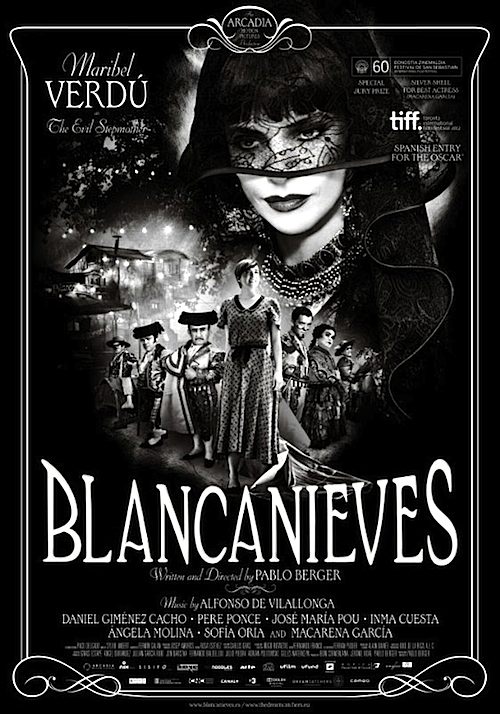
Snow White in the Bull Ring: LFM Reviews Blancanieves

By Joe Bendel. It often seems like the Academy’s rules for the best foreign language category are obscure and arbitrarily applied. Frankly, the only language spoken in Spain’s official submission is body language. Yet Pablo Berger’s silent film qualified. In fairness, it is about as Spanish as it gets, earning eighteen Goya nominations for combining the Snow White fairy tale with the rich tradition of bullfighting. Unfortunately, Blancanieves will not repeat The Artist’s Oscar success, failing to even reach the foreign language shortlist. However, it should still find considerable arthouse love when it opens this Friday in New York.

Antonio Villalta was a great matador, but one day he faced one bull too many. As the paralyzed Villalta lies upon the operating table, his beloved sadly dies in child birth. Recognizing a ticket to the easy life, the cold, calculating nurse Encarna sets her sites on the weakened widower. Yes, you could say she is an evil stepmother to young Carmen. Initially raised by her grandmother, Carmen is forced to become a servant on the Villalta estate after the kindly old woman’s death. Though forbidden to see her father, she starts paying furtive visits to the equally miserable Villalta. Even confined to his wheelchair, Villalta teaches her everything about the family business. It will be a useful skill when things come to a head with Encarna.

Suffering from amnesia, Carmen falls in with an itinerant company of diminutive novelty bullfighters. When her innate talent and extensive training are revealed, the troupe is quickly redubbed “Blancanieves and the Seven Dwarfs.” They seem to be one dwarf short, but they are never sticklers for details in Spain. Obviously, the act is a hit, which perturbs Encarna and you know what that means.

Blancanieves is the third Snow White adaptation in about a year’s time and by far the best. Yet it will draw far more comparisons to Michel Hazanavicius’s Artist than to Kristen Stewart’s home-wrecking Huntsman. Without question, Berger is a much richer visual stylist than the Oscar winning director. On the other hand Hazanavicius’s elegantly light touch, flair for physical comedy, and old fashioned romanticism are ultimately a tad more satisfying. Nonetheless, Berger frames some stunningly expressionistic tableaux and his transitions are a show unto themselves. However, he embraces all of the tragic heaviness of the Brothers Grimm and almost none of their macabre fantasy.

The cast is also quite strong (but again The Artist’s ensemble would narrowly take the honors in a face-off). Daniel Giménez Cacho’s work as Villalta is particularly poignant and the dwarfs stand head-and-shoulders above their more famous counterparts in Huntsman. Sofía Oria is also quite touching as young Carmen (while Macarena García’s older incarnation is somewhat less so).

Watching Blancanieves, one is struck by the painstaking composition of each shot and the care taken to perfectly match every note of Alfonso de Vilallonga’s score (featuring both sweeping orchestral pieces and some infectious flamenco-inspired songs). Furthermore, the lack of award season recognition for Kiko de la Rica’s gorgeous black-and-white cinematography is nothing less than a crime. A work of true cinematic artistry, Blancanieves is recommended for all real movie lovers when it opens this Friday (1/25) in New York.

LFM GRADE: B+

Posted on January 22nd, 2012 at 11:54pm.

LFM Reviews S-VHS @ The 2013 Sundance Film Festival

By Joe Bendel. Have you ever watched something so disturbing that you wish you could un-see it? Like maybe A Serbian Film or Barbra Streisand’s Guilt Trip? That is sort of the premise behind the follow-up to last year’s horror anthology V/H/S. While S-VHS is very definitely a film for horror diehards, it is not a similarly soul-shredding experience. In fact, it should be a heck of a fan-pleaser during its midnight screenings at the 2013 Sundance Film Festival.

The only place S-VHS repeats V/H/S is during Simon Barrett’s interstitial framing arc, Tape 47. Once again, strangers have broken into a sketchy looking house, finding a mysterious assortment of VHS tapes. This time around, a detective and his assistant, Ayesha, are looking for a missing college student, who evidently became obsessed with his collection of macabre found footage. It seems he believed the cumulative effect of watching certain tapes consecutively would have a transformative effect on the viewer. Naturally, Ayesha does exactly that, utilizing the monitors conveniently provided.

Adam Wingard’s Clinical Trials might be the most conventional of the four tapes the intruders watch, but it still delivers plenty of creeps and jolts. After an accident, a man has received a bionic optical implant to replace a lost eye. The experimental treatment is free, but his initial experiences will be recorded for analysis. (How such advanced technology was transferred to an obsolete VHS tape is not a question worth asking.) With his artificially boosted vision, the man starts seeing things he never could before, like the dead people haunting his home.

In a bit of a departure, Edúardo Sanchez & Gregg Hale’s A Ride in the Park aims more for gross-outs than edge-of-the-seat scares, but it delivers accordingly. Recorded through the protagonist’s bike helmet-cam, it could be described as the “zombie vomit” installment. What more do you need to know?

Not surprisingly, the strongest constituent film comes from Gareth Huw Evans, who helmed the spectacular martial arts shoot-out The Raid. Also set in Indonesia (a refreshing change of pace for the franchise), Safe Haven, co-directed with Timo Tjahjanto, consists of the footage shot by a documentary film crew visiting the compound of a reputed cult leader. Initially, the well-spoken guru cooperates in the apparent hope of counteracting some of his bad PR. However, their presence seems to ignite something evil.

Evans and Tjahjanto sure understand how to pace a film. Steadily escalating the degree of wtf-ness, they throw in just about everything but the kitchen sink, culminating with one of the best composed closing shots you could ever hope to see in a genre film. The ensemble cast is also first rate, from top to bottom.

While not quite as inspired as Haven, Jason Eisener’s Alien Abduction Slumber Party still ends S-VHS on a high note. This is truly a descriptive title. However, the dialogue and relationship dynamics are cleverly written, without sounding like an attempted Scream rip-off. It is also a good example of how brief, blurry images seen out of the corner of one’s eye can be far more unsettling than front-and-center special effects shots.

Like its predecessor, S-VHS is pretty scary stuff, but by offering more humor and gleeful gore, it happens to be more fun. A rare case of a sequel surpassing the original, S-VHS is enthusiastically recommended for midnight movie veterans (perhaps exclusively). It screens again Tuesday (1/22) and Thursday (1/24) in Park City and Sunday (1/26) in Salt Lake, as part of this year’s Sundance Film Festival.

LFM GRADE: A-

Posted on January 21st, 2012 at 9:57pm.

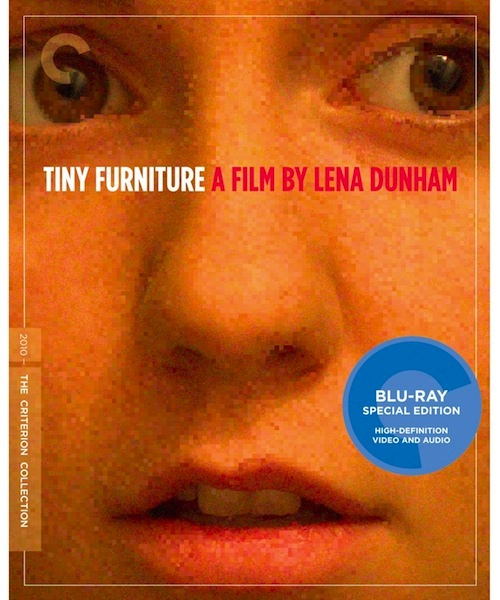
LFM Reviews Tiny Furniture (2010) on Blu-ray/DVD

By Patricia Ducey. On the long road of life, sometimes a fish does need a bicycle.

Tiny Furniture is Lena Dunham’s 2010 filmmaking debut, and led to her HBO series Girls. Given the assurance Dunham shows here as both a writer and director, it is not surprising HBO took the risk.

Loosely based on Dunham’s own life, the movie tells the story of Aura, played by Dunham, who’s on the cusp of a life fraught with uncertainty and danger; she has graduated from Oberlin College with a degree in film theory and has no job, and nowhere to go but home. Like Dustin Hoffman in The Graduate, and other youth-in-identity-crisis movies, Aura lives in a state of free-floating anxiety, born of personal confusion and career uncertainty.

Aura returns to her family’s stylish Manhattan townhouse cum studio and greets her mother Siri, an artist (played by real mother Laurie Simmons), who can hardly be torn away from her latest photography project – a portrait of daughter Nadine’s legs (real life sister Grace) looming over a tableaux of the aforesaid tiny furniture. Aura awaits a greeting, to no avail. Siri may not have time to say hello, but she has cultivated a wide array of chic friends and contacts in the hip Manhattan art scene that might prove useful to Aura – so Siri dispatches her, on her own, to a party sure to be filled with such possibilities.

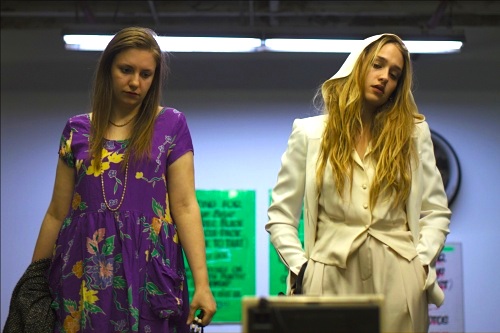
There she sees her old friend Charlotte (Jemima Kirke) who holds her hand through her transition home. She also fixes Aura up with Jed (Alex Karpovsky), a YouTube artist, who the recently dumped Aura finds attractive. Her mother and sister depart on a college visiting trip – so Aura invites Jed, in town with no hotel for meetings, to stay with her. Then Aura starts her hostess job, also provided by Charlotte, where she also develops a crush on the chef. But neither swain is interested really, perhaps because Aura wears her need so plainly all over her face. She eventually entices Jed to sleep with her, and he does actually sleep — nothing else. The chef sets up what she hopes is a date, but the date turns out to be nothing but a ghastly hookup in a back alley — they can’t go to his apartment because after all he hasn’t quite left the girlfriend who lives there.

Lena Dunham as Aura and Jemima Kirke as Charlotte in "Tiny Furniture."

So the men are on the periphery of the story, with a mother and two daughters forming the triad that moves the story forward. They compete, argue, lie and – rarely – understand one another. Most tellingly, no father is present or even mentioned; we don’t know if the father is on a business trip, or is absent due to divorce, death, artificial insemination or what. His absence hangs over the entire film; and if this is post-feminist America, I will take the patriarchy. (It would be too easy to assume that this replicates their real family; in fact, Dunham’s father, artist Carroll Dunham, is very much in the family and the marriage and – as Dunham has related in an interview – very much the maker of the rules in the home.)

So you don’t have to be a Freudian to see that what Aura needs is a parent, any parent really, but particularly a father. Her mother is emotionally unavailable, her father physically and emotionally so. The daughter Aura is lost, a child on the verge of adulthood with no one to lead her forward. She has no hope and no boundaries; she (unconsciously perhaps) chases Jed; she tells herself she is going on a date with the chef when he really wants her Oxycontin and some sex, as long as she’s offering. So again, the men she seeks out are either emotionally distant or callous louts.

I don’t mean to imply, though, that Tiny Furniture is another twee and ennui-soaked Manhattan fable. Dunham eschews many tics of the genre — like the annoying, deadpan non-acting  prevalent in so many similar films, or the hopelessness that stands in for wisdom.  The film manages something more. No spoilers here, but the last sequence, when Aura relates her sexcapade with the chef to her bored, sleepy mother, implies a nascent humanity within her that is salutary. Denied a father, and the better part of a mother, Aura might just save herself.

Posted on January 21st, 2012 at 9:56pm.

LFM Reviews The Look of Love @ The 2013 Sundance Film Festival

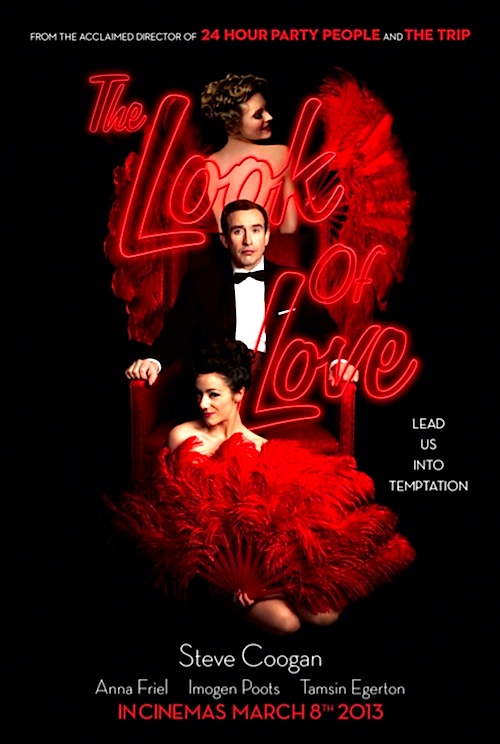
By Joe Bendel. Paul Raymond was like the British Hefner, except he was significantly richer. It turns out that real estate and dirty magazines were a highly profitable combination. Who knew? Yet, despite the money and the parties, Raymond’s story is rather sad, at least according to Michael Winterbottom’s big screen treatment, The Look of Love, which screens during the 2013 Sundance Film Festival in Park City.

Initially a burlesque impresario, Raymond’s first foray into publishing was a failure. The timing was better for Men Only in the early 1970’s. Much like Hefner, Raymond planned to turn control of his companies over to his daughter, Debbie. Unfortunately, as the audience quickly understands from the flashback structure, this will not come to pass.

Matt Greenhalgh’s screenplay unambiguously argues that doing coke with your daughter does not constitute good parenting. Actually, Look’s inclination to pass moral judgment is rather refreshing. Yet it clearly wants to have its cheesecake and eat it too. There are plenty of scenes of Raymond’s naughty stage shows and photo-shoots. However, the real estate side of his empire gets decidedly short shrift. It might not be as cinematic, but it is important. At the height of his family tragedy, Raymond was declared the wealthiest man in the UK, but Look never really explores his considerable business acumen.

Reuniting with Winterbottom again (following the thoroughly entertaining Trip), Steve Coogan is quite masterful in the dramedic lead, vividly portraying Raymond’s recklessness and remorse. Unlike obvious comparison films (such as Boogie Nights), Look boasts several strong women characters, including Raymond’s first wife Jean and his longtime lover, Fiona Richmond, both of whom were once involved in the risqué side of his business. One might even go so far as to say that Tamsin Egerton projects empowered confidence as Richmond, the sex symbol who eventually has enough. As Ms. Raymond #1, Anna Friel’s mature, self-possessed sexuality also works quite well on-screen. Conversely, Imogen Poots’ lost little rich party girl persona becomes rather exhausting.

It is hard not to enjoy Raymond’s breezy first act success story, but since we know more or less how it ends, the third act plays out like a grim end-game. As a period production, Look gets the groovy details right and if you dig David and Bacharach, you will have plenty to hum along with here. Look is a fascinating morality tale, but it just could have used a bit more pep down the stretch. Recommended reservedly for Coogan fans and those obsessed with the early adult smut industry, The Look of Love screens again Wednesday (1/23) in Salt Lake, Thursday (1/24) in Sundance Resort, and Saturday (1/26) in Park City, as part of this year’s Sundance.

LFM GRADE: B-

Posted on January 21st, 2012 at 9:54pm.

LFM Reviews The Institute @ The 2013 Slamdance Film Festival

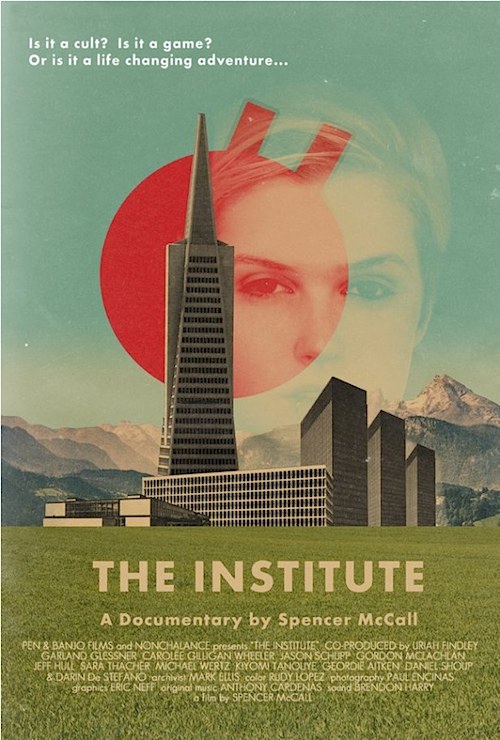
By Joe Bendel. What’s more fun than global conspiracy? If you ask former “inductees” of the Jejune Institute, you will likely get radically different responses. It seems it was all just a game, or was it? Indeed, truth is deliberately difficult to separate from fiction in Spencer McCall’s ostensive documentary The Institute, which screens during the 2013 Slamdance Film Festival in Park City.

Once upon a time, in 2008 to be exact, some strange leaflets began appearing around San Francisco—strange even by that city’s standards. The Jejune Institute was trumpeting its revolutionary scientific breakthroughs, like the personal force field, and inviting interested parties to inquire at their local offices. It turns out the Jejune Institute was headquartered in the heart of San Francisco’s glass-and-steel financial district. However, the office was nothing like Bank of America’s. Visitors were directed to a trippily appointed room, where they watched a video greeting from Jejune founder Octavio Coleman, Esq.

After a mind-bending intro to some of the basic Jejune buzz-words, inductees were sent on a scavenger hunt throughout the city, finding secret signs and clues amid the urban environment. Before long, inductees found themselves aligned with a rival faction seeking to liberate the power of “nonchalance” (the rough Jejune equivalent of The Force) from the megalomaniacal Coleman. Or something like that.

The thing is, it was all just a game, engineered by a conceptual artist to foster a sense of play in the city. Yet as soon as the behind-the-scenes architects come clean, McCall introduces a former player, whose tales of misadventures in the Bay Area sewers have to be part of the mythology. I mean, seriously.

Reportedly, McCall was brought in to document the final stages of the game and recognized a doc-worthy story when he saw one. By the same token, it seems safe to assume he is to some extent an accomplice to the mythmaking. There are enough digital tracks to suggest that the Jejune Instituters truly were running an Alternate Reality Game (ARG) that some players took very seriously. As for everything else in the film, maintain a healthy skepticism.

The thing of it is, the Jejune mythology is a great story. McCall taps into our deep, abiding interest in secret histories, conspiracy theories, and urban legends, as well as our fear of cults. For scores of players, the ARG was like submerging themselves in an Illuminatus! novel. Yes, some of them might have become obsessed to an unhealthy degree, but they might also be playing the parts.

While openly inviting comparison to Exit Through the Gift Shop, The Institute will appeal to viewers who enjoyed Resurrect Dead: The Mystery of the Toynbee Tiles. It might be strange and unreliable, but it is never dull. Recommended for those who appreciate postmodern fables, The Institute screens again tomorrow morning (1/22) at Treasure Mountain Inn, as part of this year’s Slamdance.

LFM GRADE: B+

Posted on January 21st, 2012 at 9:53pm.