LFM Reviews Vulgaria

By Joe Bendel. How are producers different from the world’s oldest profession? There is nothing the former won’t do for money. Don’t believe it? Well, watch as the producer-protagonist explains it all to his film school audience in Pang Ho-cheung’s Vulgaria (trailer here), which opens this Friday in New York.

To Wai-cheung is a second rate producer of C-grade sexploitation films. He owes Lawyer Tsang, his sharkish ex-wife, scads of alimony and takes the blame for all his little girl’s troubles in school. Nothing is going right with his life. Nonetheless, he keeps cobbling together dubious film projects. After his latest pitch crashes and burns, he takes a dinner meeting with Brother T-Rex, a Guangzhou gangster with outrageous kinks (that mule is on the poster for a reason). Against his better judgment, To agrees to produce a comeback vehicle for Tyrannosaur’s old crush, 1960’s Hong Kong sex symbol Susan Shaw (appearing as herself).

Of course, the last thing the down to earth Shaw wants to do in her sunset years is make a nudie movie. No problem, To will just CGI her head onto ambitious sexpot Tsui Ka-yan’s curvy body. Known as Popping Candy for reasons we can’t explain on a family website (well, sort of), Tsui turns out to have more substance than To gave her credit for. However, he might have completely sold out his soul and his dignity to stay in the producing game. Yet, if he can dredge up the repressed memories, he will confess them all to the film studies class he is addressing in the film’s flashback narrative device.

A real change of pace from Pang’s relationship dramedies like the misleadingly titled Love in the Buff, Vulgaria (rather aptly titled) follows more in the tradition of The Player and other satiric treatments of the movie-making process. While never showing anything really graphic per se, Pang goes for broke embracing the film’s outrageous jokes (again, you saw that mule, right?). Yet, the comedy works more often than not, traveling quite well from Hong Kong to America.

Pang regular Chapman To easily fits into the role of his namesake and the embarrassing situations that go with it. Never too cringy, he portrays producer To in that Larry David-George Costanza zone, where the sad sack and the roguishness intersect. As Tsui, Dada Chan is quite the discovery, exhibiting a sweetly endearing presence, but with plenty of va-va-voom. Young Jacqueline Chan also gives the film some genuine heart as To’s forgiving daughter, also named Jacqueline. While many in the supporting cast play it way over the top, the material sort of lends itself to that approach.

Vulgaria is a lot like original The Producers-era Mel Brooks transplanted to the internet age, infectiously delighting in its political incorrectness. It is a lot of laughs, but not for anyone who gets hung up on a naughty joke or the occasional mistreatment of animals. Consistently funnier than the intermittent Klown, Vulgaria is recommended for those who appreciate the boldness (especially by HK standards) of its gags when it opens this Friday (9/28) in New York at the AMC Empire and in San Francisco at the AMC Metreon, courtesy of China Lion Entertainment.

LFM GRADE: B+

Posted on September 26th, 2012 at 3:30pm.
What the Camera Caught the Cops Doing: LFM Reviews End of Watch

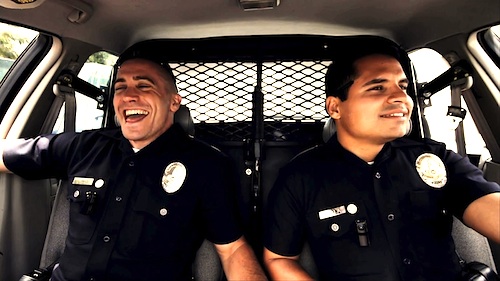
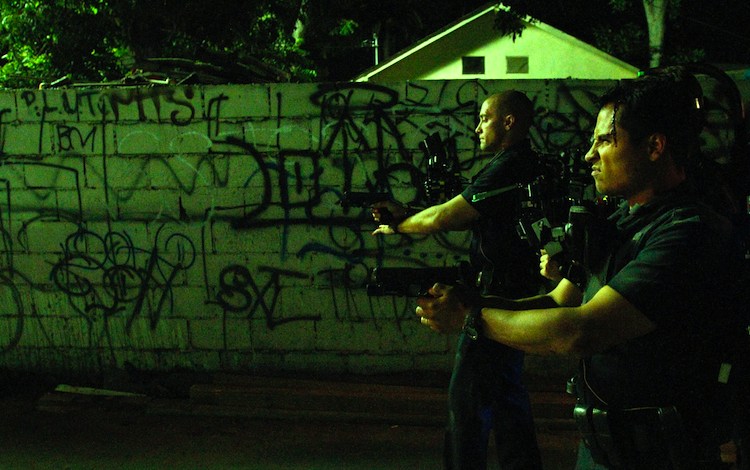
Jake Gyllenhaal and Michael Pena in "End of Watch."

By Patricia Ducey. Southland, television’s classiest cop drama, ended its season back in March and won’t return until February 2013. That’s one year! Between seasons! Which leaves me badly in need of a cure for my LAPD blues. And so I dropped in to see End of Watch, an LAPD story written and directed by David Ayer (Training Day).

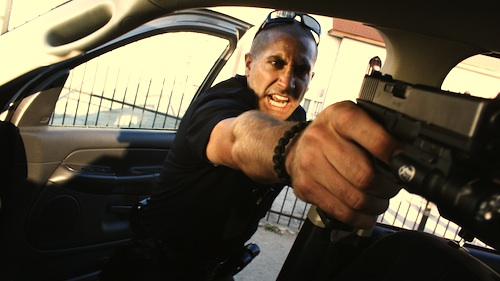
End of Watch is one part buddy drama, pairing two LAPD officers, Brian Taylor (Jake Gyllenhaal) and Mike Zavala (Michael Pena). We follow them through the mean streets of South Central Los Angeles as they banter through boredom, shoot bad guys and then stupidly and improbably conduct an extra-legal investigation of a suspicious dope peddler.

Soon they are marked for death by the Sinaloa cartel, who control the dope dealer. But the script drops in the cartel plot mostly to stitch together a series of violent vignettes into a story; the bond of affection and trust between the guys in scene after scene of cruising through L.A. is the high point of the movie. Pena is warm and funny, the tightly wound Taylor always his unwitting straight man. Some have opined that they represent a classic mismatched pair because of their different races – but this is multicultural SoCal 2012, so can we finally retire this meme? They’re just two cops who have each others’ backs and joke about everything – including race, peppered with plenty of Ayer’s trademark f-bombs.

Unfortunately, the rest of the movie doesn’t live up to their chemistry.

Jake Gyllenhaal as Brian Taylor.

End of Watch is another part adrenalin-fueled action flick. It assaults all of our senses with breakneck car chases, gun battles that leave whole neighborhoods smoking; there are also beheadings, human trafficking, and even a tough-as-nails lesbian gangsta hit girl, and of course buckets of blood. But Ayer doesn’t go totally Scarface on us, and maybe he should have. He can’t mean that this is a real South Central, a neighborhood of nothing more than warring, stereotypical gangbangers – or that this is the real LAPD, a bunch of cynical rebel burnouts trying to keep the lid on their own patch of hell. He notably does ditch the PC moniker of South L.A. for the more traditional ‘South Central’ tag, and sets the main battle here as between the old African American gangs versus the Mexican newcomers, in a nod to new realities.

But if Ayer wanted an over the top comic book film, why not go all the way? Even though the action and violence is almost non-stop – in video game style – this exaggeration distances us from the narrative. So much of the action is stylistic, especially the climactic gun battle, and as a result packs little emotional wallop. End of Watch can’t decide if it’s a movie about people or of violence, and so ends up compromised on both counts.

The emphasis on violence reinforces some unsavory stereotypes, too, about both cops and South Central residents. The characters, except for Mike Zavala, present no family or neighborhood or back-story that would breathe life into them as real characters. We don’t know where they came from and we don’t much care where they are going. In this version of South Central, we meet no people except criminals.

The LAPD do not fare well, either. They are portrayed as rowdy undisciplined pranksters, starting with the first roll call scene, where they taunt the watch commander as they squirm in their seats, giggling at each other’s jokes. I almost expected spitballs to start flying. I don’t know—I think I would be listening to the watch commander about what’s happening on the street before I headed out on patrol with my life on the line.

Smile, you're on candid camera.

Ayer sets up the story as Taylor and his partner clip micro-cameras to their uniforms to record their patrols. Taylor is filming their patrols for a school project. Nice cinematic device, but the movie never stays in that point of view – or any point of view. The bad guys are filming, the ICE agents are, too; sometimes nobody seems to be filming, so we are back at the traditional POV. Who, for instance, put the camera on the hood of the patrol car? Ultimately, it all just becomes irritating and confusing. We want to know what’s happening and can’t see much when we are following the micro-cameras, and we don’t know why the other cameras are filming, either. We keep waiting for a payoff to the planting of the school project film idea– like Taylor narrating the film to his classmates, who will never understand his job, for instance — but it never happens. The director just wanted the cool shots.

But I am not really Ayer’s demographic. I don’t play video games or like “gritty” movies like his previous Training Day. I feel queasy with these narratives; all they do is thrill and terrorize us with the hopeless lives of the “other” from the safety of the suburban Cineplex. So for me, End of Watch is what it is: a buddy movie with the kind of rush that might make you uncomfortable when you come back down.

I prefer the tone of Southland, where the cops are actually part of South Central – not simply its warrior overlords; where there are plenty of good people or even average people to protect and serve. I prefer the slow spooling out of a story, in the luxury of time a television season allows, to build a rich terrain of drama. Yes, I still miss Southland and it will be a long wait to February.

Posted on September 24th, 2012 at 12:33pm.

Crossing Over from North Korea: LFM Reviews Poongsan

By Joe Bendel. Not much is known about the poongsan breed of dog, because of their native region: North Korea. Given the stories of their tenacity, it seems like an apt enough moniker for a mysterious messenger who traverses the DMZ seemingly at will. It also happens to be his favorite brand of cigarette. Unfortunately, his unique talent will attract the wrong sort of attention in Juhn Jai-hong’s Poongsan, which screens during the 2012 edition of Yeonghwa: Korean Film Today, now underway at MoMA.

Poongsan never speaks. For his line of work that is not so bad. Typically he smuggles video-taped messages and family heirlooms to loved ones on opposite sides of the border. Occasionally, he carries a child across. Those trips only go in one direction—south. Finally getting wind of the silent mystery man, the South Korean NIS recruits him for a special gig. They eagerly covet the intel a North Korean defector has promised them, but he refuses to talk until they also bring over his lover, In-oak. No problem, he can deliver her in three hours.

While the nameless antihero is good to his word, this crossing was more eventful than usual. Those intense three hours left an impression on In-oak. Considering her feelings for her former Communist sugar-daddy-defector lover were already ambiguous at best, their reunion quickly turns sour. Meanwhile, the NIS rewards their taciturn freelancer by opening a can of interrogation on him, obsessively asking whose side he is on. Soon the Poongsan smoking trafficker and In-oak become pawns in a shadowy game played by the NIS and a ruthless NK terror cell.

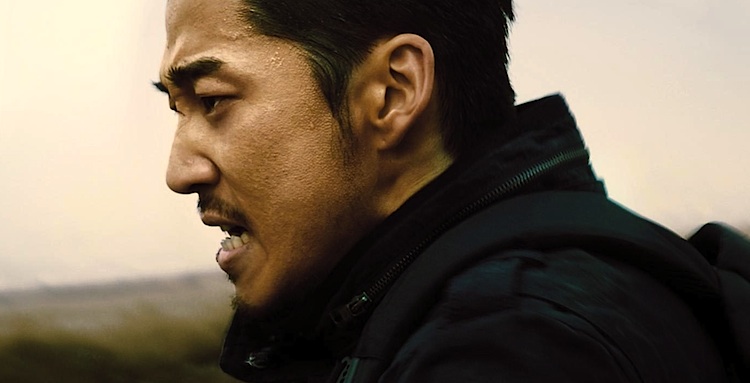
From "Poongsan."

Written and produced by Kim Ki-duk (the proud new owner of Venice’s Golden Lion for Pieta), Poongsan is somewhat akin to other why-can’t-we-all-just-get-along espionage thrillers coming out of the South in recent years (like for instance, Secret Reunion), but at least it shows the Northern Communist agents are at least as coldblooded as their Southern counterparts—and quite arguably crueler. The fact that most people are starving in the DPRK is also acknowledged if not belabored. Nonetheless, the hawkishness of the NIS seems to take it disproportionately in the shins throughout the film. Indeed, how dare they try to protect their country from a personality cult willfully starving its population into submission.

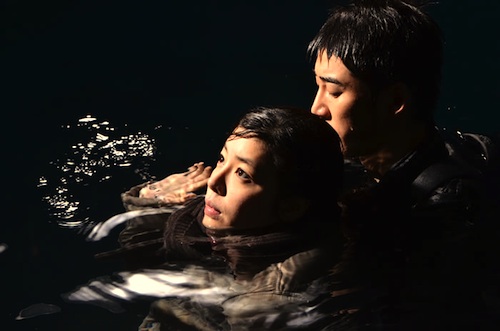
Though working strictly non-verbally, former boy band member Yoon Kye-sang gives a career making performance. Totally credible in the action scenes, he also expresses the sort of deep passionate yearning that never goes out of style at the Korean box office. Likewise, Kim Gyu-ri develops vivid chemistry with him, culminating in one of the most extreme (yet chaste) love scenes you will ever see on film. However, her little-girl-lost act gets a tad wearying when her taciturn protector is not around. At least, Kim Jong-soo is not afraid to let loose the oily bile as the dubious defector. Confusingly, though, several of the supporting cast members look as though they were recruited at a Song Kang-ho lookalike contest (but no, that does not include Song himself).

By action movie standards, Poongsan is remarkably dour. Yet the film’s need to be tragic is apparent right from the start. Kim Ki-duk protégé Juhn has a strong handle on both the tense border crossing sequences and the star-crossed romance. However, he lets the scenes of morally equivalent in-fighting get a bit draggy. Nonetheless, Bourne fans should appreciate the gritty vibe and Yoon’s star turn. Recommended accordingly, Poongsan screens this coming Wednesday (9/26) and Saturday (9/29) as part of MoMA’s annual Yeonghwa celebration of Korean cinema.

LFM GRADE: B-

Posted on September 24th, 2012 at 12:31pm.

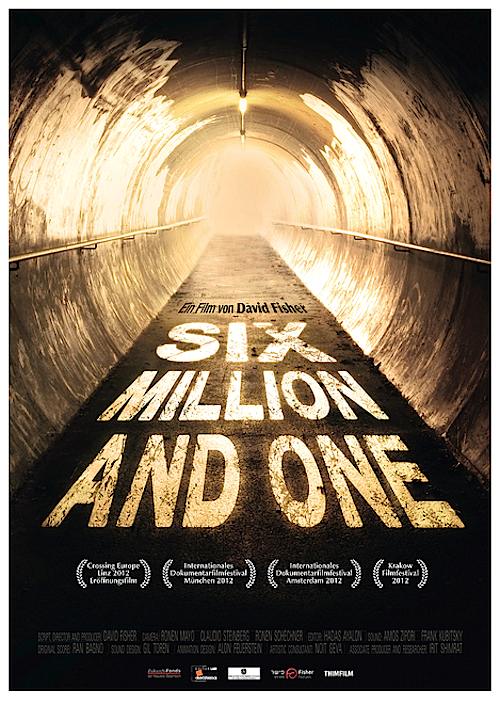
Revisiting the Holocaust: LFM Reviews Six Million and One

By Joe Bendel. David Fisher chose to drag his siblings to the historic sites of Austria – at least, the ones that the country would rather hide away from the world. They would visit the concentration camps their father survived. It is a trip Israeli filmmaker Fisher’s sister and two brothers make quite reluctantly. Nevertheless, they experience family history as a form of therapy they never knew they needed in Fisher’s Six Million and One, which opens this Friday in New York.

Fisher somehow lived through his internment at the Gusen and Gunskirchen camps, but just barely. Amongst the last camp populations to be liberated, the Fishers’ father easily could have been the National Socialists’ final victim, the titular six million and first. He did survive, but he never told the tale, except in the unpublished memoir discovered after his death. While most of the family has no interest in plumbing the depths of their father’s wounded psyche, the documentarian brother obsesses over it, using it as the blue print for SMAO.

Brother David starts the voyage solo, traveling to Austria, where he meets several townspeople who were slightly surprised to learn they had moved into houses across the street from a concentration camp. He also journeys to America to interview some of the surviving GI’s who liberated the Austrian camps and still suffer from post-traumatic stress syndrome decades later. In fact, these might be some of the most eye-opening scenes of the film, arguing for separate documentary treatment in their own right.

Eventually, Fisher cajoles his siblings into returning to Austria with him. They literally retrace their father’s steps on the notorious death march between camps and in the munitions tunnel he dug as a slave laborer. Yet, having not read their father’s chronicle, they are unaware of the significance of each leg of the journey until it is revealed by their filmmaker brother.

Notwithstanding the humanistic empathy of his visit with America’s “Greatest Generation,” SMAO revisits some well traveled documentary roads. For those of us who have covered many thematically related films, it clearly bears close comparison to Jake Fisher’s A Generation Apart (presumably no relation), as well as any number of films documenting Survivors’ return journeys to their old fateful homelands (such as Inside Hana’s Suitcase or Blinky & Me for instance). However, the refreshing wit and attitude of the Fishers helps differentiate SMAO from the field. It is clear they are never reading from a pre-written script, nor are they interesting in indulging in cheap-and-easy sentiment.

Yes, there have been a lot of films about this uniquely horrific episode in human history, but SMAO still finds something new to say. Though it displays a bit of inclination towards the discursive, writer-director-producer Fisher and editor Hadas Ayalon ultimately shape it all into a compelling narrative. Ran Bagno’s ECM-ish blend of chamber strings and experimental music also nicely underscores the dramatic presentations on-screen. Recommended for thoughtful audiences, Six Million and One opens this Friday (9/28) in New York at the Lincoln Plaza Cinema.

LFM GRADE: B

Posted on September 24th, 2012 at 12:29pm.

The King is Not Himself Today: LFM Reviews Masquerade

By Joe Bendel. It is like the Joseon-era equivalent of the eighteen minute gap in the Watergate tapes. Fifteen days of King Gwanghae’s official court history mysteriously disappeared. There was a fair bit of intrigue afoot during that period, but the king missed most of it. It is his double who briefly tends to matters of state in Choo Chang-min’s Masquerade, which opens today in select cities, including New York and Los Angeles.

When Gwanghae first assumed the throne, there was great hope for his reign. Unfortunately, he turned out to be a capricious ruler. Sound familiar? At least in early seventeenth century Korea, there were worse alternatives. Given the unsavory nature of his rivals in court, his loyal Chief Secretary Heo Gyun opts for full cover-up mode when the king is incapacitated by a life-threatening mickey. Already employing look-alike actor Ha-seon as the King’s double on a limited basis, Heo Gyun installs him on the throne full time until the royal doctor nurses the king back to health.

Han Hyo-joo as the Queen Consort.

Ha-seon knows little about the issues of the day, but his fundamental decency leads him to make better decisions than had been coming from Gwanghae of late. Trying to make nice with the beautiful Queen Consort, he starts doing those little things, like ending her brother’s torturous inquisition. Of course, these edicts only further antagonize the conspirators who brought about Ha-seon’s impersonation in the first place.

Essentially, Masquerade is the Korean costume drama version of Dave, but the stakes are higher for everyone involved. Obviously, not everybody will make it through the picture alive. The only questions are how high will the body count be and will it include the secret social climber Ha-seon?

In his first true period piece, action star Lee Byung-hun (internationally recognizable for G.I. Joe and I Saw the Devil) handles the dual role of king and clown rather well. He is convincingly imperious as Gwanghae and not terribly shticky as the in-over-his-head Ha-seon. However, it is the supporting cast that really shines, particularly Ryoo Seung-ryong (scary good in War of the Arrows), whose hardnosed Heo Gyun personifies steely gravitas. Likewise, Jang Gwang’s understated turn as Chief Eunuch Jo really sneaks up on viewers. Han Hyo-joo makes the most of the underwritten Queen Consort role, but Shim Eun-kyung really lowers the dramatic boom as Sawol, the young taster who awakens the conscience of the pretend king.

Costume designer Kwon Yoo-jin’s colorful threads look appropriately rich and finely wrought – but Choo is not overawed by the trappings of royalty, largely narrowing his focus to the micro human tribulations rather than the macro geo-politics. While there is more backstabbing than swordplay in Masquerade, it should still satisfy the entire spectrum of period action and romance audiences. Recommended for fans of Korean epic historicals, Masquerade opens today (9/21) in New York at the AMC Empire and in L.A. at the CGV Cinemas, courtesy of CJ Entertainment.

LFM GRADE: B+

Posted on September 21st, 2012 at 12:59pm.

Energy for the Future: LFM Reviews Switch

From "Switch."

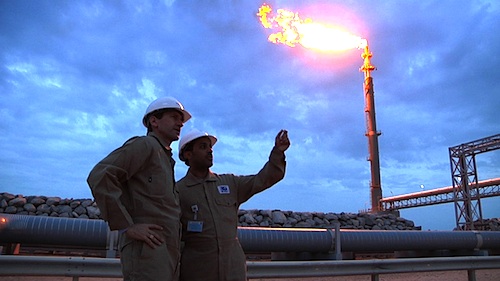
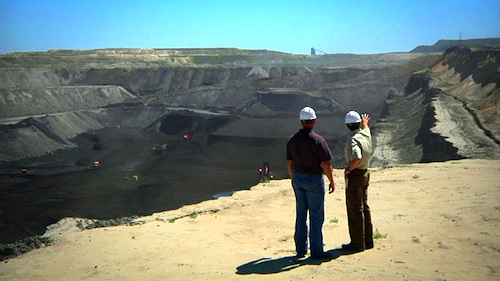
By Joe Bendel. Geologist Dr. Scott Tinker is serious about charting a rational energy policy for the future. You can tell this because he can envision a positive role for both nuclear power and hydraulic fracturing (a.k.a. fracking). Visiting diverse energy-producing sites around the globe, Dr. Tinker looks for a balanced menu of options to replace so-called “legacy” fuels in Harry Lynch’s documentary Switch (trailer here) , which opens in New York today.

It seems Dr. Tinker largely accepts the current terms of the global warming debate, but he never really belabors it in Switch. He just starts from the premise sending a lot of emissions into the atmosphere is generally a bad idea. Fair enough. However, he is level headed enough not to endorse anything along the lines of the Kyoto Protocols. According to Dr. Tinker, the West really is not going to be the problem in the future. At current rates, China and India will be releasing far more emissions than America and Europe combined—and they are not going to stop unless they determine it is in their economic interests.

He is also honest enough to admit the advantages of petroleum. This is not something the evil oil industry forced onto reluctant consumers – you can fill up your tank and drive for miles, yet it never leaves behind any soot or residue. That is why replacing it is quite the trick.

Lynch follows Tinker as he visits some remarkably photogenic power plants, but he never really finds any one panacea. Ocean and geothermal power are great if you happen to be in the perfect location, like Norway or Iceland, but not practical for a country the size of America, let alone China. Solar and wind can be nice supplements, but they are intermittent. Electric cars are cool, but they are still electric, which largely means more demand for coal.

From "Switch."

Some unexpected dark horses emerge from the pack, like natural gas. Yes, it is a fossil fuel – but a remarkably clean burning one. Addressing the media scare campaign around hydraulic fracturing, Tinker’s experts flatly state there have never been documented cases of ground water contamination, arguing the greatest potential hazard would be spills at surface level. Of course, this is not risk-specific to fracturing, but applicable to just about every commercial endeavor.

Post-Fukushima nuclear power also factors into the mix. While the media focuses on Fukushima and Chernobyl, it has ignored France – where eighty percent of electricity is nuclear generated, without incident. As Tinker and his colleague crunch the numbers, it is hard to see how the world would wean itself from fossil fuels if nuclear is not part of the calculus.

Dr. Tinker is a smart and engaging presenter, who is undeniably far more knowledgeable about energy than the ideologues typically populating documentaries. Nonetheless, Switch gets a bit repetitive, showing scene after scene of Tinker touring big shiny installations, asking just what exactly does that valve-thingy do?

Be that as it may, Switch will definitely sharpen your thinking on energy. It offers a pretty comprehensive Cliff Notes for all forms of energy generation, scrupulously free of bias. While obviously part of a larger media campaign (just like Lee Hirsch’s Bully, a.k.a. The Bully Project, and a host of other theatrical docs), Switch will still reward open-minded viewers. Recommended for slightly wonky types, it opens today (9/21) in New York at the Landmark Sunshine.

LFM GRADE: B

September 21st, 2012 at 12:59pm.