Motorcycle Robots & Busty Cyborgs: LFM Reviews Karate-Robo Zaborgar on DVD/Blu-Ray

By Joe Bendel. Don’t call it a knock-off—this is a reboot. Yutaka Daimon’s crime-fighting partner is a robot that can turn itself into a motorcycle. You could say he transforms—just like he did in the early 1970’s Japanese television series Denjin Zaborger. The spelling is slightly different, but the spirit is the same in Noboru Iguchi’s Karate-Robo Zaborgar (trailer here), which officially launches on DVD and Blu-ray this Tuesday from Well Go USA.

Somehow fabricated with the DNA of his twin brother who died in infancy, Zaborgar represents more than a weaponized motor bike to Daimon. He considers him a brother. Nursing a grudge against Sigma, the THRUSH-like international crime syndicate that killed his (their) father, Daimon is obsessed with “righteousness.” Yet, he frequently finds himself protecting venal politicians (and their DNA) from Sigma’s machinations. Further complicating matters, the secret agent starts developing feelings for Miss Borg, the chief hench-cyborg of Sigma’s evil wheelchair-bound mastermind, Dr. Akunomiya. Despite her initial resistance, Miss Borg begins to reciprocate his affections. Their resulting affair clouds Daimon’s judgment, leading to his disgrace and the apparent destruction of Zaborgar.

But wait, there’s more, including possible redemption for the older but possibly dumber Daimon and even a relationship with Akiko, the cyborg-daughter he never knew he had. He needs to get his act together quickly, though, before Akunomiya completes his plan to turn Akiko into a giant, mindless, city-stomping robot. Tokyo property values are depending on Daimon and maybe a rebuilt, reprogrammed Zaborgar.

Based on the clips of the original 1974 show seen during the closing credits, KRZ is remarkably faithful to its original source material. A production of Sushi Typhoon, Nikkatsu’s low budget genre specialists, from Iguchi and FX director Yoshihiro Nishimura, the behind classics like Machine Girl, KRZ does not feature the sort of extreme gore fanboys might be expecting. The Film Society of Lincoln Center actually programmed it as part of the children’s series, but that was really pushing it. After all, those busty cyborgs have some lethal torpedoes. It also has a strangely downbeat vibe at times.

Given Iguchi and Nishimura’s reputation as Japan’s answer to Troma, the effects in KRZ are surprisingly well rendered, even including the little remote-controlled bots coming out of Zaborgar’s head and feet. Conversely, the performances are as cheesy as you would expect, except maybe more so. As the tandem of Daimons, Yasuhisa Furuhara and Itsuji Itao are especially wooden and relentlessly un-self-aware. Still, Mami Yamasaki somehow maintains her dignity as the tragic Miss Borg, regardless of her Metropolis-fetish wardrobe.

Not exactly a masterpiece of world cinema, KRZ still has a weird way of invoking nostalgia in viewers, even if they never saw Denjin Zaborger in the first place. Anyone familiar with Ultraman of the mid 1960’s, or the subsequent Power Rangers, will be able to get it. More of an exercise in manic energy than a comic send-up, per se, Karate-Robo Zaborgar is recommended for specifically self-identifying fans old-school Japanese sci-fi monster movies when it releases tomorrow (9/11) on DVD and Blu-ray from Well Go USA.

Posted on September 10th, 2012 at 12:32pm.
Oscar-Qualified and Ready to Haunt the Festival Circuit: LFM Reviews House of Monsters

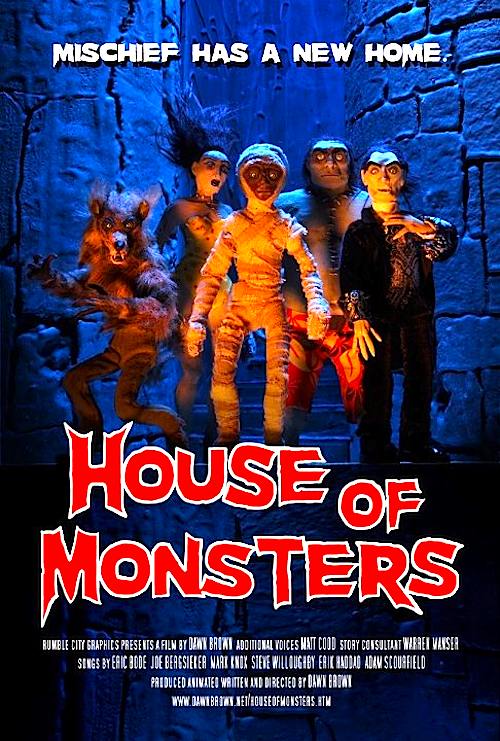
By Joe Bendel. You’d think monsters would be anti-social, but strangely enough, they can often be found sharing haunted digs. This leads to a bit of friction between the Mummy and the Frankensteins. Alas, the former pharaoh gets the worst of it in Dawn Brown’s stop-motion animated short House of Monsters, which just completed an Oscar qualifying run at the Laemmle and should now have plenty of festival action ahead of it.

One of the drawbacks of being undead is dry itchiness of desiccated skin. Fortunately, there is a mad scientist in the house to prescribe something for the Mummy. Once quite the catch, he would like to put the moves on Frankenstein’s Bride. Despite an assist from Dracula, things turn out rather badly for him. No worries. Classic monsters never die, they just come back for revenge later.

Brown, a frequent animator and special effects artist on Tim Burton films, is something of a one-man band on House, serving as writer, director, animator, and producer. Animation enthusiasts should be duly impressed by the quality and rich detail of Brown’s work here. It is easy to see why she has been in such demand. In fact, one might suspect her contributions have been the best part of many big budget films she has worked on. While House is a complete, self-contained (but admittedly brief) story, it could easily serve as a pilot or constituent episode of a longer monster project in the future.

Also an artist for Vampirella comic books, Brown clearly understands and shares an enduring affection for these characters. Indeed, you can never go wrong with the iconic undead scampering about an old dark house. While never too macabre for children, the real audience will probably be nostalgic adults who read Famous Monsters of Filmland as pre-teens and never outgrew their love of the classic Universal monster movies. (The opening title even evokes Ackerman’s famous fan magazine’s type treatment.)

At just over seven minutes, most fans will be left wanting more, which is probably the idea. Recommended for animations connoisseurs and famous creature lovers, House of Monsters should be coming to a festival near you soon and deserves a serious look come awards season.

Posted on September 10th, 2012 at 12:30pm.

Wedding Night Blues: LFM Reviews [REC] 3: Genesis

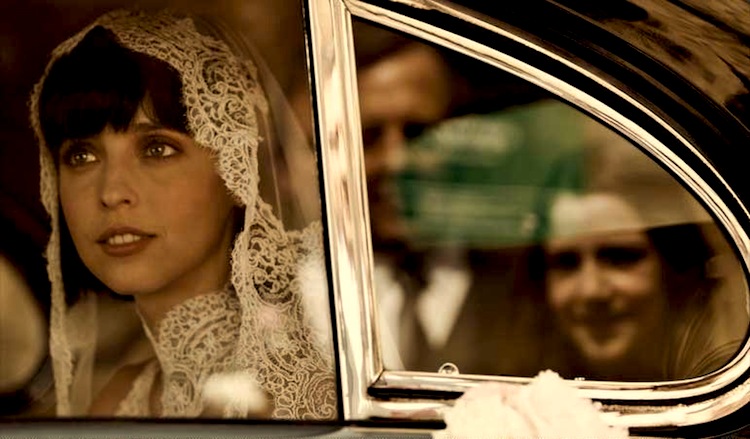
Leticia Doleria as Clara.

By Joe Bendel. It sounds awful to have the undead terrorizing your wedding, but at least that means there is a priest on hand. Indeed, it turns out that a good Father is useful to have around when it comes to holding off the zombie hordes in Placo Plaza’s [REC] 3: Genesis (trailer here), the third and penultimate installment of the Spanish walking dead franchise, which opens today in New York.

Clara and Koldo are meant for each other. She has something important to tell him, but they are unable to get five minutes of peace together, even before the zombies attack. Cousin Adria and Atun, a professional videographer, are recording the wedding and reception, in established [REC] style. Uncle Victor does not look so good, though. He was bitten by a dog or something. Then he starts biting people and they start biting people, and so on and so on.

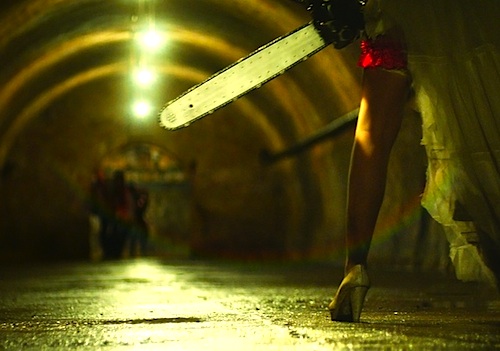
Poor Clara and Koldo get separated in carnage, but they are determined to get back together. The bride in particular is willing to do what it takes to find her groom. Why yes, that is a chainsaw she’s carrying. The Padre is also helpful, keeping the unholy multitude at bay with prayer. As in the previous film, there is a religious element to [REC] 3 that distinguishes the series from the zombie pack.

What a rough wedding night looks like.

Shockingly, Plaza breaks format early in the second act, abandoning the found footage motif in favor of a traditional omniscient viewpoint. While shaky cam can be annoying, Plaza and Jaime Balagueró, co-director of the first two RECs, have a good handle on how to use it. More than a gimmick, in the previous films, they shrewdly used the video-camera POV to control the audience’s perspective, literally keeping them in the dark at times, which rather works in context. After all, things seen fleetingly out of the corner of the eye are always more unnerving than well lit but ridiculously over the top soundstage shots.

At times, [REC] 3 also goes for laughs, relatively successfully. The wedding setting is an inspired set-up device. Hasn’t everyone been to a reception that was totally dead but refused to die? [REC] 3 is like that except more so. Plaza and his leads also sell the newlyweds’ earnest devotion fairly convincingly. Diego Martin’s Koldo is a bit of a bland screen presence, but he develops some presentable chemistry with Leticia Doleria, as the power tool wielding Clara. As horror heroines go, she certainly has her moments.

There are some clever bits in [REC] 3 that should satisfy zombie fans, but it is the weakest link of the series, so far (whereas [REC] 2 was the high water mark). It will be interesting to see what happens when Balagueró assumes the solo helm of the forthcoming and final [REC] 4. The comedic elements are fine, but he should probably stick to the franchise format. Still, for those who enjoy gore and black humor with a touch of Catholicism, [REC] 3 delivers just enough. Recommended for the core fanbase, the stand-alone [REC] 3: Genesis opens today (9/7) in New York at the Cinema Village.

LFM GRADE: B-

Posted on September 7th, 2012 at 12:43pm.

The Bhatts Do 3D: LFM Reviews Raaz 3

By Joe Bendel. The Bhatts are back and they are Bhattier than ever. Shortly after giving the world Sunny Leone’s mainstream-ish debut, India’s sensationalistic filmmaking family has returned with the first Bollywood horror movie to receive an R rating from the MPAA. Not to worry, it is almost entirely for scenes of supernatural terror. There is plenty of uncanny skullduggery afoot in Vikram Bhatt’s thematic stand-alone sequel Raaz 3 (trailer here), which opens today in New York.

Shenaya Shekhar used to be the hottest thing going in Bollywood, but she got ever so slightly older. Now, it is the younger, cuter Sanjana Krishnan who gets all the plum parts and awards. That does not sit well with Shekhar, who also carries a deeper grudge against the oblivious starlet, for reasons which will be revealed in good time. Not exactly a model of emotional stability, Shekhar is ripe for the enticement of the dark side.

The demonic Taradutt is always willing to make a deal and Shekhar is definitely someone he can do business with. Her goals are simple: to preserve her celebrity status and make Krishnan suffer. Taradutt is happy to oblige with some black magic. However, her rival will need frequent doses of his soul-enslaving potion. The Mickey-slipping job will fall to Aditya Arora, Shekhar’s indebted lover who happens to be directing Krishnan’s next picture. Though guilt-wracked, Arora complies, only to find himself falling for Krishnan as she succumbs to Taradutt’s evil influence.

If you are going to see a Bhatt-helmed film, go to one of Vikram’s supernatural forays rather than Pooja’s naughty melodramas. As far as horror-paranormal romance crossovers go, Raaz 3 has its moments. The scenes involving Hindu deities and demons work rather well, making a nice change of pace from typically materialistic horror films. Since its characters work in Bollywood, the film can also sneak in dance numbers in ways that do not sacrifice verisimilitude. Still, the cast is stuck with some absolute howlers in Shagufta Rafique’s script and nobody’s performance is exactly subtle in the first place.

Give her credit, though, Bipasha Basu vamps it up something fierce as Shekhar, always in cleavage-emphasizing wardrobe that must have restricted the poor woman’s breathing. Anything for art. At least she gets it. Emraan Hashmi just lacks presence as Arora. Instead of a tortured brooder, he just looks somewhat nauseous. In the innocent victim role, Esha Gupta’s Krishnan is sorely underwritten, but she is aces in her big dance number.

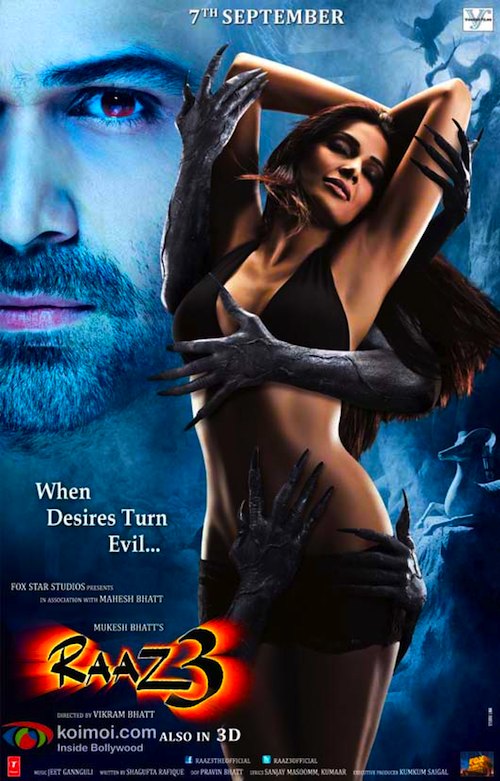
See Bipasha Basu in 3D in "Raaz 3."

Cinematographer Pravin Bhatt gets the dark and stormy atmospherics right, but the CGI is of sub-Hollywood standards.  Frankly, the 3D is also completely unnecessary here. The only instances where it really works are during the musical interludes. Most of the time, it is more of a distraction than an enhancement. For Bollywood fans, the songs are palatable, but not distinctive.

Bipasha Basu’s demon-loving diva could go toe-to-toe with Eva Green’s Angelique Bouchard in Burton’s Dark Shadows reboot. They are the real reasons to see both films, which is definitely something in either case. Recommended for those who enjoy a campy, larger-than-life star-turn rather than for likely to be disappointed horror genre fans, Raaz 3 opens today in New York, with the 2D version playing at the Big Cinemas Manhattan 1 and the 3D running at the AMC Empire. It also opens in the Bay Area, with 3D screenings at the AMC Mercado and Cinemark Union City, with the 2D showing at the Fremont Big Cities 7.

Posted on September 7th, 2012 at 12:42pm.

A Family Survives Mao’s Cultural Revolution: LFM Reviews Mulberry Child, Narrated by Jacqueline Bisset

By Joe Bendel. Paradoxically, it might have been the ardent loyalty of Jian Ping’s persecuted parents that saved them during the Cultural Revolution. At least, they never said anything incriminating their children would have been forced to repeat. Yet, the lingering trauma of the experience makes it difficult for her to relate to her Americanized daughter, Lisa Xia. By exploring their family history, the two women come to terms with their own relationship in Susan Morgan Cooper’s hybrid-documentary, Mulberry Child, which opens this Friday in New York at the Quad Cinema.

True believers, Hou Kai and Gu Wenxiu met and married through the Chinese Communist Party. They bought into the Party’s early rhetoric, which proved to be a profound mistake during the “Anti-Rightist Campaign.” Trying to defend a wrongfully accused colleague, Hou only succeeded in putting himself in the Party’s crosshairs. Despite some trying moments, Jian’s father made it through the first reign of terror, demoted but relatively unscathed. The Cultural Revolution would be a different story entirely.

As a school administer, Jian’s mother was directly in the line of fire. To make matters worse, her father’s history as a one-time Japanese POW was a red flag for the empowered zealots. As the institutionalized madness escalated, Jian’s father was imprisoned and her mother was held a de-facto captive in her school’s boiler room, forced to write self-criticism and pressured to denounce her husband. Largely raised by their grandmother, the children went months without seeing either parent.

How cowardly and cruel must an ideology be that it would force a seven year old girl to condemn her father in school? Yet, the Maoist cult continues to seduce Western academics who never had to live through it. Somehow, though, Jian’s parents still cling to their faith, as if by acknowledging that the source of the horror they lived through—the Chinese Communist Party—would somehow make all their suffering for naught.

Gu Wenxiu (actor Bruce Akoni) and Hou Kai (actress Jody Choi) in film.

Jian and her daughter can apprise the past with more clarity, but they remain susceptible to a romanticized vision of contemporary China. Ironically, their big coming together moment happens during the Beijing Olympic Games, against the backdrop of the striking Bird’s Nest stadium, designed by Ai Weiwei. Yet, the government’s relentless campaign against the artist and teacher ought to undermine the superficial images the Party tries to present to the world.

Nonetheless, when looking backward, Mulberry is quite forceful and moving. Combining Jacqueline Bisset’s voice-overs with dramatized episodes from Jian’s memoir, Morgan Cooper vividly conveys an innocent child’s perspective on an era of state sanctioned insanity. Jody Choi and Bruce Akoni Yong are particularly affecting as young Jian and the much abused Hou (“The Big Traitor”), respectively. However, the candid-style mother-daughter conversations do not carry the same dramatic weight. Yes, there is something universal to their generational disconnect, but it pales in comparison to her experience visiting her father in prison—unaccompanied because only a seven year old girl could visit a suspected enemy of the state without reprisals.

Of course, the difficulties survivors like Jian have expressing affection are the least of the Cultural Revolution’s tragic legacy, but it is what most directly affects her and her daughter. Sensitively produced, Mulberry Child is recommended for its up-close-and-personal insight into the chaos unleashed by Mao’s regime (rather than its wishful thinking for today’s China) when it opens this Friday (9/7) at New York’s Quad Cinema.

LFM GRADE: B

Posted on September 4th, 2012 at 2:34pm.

The Birth of the Han Dynasty: LFM Reviews White Vengeance on Blu-ray/DVD

By Joe Bendel. Power corrupts and the pursuit of power corrupts just as absolutely. This is the lesson an ancient mystery man has for a pompous scholar and his students, startled while paying their respects in the first Han Emperor’s tomb. He will tell them the real story of the Hongmen Banquet and the struggle to succeed the fallen Qin Dynasty in Daniel Lee’s mistitled White Vengeance (trailer here), which is now available on DVD and Blu-ray today from Well Go USA.

The tyrannical Qin Emperor is dead and nobody misses him, least of all Han leader Liu Bang and Chu nobleman Xiang Yu, rival generals who forged an uneasy alliance against the Qin. Of course, the emperor’s death prompts a rather obvious question: who will succeed him? Fearing for his own neck, the caretaker emperor decrees the first to control the Qin capitol of Xianyang wins the throne, hoping to play the warriors against each other. It works.

As sworn brothers turned bitter rivals, there are still a lot of unresolved issues between Liu Bang and Xiang Yu, particularly concerning the royal consort Yu Ji, the latter’s lover entrusted to the former for safekeeping. Among many things, Vengeance is an elegantly austere, almost chaste, love triangle.

There is also plenty of period warfighting in Vengeance, rendered with grit and scope. Lee is definitely in his element staging huge clashes of armies. He really shows viewers exactly what it means to be outflanked and why it is a bad thing. Yet, the film’s real battle is that between the military strategists, Xiang Yu’s longtime family advisor Fan Zeng and the freelance Obiwan Zhang Liang, who sides with his rival because of Liu Bang’s professed lack of ambition. When the two counselors match wits during a game of weiqi, the stakes are significant and bloody.

Liu Yifei in "White Vengeance."

Boasting an all-star HK and Chinese cast, Vengeance features memorable supporting performances from top to bottom. Not surprisingly, Anthony Wong dominates the film as the blind but all-seeing Fan Zeng, instantly bringing the gravitas necessary for the cunning yet classically tragic figure. Still, as the crafty Zhang Liang, Hanyu Zhang holds his own with the recognizable Johnnie To veteran.

Unfortunately, neither Feng Shaofeng nor Leon Lai displays the same commanding screen presence as the rival generals. Actually, they are rather bland. In contrast, Jordan Chan packs quite the late inning punch as Han loyalist Fan Kuai, while (Crystal) Liu Yifei is appropriately orchid-like as Yu Ji, but she also makes the most of a bigtime dramatic close-up down the stretch.

Lee rather dexterously shifts viewer sympathies in ways that might even be considered subversive. Indeed, there is definitely a point in Vengeance about the high cost of taking and keeping power. What they say about good intentions still holds true. An ambitious historical epic with plenty of action, White Vengeance is recommended with considerable enthusiasm for fans of Hong Kong cinema. It releases today (9/4) on DVD and Blu-ray from Well Go USA.

LFM GRADE: B+

Posted on September 4th, 2012 at 2:32pm.