LFM Reviews The Tall Man

By Joe Bendel. It is the town even country music forgot. It has the grim name of Cold Rock, Washington, but it might as well be called “Stimulus Village.” When the mine closed, the jobs disappeared, but that was just the start of their problems. A prolonged epidemic of child abductions continues to plague the town. Sketchy sightings of a shadowy figure have given rise to a new urban legend, but one desperate woman will confront the truth behind the bogeyman in Pascal Laugier’s The Tall Man (trailer here), which opened Friday in New York.

Julia Denning is registered nurse and the only remaining medical care-provider left in Cold Rock. While her late husband was a beloved pillar of the community, many of the locals never really warmed to her. Yet, she stays out of a sense of duty. Then one fateful night, she wakes to find little David has been spirited away. More resourceful than her neighbors, Denning gives chase, nearly reclaiming David from his abductor. However, when Lieutenant Dodd, the big city copper on loan to the overwhelmed small town, deposits the battered and distraught Denning at the local diner for safekeeping, she finds her fellow townspeople are acting suspiciously squirrely.

There is a huge game-changing twist in Tall Man, but Laugier drops it comparatively early in the game. Instead of an M. Night Shyamalan ending intended to make viewers feel stupid for buying into his films’ ostensive premises, Laugier allows at least a good third of the picture to explore the implications of his revelation. While the big surprise eventually leads to credibility questions that would be spoilery to explain, it is executed quite smoothly.
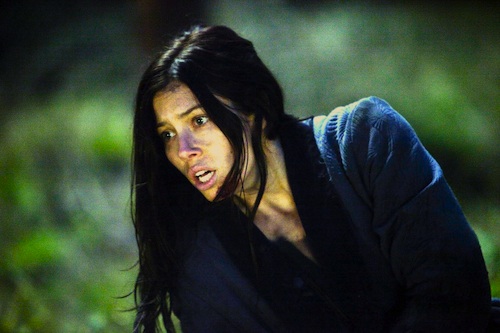
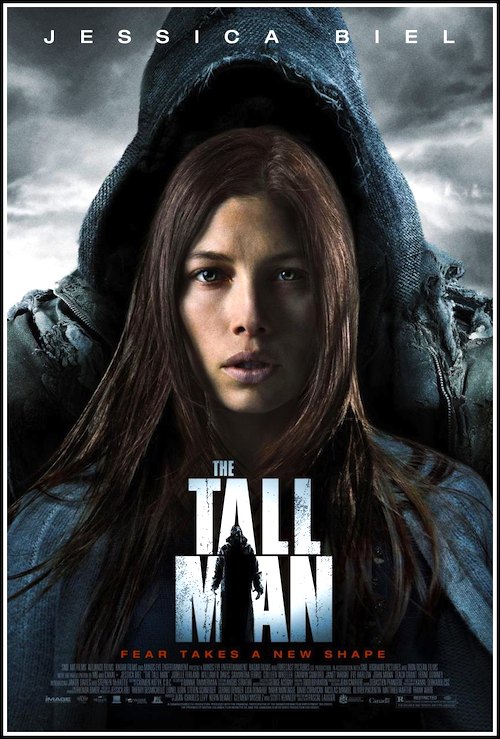
Jessica Biel in "The Tall Man."

As Denning, Jessica Biel plays a critical role selling the gotcha, rather decisively subverting the woman-in-jeopardy archetype. Stephen McHattie (star of Pontypool, probably the best zombie film since the original Night of the Living Dead) brings genre cred and a cool, steely presence to Lt. Dodd. Unfortunately, the rest of the ensemble is largely underwhelming as underwritten stock characters. Still, it is somewhat amusing to see William B. Davis, the cigarette smoking man in The X-Files, as the ineffectual Sheriff Chestnut. You wonder why they keep re-electing him, given the circumstances.

Tricky to categorize, Tall Man largely inhabits the zone where horror movies and dark thrillers overlap. Laugier is quite effective establishing the dark, eerie vibe, but his third act-denouement suffers from a lack of tension. Still, The Tall Man is far more distinctive than other disposable horror-ish films that stumbled into theaters this year, such as ATM and Beneath the Darkness. Soon to be an interesting VOD or rental choice, The Tall Man just does not quite have enough thrills or scares for current New York City movie ticket prices. Maybe worth keeping in mind for later, it opened Friday (8/31) at the AMC Village 7.

LFM GRADE: C+

Posted on September 4th, 2012 at 2:32pm.

Bombs and Bikes: LFM Reviews Quick on Blu-ray/DVD

By Joe Bendel. Safety first, kids. Remember, you never know what some psychopath could sneak into your helmet, so you are better off not wearing one – regardless of how recklessly you might race through the city’s streets. One biker turned messenger learns this the hard way in Jo Bum-gu’s Quick, which releases today on DVD and Blu-ray from Shout Factory.

In 2004, Han Ki-su broke up rather spectacularly with his girlfriend, Choon-sim. It is a heck of a pile-up. Seven years later, she has reinvented herself as Ah-rom, the lead singer of an up-and-coming girl group, while he has de-invented himself as motorbike deliveryman. Still fearless on a bike, Han delivers a bomb for a mysterious client unaware of its contents. There will be more where that came from. Unfortunately, his ex Ah-rom will become a part of the madness when she books Han to whisk her off to a gig. Putting on his helmet, she sees a rather ominous countdown clock where there shouldn’t be one. As the voice on Han’s cell phone explains, he has thirty minutes to make a series of deliveries or the helmet goes boom.

While Quick owes an obvious debt of inspiration to Speed, it could also be considered the motorized forerunner to Premium Rush – but with a more talented cast. There will be plenty of breakneck weaving through traffic and unlikely Evel Knievel jumps. There is also a yakuza backstory to the mad bomber’s crime spree so convoluted, even the cops can’t keep it straight. For stunt driving, though, Quick is hard to beat. The hospitalized stuntmen seen visited by cast members during the closing credits can attest to that.

Granted, Kang Ye-won is considerably less annoying than Sandra Bullock, but her character’s initial diva act is a bit cringy for a while. If nothing else, having a bomb attached to your head ought to inspire clarity of thought. Still, she looks good in vinyl as her character eventually settles in and gets serious.

Frankly, the humor in Quick is rather broad and does not travel well. Fortunately, Lee Min-ki never goes for laughs as Han, mostly brooding like a rebel without a cause, except when he is raging against their tormentor. As biker movie protagonists go, he is pretty good really. However, since the identity of the evil mastermind is kept secret until well into the third act, Quick does not have a lot of moustache-twisting villainy.

To recap, Quick has a whole lot of explosions and chase scenes. It is also nice to see the fim’s shout out to the stunt personnel, given the rate the Korean film industry chews them up and spits them out (at least according to stuntman-filmmaker Jung Byung-gil’s documentary Action Boys, which screened at NYAFF four years ago). Never lacking adrenaline, Quick is easily recommended for action fans. It is now available at most online retailers from Shout Factory.

LFM GRADE: B-

Posted on September 4th, 2012 at 2:30pm.

LFM’s Govindini Murty on Lars Larson’s National Radio Show

LFM Co-Editor Govindini Murty was on Lars Larson’s national radio show Friday talking about The Ambassador and other new releases. Special thanks, as always, to Lars and his staff for inviting Govindini on. She always has fun appearing on his show.

Lars’ show is broadcast on over 200 stations nationwide, and runs at different times across the country, so to find his show be sure to check out his website here.

Posted on September 4th, 2012 at 2:29pm.

LFM’s Govindini Murty at The Huffington Post: Supermodels and True Beauty: A Conversation with Timothy Greenfield-Sanders of HBO’s About Face

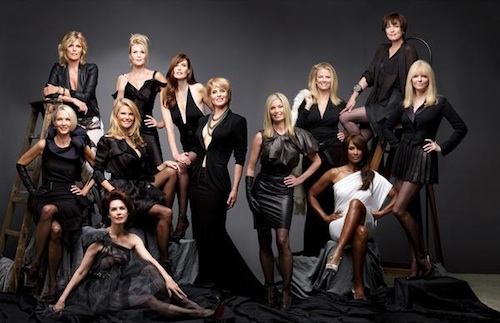
The supermodel sorority from "About Face."

[Editor’s Note: the post below appears today on the front page of The Huffington Post.]

By Govindini Murty. They’re among the most iconic faces of the second half of the twentieth century. Isabella Rossellini, Beverly Johnson, Paulina Porizkova, and their supermodel sorority helped to shape public perceptions of beauty and womanhood at a time of rapid expansion in the mass media. Their faces graced thousands of magazine covers and they were role models to millions of young women.

But was the rise of the supermodel a sign of female empowerment, or of female objectification?

About Face: Supermodels Then and Now, an insightful new documentary by director and photographer Timothy Greenfield-Sanders available on HBO on-demand through September 3 and HBO Go through 2013, interviews sixteen of these supermodels about the true nature of beauty in an age of consumerism and mass media.

As alluded to in About Face, the irony that underlies the modeling profession is that it should lead to both the empowerment and objectification of women. On the one hand, the mass distribution of images of female models through fashion magazines, ads, and other media in the past century has led to women becoming quite literally more visible in today’s world – with that visibility being an affirmation of their femininity and right to exist as women in the public sphere. In contrast to this, from the Puritans to the Taliban, misogynistic societies through history have restricted sensual or beautiful images of women as a prelude to denying their basic right to participate in public life, citing women’s beauty as a “corrupting” influence on social morality. The predominance of beautiful images of women in Western culture has thus affirmed the broader right of women to exist in public as feminine and not as neutered beings.

On the other hand, modeling has also had the effect of objectifying women by focusing on external surfaces, and at times unnatural standards of beauty. In About Face, Isabella Rossellini asks of the pressure for women to undergo plastic surgery: “Is this the new foot-binding? It’s misogyny to say that older women are unattractive.” Objectification can also lead to racism by dehumanizing people and imposing narrow standards of ‘beauty’ or ‘normalcy.’ Model and agent Bethann Hardison describes in About Face trying to book African-American models for runway shows in the ’70s and ’80s, only to be told by the casting agents that such models weren’t their “aesthetic.” As Hardison explains “‘Aesthetic’ is borderline for racist.”

I spoke with director Timothy Greenfield-Sanders about some of these issues at the LA Film Festival’s screening of About Face. The interview has been edited for length.

2012-08-31-beverly_johnson_smi_0002.jpg
Model Beverly Johnson.

GM: What drew you to these ladies? I know you met them initially at a party in New York, but what did you find so magical about them?

TGS: I think when I met them at that party … I immediately got a sense of how smart they were. You know, the cliché is that you either have brains or beauty, but you don’t have both. Well, they seemed to have both. It really makes it an interesting film. And I thought that people weren’t aware of that. I have two young daughters who knew who they were. But many young people today who are so interested in fashion, they don’t know the history of it and of these iconic women.

GM: What has changed about modeling? You mentioned in the screening that these models were so unique, whereas today the models and their careers seem more transient. Why is there this disparity today versus back then?

TGS: I think that it was a smaller world then. I think there was a warmer relationship between the models and the designers and even the businesspeople involved. It was not so cut-throat and not so corporate. And I think today it’s just big business and big money, and I don’t think the human relationship is there as much. I think it’s very changed.

GM: Do you think a big part of that is the issue of covers – that the actresses are taking over magazine covers?

TGS: Yes.

GM: It’s such a striking change. What has that done to the morale of the models? Does it make a big difference behind the scenes?

TGS: I’m not sure I can answer that because it’s not my world, exactly. But I know certainly it was huge in those days to have covers, because covers were the definition of success. And the cover of Vogue was the ultimate success. So when Beverly Johnson got on the cover of Vogue – the first black woman to do so [in August, 1974], that was a big deal. And today – that doesn’t happen for models.

2012-08-31-PaulinaPorizkovapaulinaporizkova13818261454559.jpg
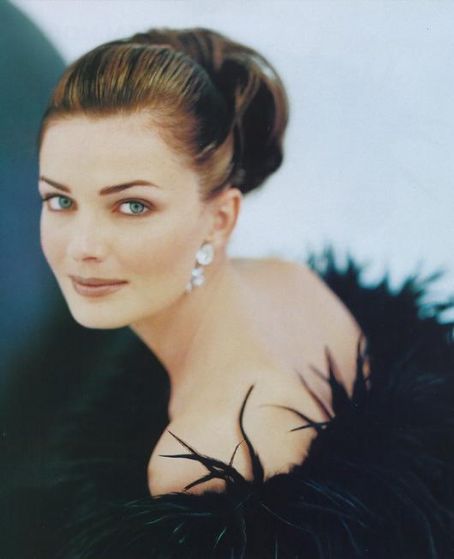
Model Paulina Porizkova.

GM: I thought it was very interesting what Dayle Haddon said that it wasn’t just that she thought she was the prettiest – in fact she didn’t quite fit into the physical type that was popular at the time, but that she brought something else to the picture.

TGS: She brought something else. And Dayle Haddon had to struggle because she wasn’t the look of the moment. She was a very smart woman and she figured out a way to add something more to the picture.

GM: Do you think the reason that those models from that era were so powerful – we’re talking the ’70s and ’80s, was because they were often muses for the designers they were working with?

TGS: Yes, exactly.

GM: I think of Yves St. Laurent and models like Khadija Adams, or even Catherine Deneuve in the ’60s who was dressed by St. Laurent for Belle de Jour. I think of Calvin Klein and Brooke Shields, they were so intimately tied together. Continue reading LFM’s Govindini Murty at The Huffington Post: Supermodels and True Beauty: A Conversation with Timothy Greenfield-Sanders of HBO’s About Face

LFM Reviews Jet Li’s Flying Swords of Dragon Gate in IMAX 3D

By Joe Bendel. It was a time when eunuchs terrorized the land. However, a handful of wandering knights are willing to challenge them, even at the cost of their lives. Good multi-taskers, they will still find time for a bit of treasure-hunting in Flying Swords of Dragon Gate, Tsui Hark’s monster 3D return to the legendary Dragon Gate Inn world, which opens a special two-week IMAX-coming-straight-at-your-head limited engagement this Friday in New York.

Sort of but not really a sequel to Raymond Lee’s 1992 Dragon Gate Inn (produced and co-written by Tsui), Flying 3D picks up three years later in movie time. Dragon Inn burned to the ground and the femme fatale proprietress disappeared under murky circumstances, but since there was a demand for a sketchy flophouse right smack in the middle of sandstorm alley, the inn has been rebuilt by a gang of outlaws. While they might roll the occasional guest, they are really more interested in the legend of the fabulous gold buried beneath the sands.

Two mysterious swordsmen calling themselves Zhou Huai’an will find themselves at the remote outpost after tangling with the corrupt eunuch bureaucracy. One Zhou has just rescued Su Huirong, a potentially embarrassing pregnant concubine from the forces of the East Bureau. This Zhou also happens to be a she and she has some heavy history with the man she is impersonating. For his part, the real Zhou Huai’an has just barely survived a nasty encounter with the East’s top agent, Yu Huatian.

The doubling continues when fortune hunter Gu Shaotang shows up at the inn with her partner Wind Blade, a dead-ringer for the evil Yu. Add to the mix a group of rowdy, hard-drinking Tartar warriors, led by their princess Buludu and you have a rather unstable situation. Before long, sides have been chosen and a massive gravity-defying battle is underway, as the mother of all sandstorms bears down on Dragon Gate Inn.

Frankly, the 3D in Flying is so good, the initial scenes are a bit disorienting. Tsui probably has a better handle on how to use this technology than just about any other big picture filmmaker, dizzyingly rendering the massive scale of the Ming-era wuxia world. Flying is also quite progressive by genre standards, featuring not one but three first-class women action figures. When the headlining Jet Li disappears from time to time, he really is not missed. Of course, when it is time to go mano-a-mano in the middle of a raging twister, he is the first to step up to the plate.

All kinds of fierce yet genuinely vulnerable, Zhou Xun is fantastic as Ling Yanquiu, the Twelfth Night-ish Zhou Huai’an. Likewise, Li Yuchun is a totally convincing action co-star as the roguish Gu, nicely following-up on the promise she showed in Bodyguards and Assassins. Yet Gwei Lun Mei upstages everyone as the exotically tattooed, alluringly lethal barbarian princess. Her Buludu is both more woman and more man than Xena will ever be. In contrast, Chen Kun is a bit of a cold fish in his dual role, which suits the serpentine Yu just fine, but does not work so well for Wind Blade.

Throughout Flying, Tsui chucks realism into the whirlwind and never looks back. If you are distracted by scenes that look “fake,” many of the CGI fight scenes will have you beside yourself. On the other hand, if you enjoy spectacle, you really have to see it. Surpassing its predecessor in nearly every way, Flying Swords of Dragon Gate is a whole lot of illogical fun. Highly recommended for everyone still reading this review, it opens for two weeks only this Friday (8/31) at the AMC Empire.

LFM GRADE: B+

Posted on August 30th, 2012 at 1:25pm.

LFM Reviews The Bullet Vanishes

By Joe Bendel. In the 1930’s, forensic science had not really caught on yet with the Shanghai police force. However, Song Donglu is no ordinary copper. As an assistant prison warden, his interest in criminal psychology spurred him to challenge many convictions. To be proactive, or to spare themselves further embarrassment, his superiors have transferred him into the field to help the Shanghai police get it right the first time. He will be initiated with a particularly sinister case in Lo Chi-leung’s The Bullet Vanishes (trailer here), which opens this Friday in New York.

There has been a shooting at the local bullet factory—several actually. It might be a testament to their craftsmanship, except the bullets in question seem to disappear upon entry. Many of the workers believe it is really the curse of a worker unjustly accused of stealing product. The autonomous factory owner dealt with the case per their traditional method: a friendly game of Russian roulette. When those who wronged the woman start turning up dead, the other workers get a bit spooked, setting production even further behind.

Song does not believe in ghosts. He is a man of science. Still, he has some rather mysterious circumstances on his hands, like corpses with gunshot wounds but no discernible bullets to analyze. Before long, he will also have to wrap his head around a classic locked room murder. At least his new partner, Guo Zhui, has his back. They can’t say the same for their superior officers.

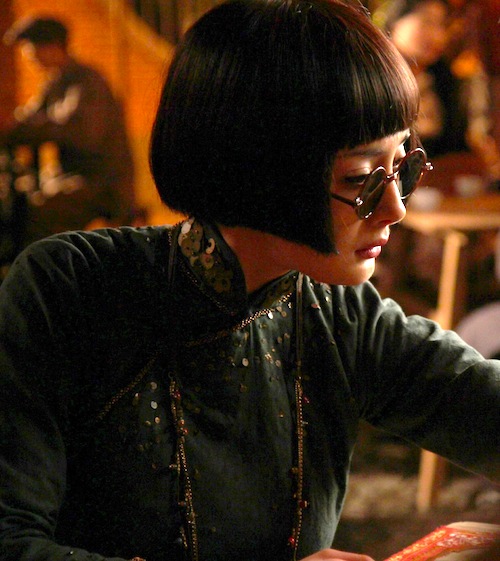
Mi Yang in "The Bullet Vanishes."

Though there are a lot of familiar Holmsian elements in Bullet, Lo and co-writer Yeung Sin-ling consistently give them a fresh spin. Perhaps most intriguing is Song’s ambiguous relationship with a convicted black widow murderess (played by a glammed down but terrific Jiang Yiyan), who could either be his Irene Adler or Hannibal Lecter. Determining which could be fertile ground for a sequel.

In fact, Bullet is pretty unusual for a big screen murder mystery, because it values atmosphere and procedural process (as antiquated as it might be by our standards) over formulaic chases and phony suspense. Viewers might have a general sense of where it is headed, but at least the film makes an effort to hold onto its secrets. There are still several well mounted period action sequences sprinkled throughout the film, but the overall vibe of Bullet is refreshingly cerebral.

With Song, Lau Ching-wan brings to life a great character. Yes, he is a bit socially awkward at times, but the detective is his own man, far more compassionate than Holmes ever was, particularly in his scenes with the mariticidal inmate. As the more action-oriented Gui, Nicholas Tse is in his element, also developing some nice romantic chemistry with Mi Yang’s Little Lark, the fortune teller. Together as cops with contrasting styles, Lau and Tse have an appealing give-and-take rapport going on. As for Boss Ding, the primary villain and focus of viewer scorn, Liu Kai-chi certainly is not shy chewing the scenery, vaguely suggesting elements of both the psycho and comedic Joe Pesci. That is not a bad thing.

From Chan Chi-ying’s stylish noir cinematography to Stanly Cheung’s natty 1930’s-era costumes, Bullet is a great looking film. It is also smart and old-fashioned in a good way. Recommended with enthusiasm for mainstream mystery fans, The Bullet Vanishes opens tomorrow (8/31) in New York at the AMC Empire and Village 7, as well as in San Francisco at the AMC Cupertino and Metreon, courtesy of China Lion Entertainment.

LFM GRADE: A-

Posted on August 30th, 2012 at 1:24pm.