The James Bond film Skyfall put a new production update (see above) on-line recently about the film’s shoot in Shanghai. The film’s publicity team has thus far been fairly good about keeping everyone updated on Skyfall‘s progress – without spoiling anything with too many details – so check out this new update above. Shanghai certainly looks exotic and exciting as a Bond location.
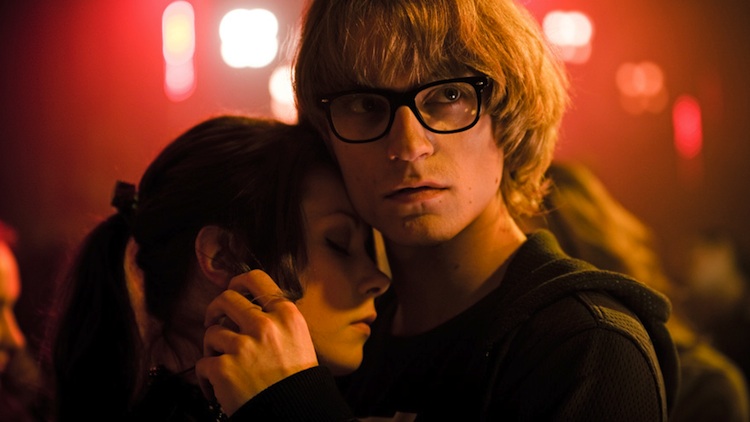
By Joe Bendel. Drawing evil vixens and costumed crime-fighters usually is not the best way of winning over high school girls. Unfortunately, Donald Clarke does not have long to figure that out. He is dying of leukemia, but has a few obvious teenager goals he would like to accomplish first in Ian Fitzgibbon’s Death of a Superhero, which screens at the 2012 Tribeca Film Festival.
Clarke is an understandably angry young man. If he was not socially awkward before, his bald head leads him to retreat further into himself. His only satisfaction comes from his comic art and his escalating graffiti escapades. Hoping to improve his state of mind, his well meaning parents take him to Dr. Adrian King, an art therapist who specializes in helping terminally ill patients come to terms with their mortality. Shrewdly, King does not try too hard to win Clarke’s confidence, thereby establishing a level of comfort between them. About the same time, Clarke meets a rather cute and rebellious transfer student he might actually stand a chance with, if he is not distracted by stupid high school pettiness.
Periodically, interludes of Heavy Metal-style animation provide a glimpse inside Clarke’s head, depicting his alter-ego battling The Glove, a Doctor Doom-like villain symbolizing his illness, and enduring the torments of the shapely Nurse Worsey, who embodies all his pent-up angst. Frankly, they are cool enough to give Superhero a genre appeal such material would not ordinarily hold. However, the third act may seem familiar to some viewers, following almost precisely the same narrative path as Ian Barnes’ Oscar nominated 2009 short film Wish 143. Since Anthony McCarten adapted Superhero from his own 2006 novel, you can assume whatever you will.
Thomas Brodie-Sangster is convincingly bitter and troubled as Clarke, but he has some nice chemistry with Aisling Loftus as his potential girlfriend. Taking a break from the motion-capture suits, Andy Serkis also demonstrates wise restraint as Dr. King, making this movie shrink exponentially easier to take than Robin Williams in Good Will Hunting.
It is hard to imagine a dying teenager film that refrains from heart-tugging manipulation, and Superhero is certainly no exception. Yet the retro noir animation gives it a real edge. That unique look and several well tempered performances help earn its inevitable big emotional crescendo. Surprisingly effective, Death of a Superhero screens during the 2012 Tribeca Film Festival next Friday (4/27), Saturday (4/28), and Sunday (4/29), with a regular theatrical release soon to follow.
New clips have been emerging for Battleship in recent days. This spoilerish clip features an enemy alien being examined/unmasked by a Navy crew, and this clip features Brooklyn Decker and Taylor Kitsch in a bar.
The behind-the-scenes clip above showcases Capt. (Ret.) Rick Hoffman’s involvement as the Navy’s advisor on Battleship, which included getting a cameo as Chairman of the Joint Chiefs of Staff. Not bad for a former Captain.
And speaking of Brooklyn Decker, she’s featured in the May edition of GQ, something that’s also worth looking at. Ahem.
Battleship has already made $58 million worldwide, and opens here in the U.S. on May 18th.
By Joe Bendel. Hardcore gamer Juri needs to get a life and some sun. He is starting to lose touch with those closest to him. Instead, he gets a double to help him play his most challenging game yet. This leads to complications in Petri Kotwica’s Rat King, which screens during the 2012 Tribeca Film Festival, now officially underway in festive New York City.
Juri does not even know what his two best friends look like. They are gaming buddies he met online. Unfortunately, after logging-off from their last first-person shooter outing, they have maintained an eerie internet silence, disturbing Juri to no end. Suddenly, Niki shows up in the flesh. Evidently his two comrades got involved with a game of a more ominous sort. Now their mutual pal is dead and Niki is in hiding. Yet, like the hopeless addict he is, Juri cannot resist logging on to the sinister program.
Niki agrees to help Juri navigate the game, in exchange for secretly sheltering him. Rather than a video game, it is more of an online RPG that demands Juri – or ‘Rat King,’ as he has been dubbed- to perform a series of real world tasks which quickly escalate into rather dangerous territory. Meanwhile, Niki takes Juri’s place in the offline life he has been ignoring. After all, one pale geeky high school student is as good as another, right?
Rat King cleverly plays on a lot of the fears and paranoia of the gamer subculture. It is also perfectly cast, co-starring Max Ovaska and Julius Lavonen, two well established young Finnish actors who really could pass for twins. However, it rashly barges into some treacherous ground when the plot turns toward a potential Columbine incident, inviting comparisons to films like Tetsuya Nakashima’s brilliant Confessions, but lacking comparable gravitas and power.
Still, Finnish thriller specialist Kowica skillfully pulls viewers into this noir world, insidiously building the tension. Ovaska and Lavonen are both quite good as the doppelganger-gamers, credibly looking and acting like high school kids that are a bit off.
It seems fitting that John Badham’s WarGames, the grandfather of all out of control online game movies, will also have a ticketed retrospective screening at this year’s Tribeca, because the two films would make an intriguing pairing. While not a classic, Rat King it is a solid meat-and-potatoes thriller executed with a fair degree of style. Recommended for gamers and those who frequently lose patience with them, Rat King screens again tomorrow (4/20) and the following Friday (4/27) as part of this year’s Tribeca Film Festival.
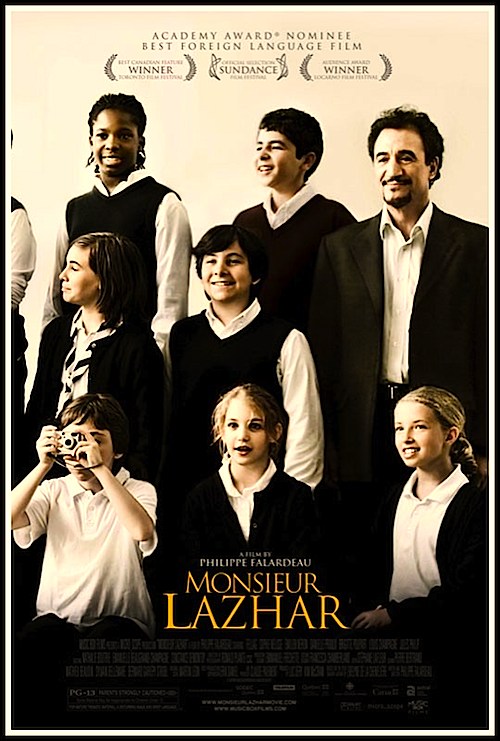
By Patricia Ducey. Oh, Canada! Every so often, out from beneath the ice and snow of our northern neighbor, emerges a film so en pointe that it seems intended for an American audience. Like The Barbarian Invasions, another French Canadian offering, with its stinging comparison of Canada’s health system to ours, Monsieur Lazhar takes on education — and the well meaning but destructive political correctness that apparently stultifies both our systems. But beyond the concerns of the day, Monsieur Lazhar resonates in the tradition of school teacher movies from The Children’s Hour to Stand and Deliver, embracing the light and dark tones of both – and is totally affecting, earning its many Canadian awards and nomination for the Academy’s Best Foreign Film Oscar.
Algerian-born comedian and humorist Mohamed Fellag stars as Bachir Lazhar, the substitute teacher in a Montreal grade school class that recently lost its beloved teacher Martine through suicide, a death seen as even more horrific because she hanged herself in the classroom where she knew the children would find her. The story opens as Lazhar, an asylum seeker from Algeria, interviews for a substitute teacher position with the school’s principal, Mme. Vaillancourt (Danielle Proulx). He has read about the teacher’s death in the paper and presents his CV to the harried principal.
She soon hires him and he begins his work with the bereaved class. First off, he is mystified by the classroom setup, where all the desks form little semi-circles to enhance the team approach to learning (to avoid any child being shamed by giving a wrong answer). He orders the desks rearranged in orderly rows. Each child is now an individual again, on his or her own – which awkward use of the personal pronoun brings me to Lazhar’s next problem. In a grammar lesson the children school him on the “new” system of pronouns they must use – pure edu-babble – to what end, he cannot fathom but he accedes. The school psychologist arrives, and chides him to leave the handling of grief that bubbles up unbidden from the children to her, as if this human and empathetic activity could not possibly be managed by a non-professional. Finally, a boy acts up in class, and Lazhar cuffs him lightly on the cheek. This is the straw that breaks the camel’s back, and the principal brings him in for a meeting, where she informs him of modern educational rules – among them, no touching of a child, ever — not even to put sunscreen on a child, as the gym teacher recounts.
But Bachir’s students thrive in the new, structured environment. More importantly, they trust the empathy that comes from his heart and from his experience. The adults, who are “freaking out” more than the kids, apply and misapply silly nostrums that ultimately make the kids feel worse. But his story and the kids’ grief are connected, and we learn more about the troubled boy Simon and his connection to the tragic Martine, and of Bachir and the reason that he is alone in Montreal. Suffice it to say that he and his family fell victim to another system that repressed and forbade certain kinds of speech and carried that diktat to calamitous ends. He knows all too well what lies at the end of this utopian vision, and eventually he must decide where he will draw the line. As they come together, both stories echo the themes of the movie, both personal and political.
Philippe Falardeau, who won the Canadian best director for this film – and deservedly so – suppresses any tendency towards cuteness or sentimentality, with a totally naturalistic look and feel of a wintry Montreal. His actors do not appear fussed over by stylists or makeup staff, and they seem to live and work in cluttered, lived in spaces. In addition, he wisely pulls back the dialogue and direction when histrionics or sappiness would have been easy, yet this subtle and understated style makes the eventual impact even more transcendent.
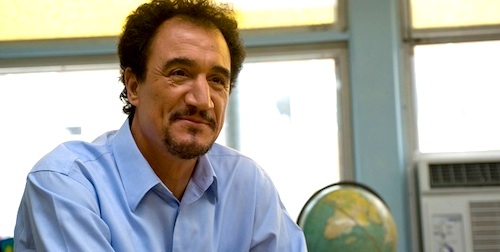
Mohamed Fellag as Bachir Lazhar.
Fellag is endearing, sometimes humorous, and conveys much emotion with the lift of an eyebrow. Sophie Nélisse as Alice and Émilien Néron as Simon, the children who discover the teacher’s body, rise to equal footing with Fellag and the other adults with performances so artful and natural that Falardeau and his young actors must be commended. (Here Falardeau talks with critic Dan Persons about the film, and gives what amounts to a master class in directing children. Hollywood directors, take a listen.)
The film does indeed honor the power of the student-teacher relationship, its power to heal and to inspire, but it also calls into question the folly of the authoritarian impulse that undergirds so much of education today. In the end, Bachir stands for humanism and, paradoxically perhaps, order. They hinge one upon the other – he knows that one child is not interchangeable with another, and that each child flourishes best in an atmosphere of basic order paired with open, honest communication. The movie ends fittingly with Bachir’s final act of defiance against the regime — a small act, but one perfectly in keeping with his larger lesson to the kids that “a classroom is a place of friendship, of work, of courtesy, a place of life.”
The viral marketing for Ridley Scott’s forthcoming Prometheus continues apace, today with this video advertising the new ‘David 8’ robot, as designed by the ‘Weyland Corporation’ (the company that sends out the crews in Prometheus and the Alien films) and as embodied by actor Michael Fassbender. Enjoy, or be creeped out, or both.
We all know a few people like this, yes? A lot of them work at Williams-Sonoma, for some reason.