By David Ross. Erik Mongrain’s “Air Tap” (see above) is a genuine benchmark of the modern guitar. The composition is perfect, the technique largely novel. Beyond the slightly uncharacteristic “Air Tap,” Mongrain’s music seems at first merely atmospheric in the Windham Hill tradition, but his compositions turn out to be aggressively intricate and even scholarly – as it were solutions to thorny riddles of musical theory. One realizes that Mongrain has fully departed from bop and rock histrionics in order to create a new mode on an entirely different basis of order, symmetry, and almost Asian apertures of silence. If Bach had played the koto, he might have sounded something like this. Mongrain’s two albums – Fates (2007) and Equilibrium (2008) – are as deceptively understated and precisely reflective as Ezra Pound’s “In a Station of the Metro” (1913):
The apparition of these faces in the crowd;
Petals on a wet black bough.
I would call Mongrain a link in the guitar’s fundamental evolution. He is, of all things, a Quebecois – see here for biographical details.
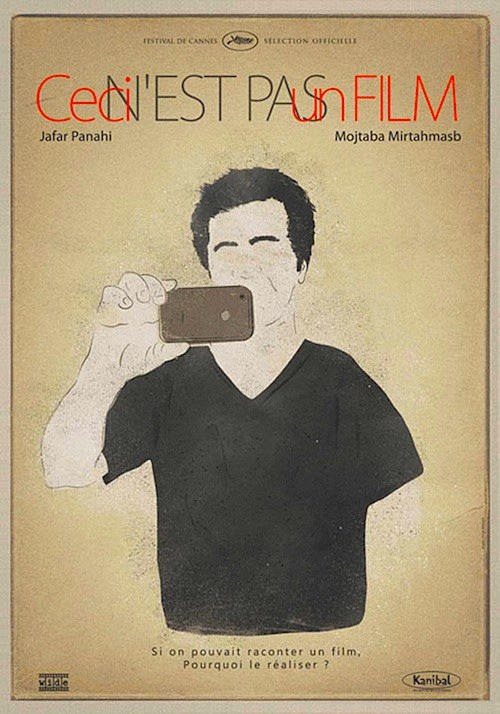
By Joe Bendel. Jafar Panahi will not be appearing at the 49th New York Film Festival. He was never expected. However, it was hoped Mojtaba Mirtahmasb would be able to promote his recent collaboration with Panahi on the international festival circuit. Ominously though, Mirtahmasb’s passport was confiscated just as he was leaving to attend Toronto and he was subsequently arrested, along with five other Iranian filmmakers. At least Mirtahmasb will have a good idea of what to expect. With Panahi, he co-directed This is Not a Film (trailer here), a documentary record of a day in life of the award winning filmmaker chafing under house arrest and a prospective twenty year ban on movie-making, which screens at this year’s NYFF.
For those unfamiliar with his story, Panahi and fellow filmmaker Mohammad Rasoulof were sentenced to six years in Iranian prison (a.k.a. Hell on Earth) and prohibited from practicing their art for two decades. With his appeal pending, Panahi is confined to his relatively upscale but not all that spacious Tehran flat on the eve of Persian New Year. Since he cannot make a film, he makes This is Not a Film, with the furtive assistance of Mirtahmasb, a digital video camera, and the odd handheld device.
Considering we are simply watching a man putter about his apartment (with Igi, the scene stealing pet iguana), Not a Film is surprisingly engaging. Even under extreme stress, Panahi is clearly a man of considerable wit and charm. We watch as he blocks out a film that might never be produced and listen as he cryptically discusses projects with Mirtahmasb in an effort to shield him from presumed eavesdroppers. These are the small, grimly fascinating day-to-day realities of artistic repression in Iran. Just in case any of the significance is lost on viewers, the blank closing credits ought to bring it all home.
Not a Film is a quiet film that resolutely avoids anything that might be deemed provocation. Frankly, the circumstances that gave rise to the not-film should never have happened. Yet, since it is here, in its way Not a Film is an inspiring example of the creative impulse as it flows like water through the cracks of an oppressive state. Indeed,it is already renowned as the film that was smuggled out of Iran in a cake.
To give credit where it is due, the international film festival network has done good work keeping attention focused on Panahi’s plight. The 2010 Cannes Film Festival pointedly reserved an empty chair for the filmmaker when he was not allowed to attend, even though he was chosen to serve on the jury. Earlier this year in New York, the Asia Society hosted a Panahi retrospective to further publicize his case. However, it is important to remember Rasoulof and now Mirtahmasb as well, who are also prisoners of artistic conscience, but might not have the same name recognition on the world stage. Highly recommended, Not a Film screens this Thursday (10/13) at Alice Tully Hall, as a Main Slate selection of the 2011 New York Film Festival.
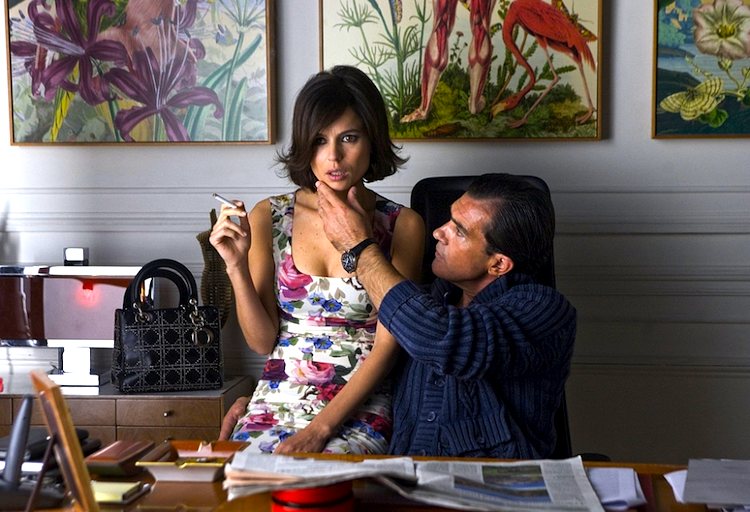
Elena Anaya & Antonio Banderas in "The Skin I Live In."
By Joe Bendel. Call it facial determinism. In Hiroshi Teshigahara’s Face of Another, a new “life-mask” countenance fundamentally alters the personality of a scarred businessman. With his latest film, Pedro Almodóvar addresses similar themes of appearance and identity, but dramatically raises the stakes for his experimental subject in The Skin I Live In (trailer here), which opens this Friday in New York, following Wednesday’s gala screening at the 49th New York Film Festival.
Dr. Robert Ledgard gave his mysterious “patient” Vera the face of his late wife, who was severely burned and disfigured in a fateful car crash. As a result, Marilia, his motherly housekeeper, worries the plastic surgeon is developing an unhealthy emotional attachment to his unwilling test-case. As flashbacks explain the chain of events that brought Vera to his isolated villa, we learn just how twisted their potential relationship would be.
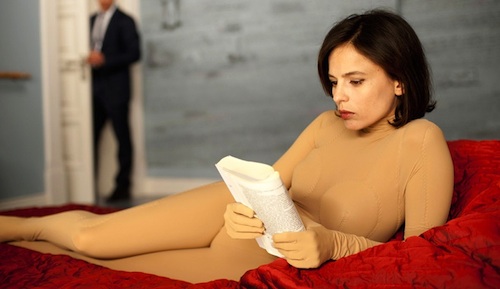
Elena Anaya as Vera.
Though billed as Almodóvar’s horror movie, Skin really constitutes a continuation of his noir-esque period begun with his previous film, the underappreciated Broken Embraces. Indeed, it is structured around a big twist, which makes it challenging to discuss its themes and motifs without getting spoilery. Frankly, just a few details are probably sufficient to give the game away. However, it is probably safe to say Ledgard nurses some serious grievances, while initial appearances are deliberately deceptive.
Though also undeniably restrained compared to the films that made Almodóvar’s reputation, Broken Embraces had a slow-burning undercurrent of dark passion. By contrast, Skin is a decidedly chilly film. Overtly voyeuristic, Almodóvar avoids delving beneath the surface of his characters, consciously concentrating his focus on the surface level instead. Still, he adeptly uses the Hitchcockian cinematic vocabulary as well as the claustrophobic setting to create a fairly creepy genre film.
Although he never truly unleashes his inner mad doctor, Antonio Banderas is certainly a severe presence as Dr. Ledgard. However, Elena Anaya is quite remarkable as the suicidal Vera, convincingly handling her character revelations, which are considerable. A tricky role to approach, she fully commits to it, providing the film’s only emotional center.
Skin is an intriguing film, but were it not for the vulnerability and immediacy of Anaya’s work, we would simply feel as though we were being played, rather than pulled inexorably into a dark morality drama. While the implications of Almodóvar’s screenplay (adapted from Thierry Jonquet’s novel Mygale), will stay with viewers, his execution will most likely leave them cold. A mixed bag, Skin is largely distinguished by Anaya’s performance. For Almodóvar fans, it screens twice this Wednesday (10/12) as a gala selection of the 2011 NYFF. Though only standby tickets are still available, it also opens theatrically this Friday (10/14) in New York at the Landmark Sunshine.
By Jason Apuzzo. •I had the chance recently to read the screenplay for The Thing, which opens next Friday, Oct. 14th. To sum up my reaction in a nutshell: I liked it, given that the film’s basic requirement is to serve as a direct prequel to John Carpenter’s 1982 thriller. I frankly would’ve preferred a totally new interpretation of the original story, instead of a prequelized version of Carpenter’s; be that as it may, my sense is that if you’re planning on seeing the film next Friday, and aren’t otherwise bothered by the new film’s lack of star-power – or the kind of intense, sci-fi gore associated with Carpenter’s original film – you’re likely to have a good time.
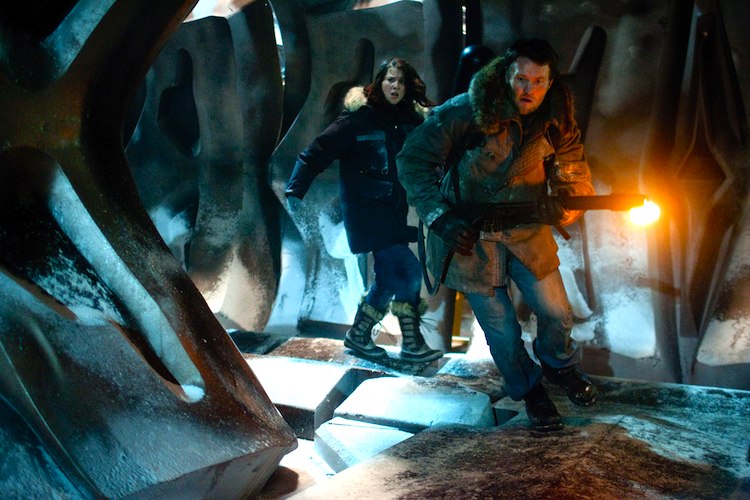
This new version of The Thing, which is set back in 1982, sweeps you into the story quickly and efficiently, introducing a variety of new, relatively low-key characters – including, most importantly, young paleonthologist Dr. Kate Lloyd (Mary Elizabeth Winstead) and helicopter pilot Sam Carter (Joel Edgerton) – who along with several others travel to the Norwegian ‘Thule’ research station in Antarctica, where a mysterious saucer … and an even more mysterious occupant of the saucer, frozen in ice … have been discovered by the Norwegian research team. If you’re familiar with the original Carpenter film, you already know what ends up happening to the Thule station, discovered by Kurt Russell in the original. If you don’t already know, I won’t spoil it for you – but suffice it to say that ‘things’ go badly, as it were.
This new, prequelized version of The Thing feels like it has a lot in common with Ridley Scott’s original Alien, in the sense that the story is built around a thoughtful young woman who keeps her wits about her while the rest of her team descends into hysteria, paranoia or is otherwise carved into pieces like so much whale blubber as the alien ‘thing’ slowly wreaks its havoc in the isolated station. Much as with Sigourney Weaver’s Ripley in Alien, Kate Lloyd here doesn’t really do very much or assert herself prominently until about halfway through the story – she simply keeps her eyes open, while others pursue their various agendas, largely blind to the danger in their midst. It should be a good role for Mary Elizabeth Winstead; I hope she makes the most of it. (Winstead talks about the parallels between her role and Weaver’s Alien role here.)
Truth be told, I’ve only recently become a fan of John Carpenter’s 1982 version of The Thing, which I went back and re-watched a short while back. Although the film is moody and atmospheric, with some nice performances from Kurt Russell and the supporting cast, I still strongly prefer Howard Hawks’ original – although it’s basically true that Carpenter’s film is more ‘faithful’ to the original conception of the morphing, imitative creature in John W. Campbell’s 1938 short story, “Who Goes There?” For my taste, Carpenter’s film gets a little lost in its gore and disgusting excess – losing its suspense every time we’re forced to watch the creature transform into some repulsive new hybrid of man and beast. Alas, expect more of this sort of thing in the new film – no doubt amped-up by digital technology.
What Carpenter’s film has going for it, however, is a genuine sense of terror and dread that has been lacking from a lot of sci-fi alien invasion films of late. So many of the current alien invasion projects (Battle: Los Angeles, the Transformers movies, Skyline, Falling Skies, Battleship, etc.) are basically sublimated war films of one kind or another. John W. Campbell’s original story, along with Carpenter’s telling of it, introduce the much more terrifying notion that an alien might be right beside you – a shape-shifter, ready to destroy and/or assimilate you on a moment’s notice. This new version of The Thing re-awakens the primal fear associated with not trusting someone, that creeping sense that the person next to you might not even be fully human – an eerie, paranoid notion that is actually what much of 1930s and 1950s sci-fi was based on.
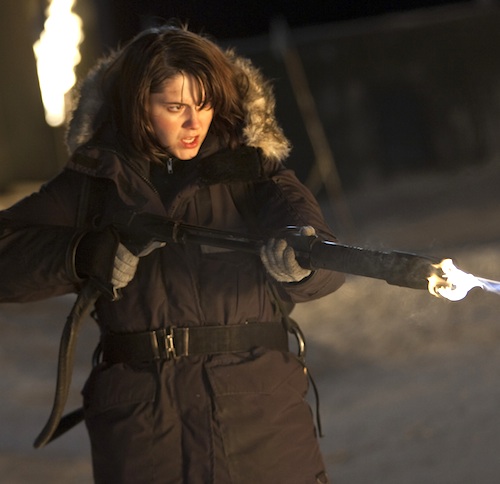
Can she deliver? Mary Elizabeth Winstead in "The Thing."
So what should you expect, in terms of what will be different about this film in comparison to the original? Truth be told, relatively little – with just a few exceptions, as the new film’s screenplay really does fit Carpenter’s film like a glove. (Incidentally, it’s cool to read a screenplay that says: “Cue Morricone’s score.”) On the positive side, and without spoiling too much, something’s that’s been unexploited by the two previous versions of The Thing (1951 and 1982, respectively) has been the saucer by which the creature arrives. Expect to spend more time around and also inside the saucer in this new version; what happens there is intriguing and suspenseful. On the neutral side, the ‘test’ for determining whether someone is really human or not is clever – but doesn’t necessarily provide as suspenseful a moment as there was in the Carpenter version. On the negative side, I thought that this new Thing screenplay really lacked something that both the Carpenter and (superior) Howard Hawks versions had: crackling humor. This new Thing is a very sober, straight-forward, dour-‘Norwegian’ telling of the story – a telling that really needed the kind of humor you get from having a group of wise-cracking American characters around. Humor is a great way to relieve fear and tension, and I’m concerned that this new film will be lacking it.
• Speaking of Alien and alien-related prequels, there’s been a lot of chatter recently about Ridley Scott’s Prometheus, although none of it as exciting as the leaking in August of images from the film’s Comic-Con showreel. I’ve seen those images, by the way, and would love to post them here – but I’m not eager to be contacted by Twentieth Century Fox lawyers about it, so you’ll just have to go someplace like here to see at least a few of them. In any case, what these images reveal are two things: 1) the film already is looking extraordinary in terms of its dark, retro-design, really pulling you back into the murky, claustrophobic world of the original film; 2) Prometheus is quite obviously an Alien-prequel, Sir Ridley’s coy assertions aside. This is really looking like a film not to miss next summer.
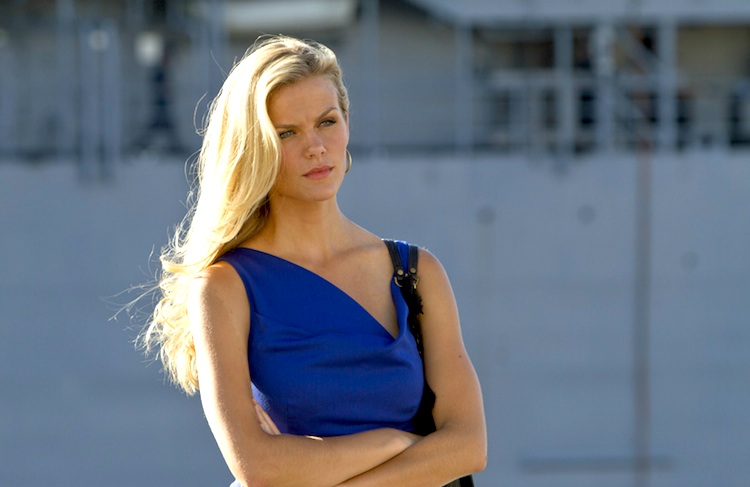
• Entertainment Tonight recently did a cheerful little behind-the-scenes feature on Battleship, which you should make sure to see. Much as with the Hasbro-Michael Bay Transformers, it looks like director Peter Berg received a lot of assistance from the military on this film, and Berg otherwise talks about working on the film here. We also now have the first official photo of Rihanna appearing in the film, cast members Alexander Skarsgard and Hamish Linklater are out talking about Battleship … and, of course, most importantly, we finally have the first official photo of Brooklyn Decker in the film (see below). She’s looking a little frosty.
Brooklyn Decker glares at her fiancé in "Battleship."
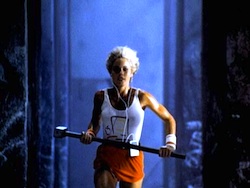
By Jason Apuzzo. As a brief tribute to Steve Jobs and his remarkable legacy, I thought we’d take a look back at Apple’s famous 1984 ad introducing the Macintosh, an ad directed by Ridley Scott. It was this ad, run only once – during 1984’s Super Bowl – that introduced the Macintosh to the world.
The ad is, of course, a succinct and marvelously effective little riff on George Orwell’s original 1984 – although somehow I don’t remember any busty blonde athletes in that novel, do you? (Jobs & Co. really knew how to sell.)
In any case, enjoy it, reminisce, and perhaps even learn something from it. The ad very much captures Jobs’ innovative spirit, which we’ll certainly miss.
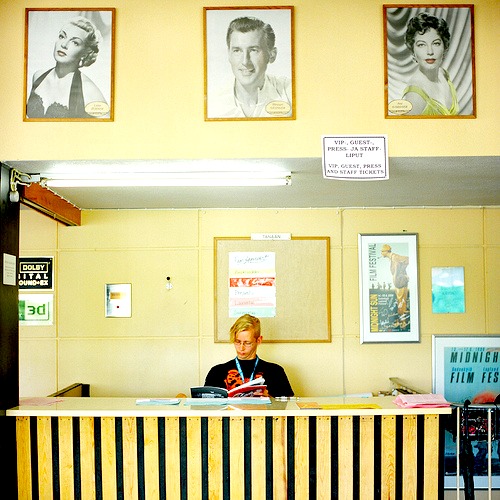
By Joe Bendel. A film festival must be pretty secure in itself to program a four and a half hour documentary tribute to another festival. Such is the case with the 49th New York Film Festival. Though not exactly an international launching pad, like Toronto or Cannes, the Midnight Sun Film Festival in Sodankylä, Finland has drawn some of the most admired names in the history of cinema. Festival director Peter von Bagh interviewed many of them on-stage, eventually editing some of their most provocative recollections and insights into the four part documentary, Sodankylä Forever, which has a special two-night screening at this year’s NYFF.
Held in June when the Midsummer sun never sets, the festival might be patrons only opportunity for a brief respite of darkness. However, each day’s line-up begins with an in-depth discussion with a prominent filmmaker. In a way, von Bagh’s Sodankylä is particularly timely and appropriate for this year’s NYFF, because it includes several excerpts of interviews with Iranian filmmaker Jafar Panahi, who obviously will not have the opportunity to participate in Q&A sessions after the screening of his latest film, This Is Not a Film.
Indeed, many world class auteurs sat down with von Bagh, including Wim Wenders and Roger Corman, who are also represented at NYFF, as filmmaker and subject, respectively. Yet, for pure movie fans, the highlight of Sodankylä will be hearing Empire Strikes Back director Irvin Kershner discus his initial reaction to a sneak peak at Star Wars (or A New Hope as we are now supposed to call it).
Arguably though, the best material comes from filmmakers who labored under the yoke of Communism. Most notably, Krzysztof Zanussi pointedly criticizes the festival’s special screening of Eisenstein’s Battleship Potemkin, explaining how the ideology it sought to promote caused such profound pain for his country. By the same token, von Bagh deserves credit for putting his comments into the film.
Although an entire segment is essentially devoted to picking desert island films, most of Sodankylä proceeds in a rather idiosyncratic fashion. Von Bagh frequently uses something an interview subject said (or almost nearly said) as a transitional hook into the next auteur, like a game of free association featuring the likes of Sam Fuller, Miloš Forman, Abbas Kiarostami, Claude Chabrol, Jacques Demy, Andrei Konchalovsky, Jerzy Skolimoski (who probably has the best one-liner), and John Boorman (who probably offers the funniest anecdotes).
It is important audiences understand Sodankylä is not That’s Entertainment. Throughout the film, the only film clips von Bagh shows are part of wider audience shots. However, (aside from some rather superficial axe-grinding from John Sayles) the collected reminiscences and commentary are all quite perceptive and engaging. One of the more ambitious screening events at the 49th New York Film Festival, Sodankylä is respectfully recommended for earnest students of cinema. It screens in two installments this coming Tuesday (10/11) and Wednesday (10/12) at the Francesca Beale Theater.
 By David Ross. Erik Mongrain’s “Air Tap” (see above) is a genuine benchmark of the modern guitar. The composition is perfect, the technique largely novel. Beyond the slightly uncharacteristic “Air Tap,” Mongrain’s music seems at first merely atmospheric in the Windham Hill tradition, but his compositions turn out to be aggressively intricate and even scholarly – as it were solutions to thorny riddles of musical theory. One realizes that Mongrain has fully departed from bop and rock histrionics in order to create a new mode on an entirely different basis of order, symmetry, and almost Asian apertures of silence. If Bach had played the koto, he might have sounded something like this. Mongrain’s two albums – Fates (2007) and Equilibrium (2008) – are as deceptively understated and precisely reflective as Ezra Pound’s “In a Station of the Metro” (1913):