Libertas Update + Mini-Invasion Alert!: Reaction to Falling Skies, Super 8, Green Lantern

By Jason Apuzzo. Last week was extremely busy for me on non-Libertas fronts, and as a secondary matter I also happened to bust up one of my shoulders (no worries; it’s on the mend), making it a little difficult to write – so LFM was quiet for most of last week.

I wanted readers to know, however, that I was not completely AWOL while Earth was being invaded.

I’m referring here, of course to the alien invasions depicted in Green Lantern, Super 8 and the premiere of TNT’s Falling Skies – all of which I made sure to see. And although it would take a prohibitive amount of time and effort at this point to write full reviews of each project, I wanted to at least provide some brief reactions:

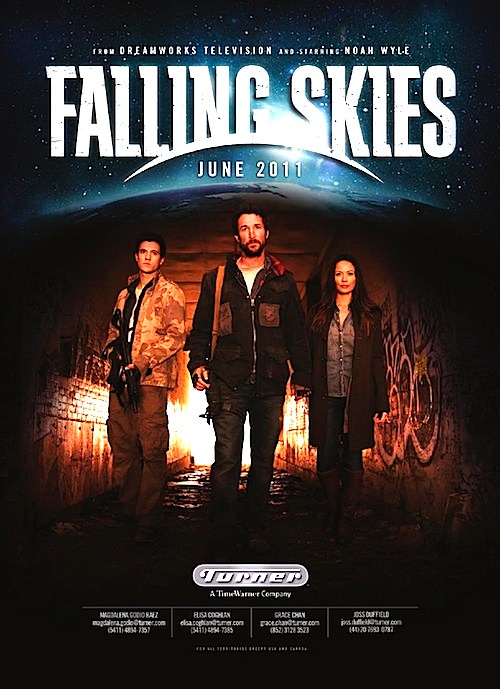
• The Steven Spielberg/Robert Rodat alien invasion series Falling Skies had a very big cable debut on TNT Sunday night, pulling in an estimated 5.9 million viewers. To put that figure in perspective, there’s not a single show on Fox News that comes even close to that sort of audience size.

The question is whether Falling Skies will keep that large audience – because although I generally liked what I saw of Falling Skies, and would’ve loved it if I was still back in high school (with the show’s Aliens-meets-Red Dawn vibe) … in 2011 I wasn’t deeply impressed with it. Indeed, I would say the show seemed inferior in many respects to ABC’s similarly-themed V series that just got cancelled after its second season.

Until the second half of Sunday’s Falling Skies premiere, I was generally finding the show dreary, humorless, and lacking in either pizazz, strong characters or imagination. Everything about the show was seeming like a re-hash of other, stronger projects – like Spielberg’s own War of the Worlds, or Robert Heinlein’s The Puppet Masters. Noah Wyle was seeming wimpy, and I wasn’t enjoying Will Patton’s turn as the megalomaniacal Desert Storm vet.

Things picked up in the second half of the show, however, with the introduction of some colorful characters – specifically Colin Cunningham playing the post-apocalyptic renegade-outlaw-dude-with-stringy-hair John Pope, and Sarah Carter playing the bad-ass killer blonde Margaret. Finally the show started to click, gain an edge, and I was interested. Suddenly I was finding Noah Wyle engaging and sympathetic. Suddenly I noticed that Will Patton’s character, although unsympathetic and a caricature, was consistently being proven right in how he dealt with the alien menace. I was also liking the fact that the great Dale Dye was in the show. And suddenly I was digging the murky, close-quarters combat with the aliens, and the show’s implicit, Battle: Los Angeles-style endorsement of martial virtues.

I also think Spielberg & Co. are shrewd to not tip their hand early as to the aliens’ intentions. V occasionally seemed convoluted and over-plotted, while Falling Skies seems much simpler – though perhaps not as fun. In any case, I will continue to follow the series and see how it develops … Continue reading Libertas Update + Mini-Invasion Alert!: Reaction to Falling Skies, Super 8, Green Lantern

Brit Sci-Fi Invasion: LFM Reviews The BBC’s Outcasts

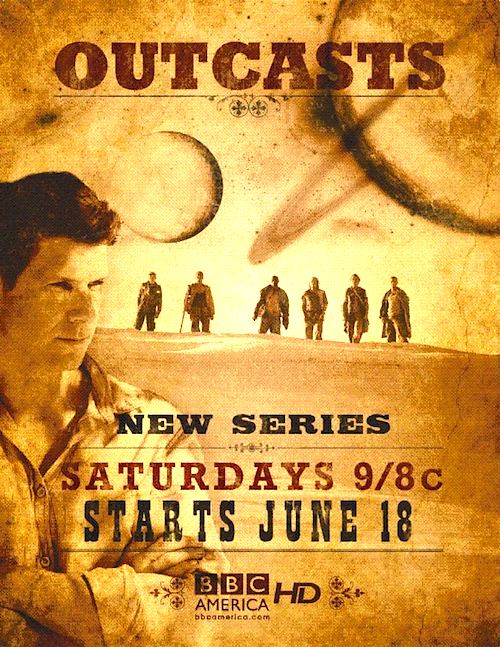
By Joe Bendel. Life on Earth has become untenable. It is not so much environmental conditions, per se, but man’s own inhumanity towards man that is destroying the planet. With drug cartels taking over Europe and Chinese militarism running unchecked, war is the only terrestrial constant. As a result, many have evacuated in giant space arks. Those lucky enough will find refuge on the planet Carpathia (named for the ship that stopped to rescue Titanic survivors). However, the colonists of Forthaven will find their new home is not exactly an Eden in Outcasts, a new eight-episode science fiction series that premiered on BBC America this past Saturday.

Though still a relatively young community, Forthaven already has a tragic history. During its early years, a mystery disease called C-23 nearly wiped out all of its children. The steps President Richard Tate took to deal with the disease will haunt the geneticist turned political leader in future episodes. With post-C-23 birthrates perilously low, the arrival of a new ship from Earth is understandably big news. Forthaven needs to replenish its future generations. Bringing down the transport safely is Tate’s highest priority, but a domestic incident will have macro implications for the colony.

Viewers quickly learn Carpathia’s dirty laundry. Tate had initiated and then canceled an ambitious genetic engineering program to create cloned humans, or “Advanced Cultivars” (AC’s). Presumed dead, those AC’s now live a nomadic existence outside Forthaven, which they most definitely hold a grudge against.

After a strong start, episodes three and four get somewhat bogged down with the dour ethical implications of the AC program. Fortunately, Outcasts rebounds thereafter (no sense crying over spliced genes), as the nefarious Julius Berger, a prominent survivor of the transport ship (and both a New Agey religious zealot as well as a moral relativist), plots a coup d’état against Tate. Series creator Ben Richards establishes a suitable environment for intrigue, with the PAS officers (the cops in charge of internal security) remaining loyal to Tate, while the XP’s (the military Expenditionaries) are inclined to side with Berger. As if Tate did not have enough to worry about, he also learns in dramatic fashion there is a reason the Carpathia’s indigenous hominid life forms died out eons ago. As they say in science fiction, they are not alone.

Richard Tate is a great sci-fi character and the key reason why Outsiders works so well. Initially he appears to be a commanding humanitarian in the Jean-Luc Picard vein. Yet Tate is a darker, more complicated figure. Profoundly touched by tragedy, he is still able to make hard decisions and sleep relatively well at night. Character actor Liam Cunningham has the perfect hard-nosed gravitas for the part, as well as the sonorous voice that plays so prominent a role in episode one.

From the BBC's "Outcasts."

In a bit of a misfire, Hermoine Norris plays PAS chief Stella Isen, Tate’s closest ally, with frosty reserve – much like her character Carol Jordan in Wire in the Blood. That worked much better playing off the manic squirreliness of Dr. Tony Hill than the steely resolve of Tate. Conversely, Amy Manson and Daniel Mays are rather engaging as Fleur Morgan and Cass Cromwell, respectively, our primary POV PAS agents, who harbor a Tracey & Hepburn attraction to each other – but are also burdened with secret pasts.

Though the special effects of Outcasts are eminently presentable, the series is more concerned with social speculation and character development. Sadly, it appears that the first eight episodes are all we are getting, at least for the time being. While the conclusion offers a measure of satisfaction, it provides little closure, leaving Forthaven poised on the brink of a multi-front war for survival. Indeed, one could easily envision the story continuing in a hard-driving action film. It is worth hoping for. Indeed, Outcasts is one of the better conceived and executed science fiction series featuring a genuinely compelling lead protagonist. It is recommended for all sf fans and Anglophiles, and it debuted this past Saturday on BBC America.

Posted on June 20th, 2011 at 3:03pm.

Exposing a Cult of Personality: LFM Reviews Shadow of the Holy Book

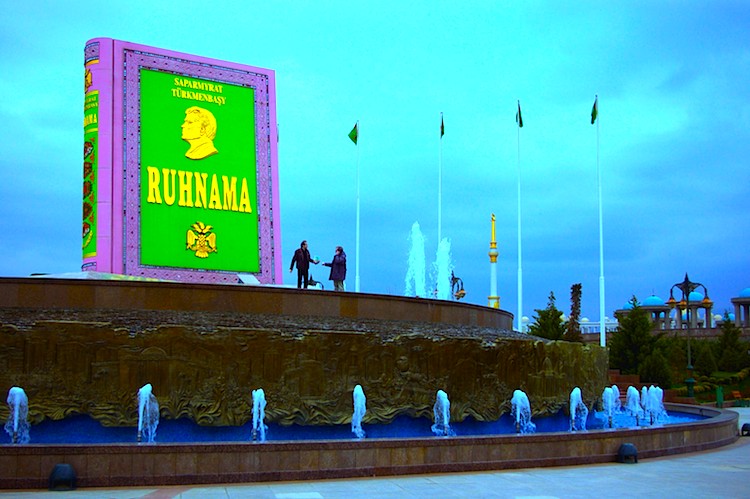
By Joe Bendel. Imagine an Islamist police state ruled by Dianetics. That is basically the state of what passes for reality in Turkmenistan. They also have obscene oil and natural gas deposits. As a result, a lot of people who should know better have feigned interest in the Ruhnama, a book supposedly written by the largely illiterate president-for-life Saparmurat Niyazov that co-opted elements of Islam for the sake of his personality cult. Director Arto Halonen (the quiet one) and co-writer Kevin Frazier (the gabby one) try to ask some of Niyazov’s international enablers why they think the Ruhnama is so swell in their would-be muckraking documentary Shadow of the Holy Book, which screened last night as part of DocPoint’s tenth anniversary celebration tour of New York.

Appointed by Gorbachev as Turkmenistan’s Communist Party strongman, Niyazov was a hardliner who supported the 1991 coup attempt against his patron. Indeed, Niyazov’s dictatorship incorporated the worst elements of Communism, Fascism, Islamist extremism, and flat-out lunacy. Yet Halonen and Frazier largely ignore the ideological roots of Ruhnamania for inexplicable reasons (though perhaps that picture of Castro in their office is a clue).

When Shadow documents the institutionalized insanity of Niyazov’s Turkmenistan, it is jaw-droppingly scary. Subjects like algebra and physics were banned from schools, in favor of greater Ruhnama study. Architectural behemoths combining Fascist pomp, Islamic symbolism, and what can only be described as kitsch have been erected to glorify the crackpot tome. There is even a gargantuan book with pages that actually turn.

Continue reading Exposing a Cult of Personality: LFM Reviews Shadow of the Holy Book

Venture Capital & The Origins of Silicon Valley: LFM Reviews Something Ventured

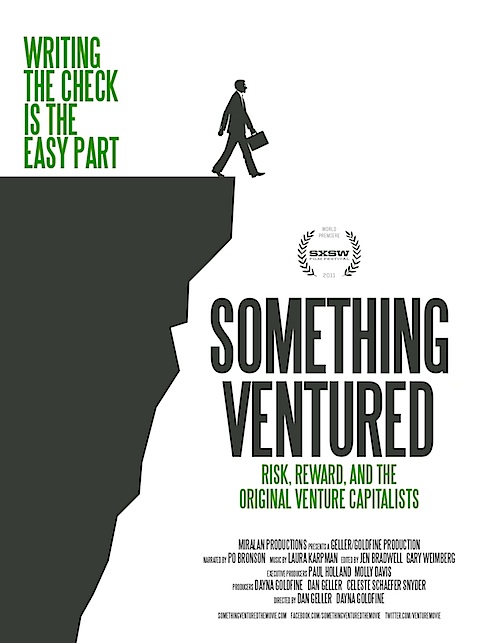
By Patricia Ducey. In 1957, a group of eight California engineers, unhappy at their jobs at Shockley Semiconductors, decided to leave en masse for more compatible environs and wrote to a Wall Street banker for help in finding just the right employer. That banker, Arthur Rock, saw other possibilities and flew out West to convince them to start their own company. He would provide the capital, they would provide the scientific know-how. Later dubbed “The Traitorous Eight” by Shockley, they had to ask Rock what venture capital was and why they would want to start their own company, but they acceded. Rock and his investor and engineers then formed their entirely new company, Fairchild Semiconductors—and Silicon Valley was born.

The new documentary Something Ventured tells their story and numerous others; and it’s as sparkling, sweet—and potent—as a champagne cocktail.  Something Ventured is also an unapologetic paean to capitalism, dispensing a much needed corrective to the current cries of “Tax the Rich,” “At some point you’ve made enough money” or “Off with their heads!” All right, I made up that last one, but you get my point.

Producers Paul Holland (a partner himself at a venture firm) and Molly Davis chose Emmy-award winning filmmakers Dan Geller and Dayna Goldfine to helm the film. The able duo mix pop music, priceless old footage and facts and figures with interviews of the now octogenarian money men who funded the future. Holland, and many of the people in the film, aim to inspire a new generation of entrepreneurs—and, perhaps, to gently encourage our government and media to consider the upside of capitalism for once.

But the filmmakers include the downside of the high risk atmosphere of startups, too. The investors note that about half of the original founders of startups are replaced within 18 months of a new corporate structure. Sandy Lerner, a founder of Cisco, recalls painfully how she was fired from the company she loved by the new owner/managers (and how many times has Steve Jobs been fired?), while Tom Perkins and Pitch Johnson recall a few of the inventions that turned out to be duds and companies (termed “the living dead”) that never took off.

If at times the film feels like a storytelling session with the boys at the coffee shop, that’s because it started out that way. Linda Yates, Holland’s wife, introduced him to the semi-retired investors, and he enjoyed their stories so much he decided to share them. These are men of good humor, optimism and ambition and clearly relish their role as facilitators to the innovators they met along the way. They insist that the entrepreneurs of Apple and Genentech, Cisco and numerous others of their startups, are the real heroes. Their own passion is to create and grow businesses where no business existed before, and they still are spreading the good news today – in their typically larger-than-life fashion. (Pitch Johnson, for one, jumped in his private plane one day in 1970 and flew to Cuba to convince Fidel Castro of the superior benefits of capitalism. No word yet on Castro’s response.) Continue reading Venture Capital & The Origins of Silicon Valley: LFM Reviews Something Ventured

The Soviet War against Finland II: LFM Reviews War Children

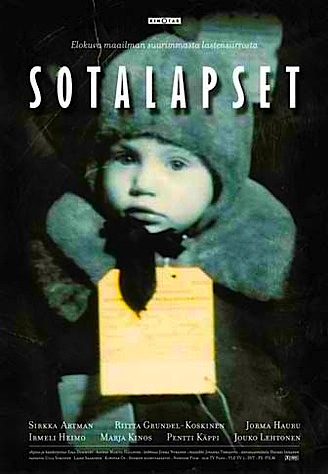
By Joe Bendel. It was a scene somewhat reminiscent of the kindertransport, the World Jewish Relief’s coordinated effort to relocate Jewish children in British foster homes. Yet these were Finnish children, packed off to Swedish host families, in advance of the invading Soviet would-be conquerors. Decades later, several of the surviving relocated youngsters record their experiences for posterity in Erja Dammert’s documentary War Children, which screens today as part of DocPoint’s tenth anniversary celebration in New York.

It is a testament to the Finnish people that they were able to withstand the forces of Soviet domination. In 1939, though, Finland’s future as a free and democratic country was far from certain. For their own safety, scores of Finnish parents sent their sons and daughters off to temporary refuge in ever-neutral Sweden. Such painful decisions are difficult to explain to children, though. Evidently, in several cases they did not even try, simply packing up their sleeping young ones and depositing them on outbound trains.

Not surprisingly, the young Finns typically experienced difficult transition periods, particularly since few if any of the children spoke Swedish. Yet, eventually many acclimated quite well to their hosts’ higher standards of living. Naturally, they also formed emotional bonds with their foster parents. Indeed, for many of the younger children, their Swedish surrogates largely supplanted the memories of their legal Finnish parents.

Though not as elegantly crafted as the thematically related Y in Vyborg, War Children is unfailingly sensitive and respectful in its approach to its subject matter. Broadway patrons will also notice certain parallels between the former Finnish refugee children’s stories and The People in the Picture, Donna Murphy’s new musical running through June 19th at the Roundabout’s Studio 54 Theater. Of course, it is important to stress that the Finns were not facing the same genocidal threat as European Jewry, but rather the everyday indiscriminate brutality of the Soviets.

DocPoint features a diverse slate, but some of its best selections open an intimate window into Finland’s unique WWII experience, hitherto largely overlooked by American media and scholarship. Indeed, War Children is a very strong film, while Vyborg is even more so. Both are definitely recommended during DocPoint’s 2011 New York tour. War Children screens today (6/11) at Scandinavia House.

Posted on June 11th, 2011 at 9:22am.

The Cold War as Fashion Statement: LFM Reviews X-Men: First Class

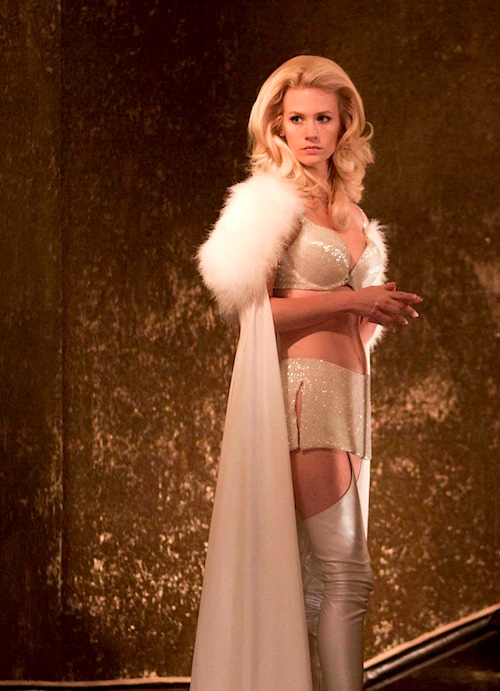
She wears it well: January Jones as Emma Frost.

By Jason Apuzzo. I tend to approach comic book movies like someone working on a bomb-disposal squad: I dutifully suit up, say a fond farewell to my wife, head to the theater and pray nothing explodes in my face.

So for several months I’ve been eyeing X-Men: First Class, the latest entry in a franchise I’ve not generally liked, in hopes that this stylish-looking film – which mixes 60s spy chic, Cold War nostalgia and January Jones in a gravity-defying bustier – in hopes that the film would revive or at least agitate my interest in comic book fare.

Alas, it didn’t.

That’s not to say that X-Men: First Class doesn’t have its moments, or that the film isn’t entertaining.  A film that riffs so freely and enthusiastically off James Bond films (of the Connery vintage), 60s go-go/mod culture, The Avengers, Cold War military thrillers like Ice Station Zebra, and even Dean Martin’s cheeky Matt Helm movies can’t be all bad, right? No, it certainly can’t – and X-Men: First Class is a diverting, two-hour plus voyage back into the Kennedy era, a period in which the West seemed a bit more self-confident, stylish and cohesive than it does today.

But First Class is a voyage that carries so much baggage with it – so much 2-cent teen psychology, so many embarrassingly campy characters (Beast, Banshee, and some chick who flies around like Tinkerbell with exploding saliva), and so much equivocating about the relative moral weight of America and the Soviet Union, that I’m unable to say I really enjoyed it.

And that’s a shame. You really have to work to make me not like a film of this kind. You have to do things like: suggest that America’s military establishment (along with the Soviets’) during the Kennedy era was being manipulated by a sadistic ex-Nazi … who likes to quote lines (of the “for us or against us” variety) from George W. Bush. You have to depict the CIA and America’s military high command as bumbling and incompetent at best, corrupt and ruthlessly exploitative of innocent peoples’ lives at worst.

You also have to give Kevin Bacon a major starring role. Do we still need that in 2011? I thought the 1980s had taught us better.

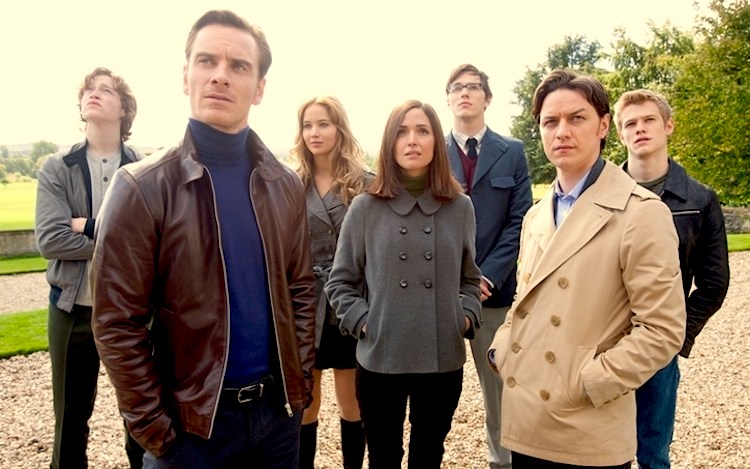
Everybody wears great jackets ... but what's Jennifer Lawrence staring at?

X-Men: First Class is the fifth film to mine the seemingly inexhaustible lore of the original X-Men comic book series, and it’s a film that has taken the unusual step of going all the way back to the series’ origins in the early 1960s – bravely eschewing Hollywood’s fear of losing teen audiences in period detail. It’s so easy to imagine the Fox executives to whom this film was pitched nervously asking, “Will teenagers know who the hell Kennedy was? Will we have to explain to them who the Soviets were, and why they were the bad guys? Does anybody still remember that Nazis fled to Argentina?” We tend to forget that the younger generation nowadays isn’t taught any of this stuff, and so can’t be counted on to have the same emotional response to the sight of, say, a May Day military parade in Moscow. For this reason, I applaud the makers of this film – and Brit director Matthew Vaughn, in particular – for having the ‘courage,’ if that’s the right term, to ignore conventional wisdom and trust that the glamour and romance of early 60s Cold War culture would shine through. It did. Continue reading The Cold War as Fashion Statement: LFM Reviews X-Men: First Class