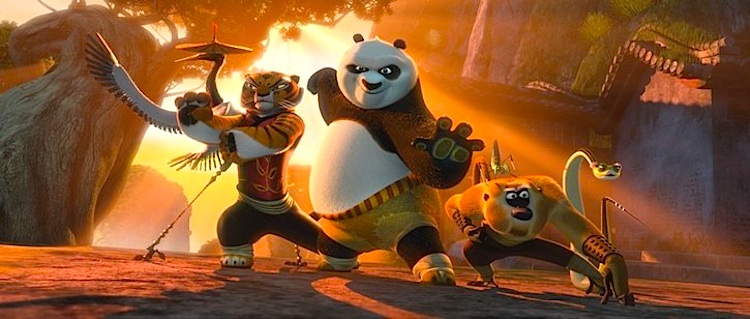
By David Ross. THE PITCH: The Kung Fu Panda is back and bulkier than ever: a blubbery accident in progress, though with some genuine kung fu mojo beginning to control the belly-led momentum that is his comic signature. Po’s antagonist is a Napoleonic peacock who plans to conquer China with the help of a fiendish new invention: canon. So it’s bear vs. bird, with the Middle Kingdom hanging in the balance.
THE SKINNY: The first KFP grossed $630,000,000 worldwide, and DreamWorks naturally declined to fiddle with a lucrative formula. The formula is entertaining enough, and nobody is likely to grumble.
WHAT WORKS:
• Pilferings from Jackie Chan. KFP II is basically a non-stop action sequence that makes hay with props and spaces in the classic Chan mode, and of course Po is a version of Chan in his semi-comic, semi-bumbling guise. Chan himself plays Master Monkey and presumably broke no bones in the process. Kids will love this mid-air mayhem, though parents may worry that the sequel is going to be called Visit to the Emergency Room.
• Pilferings from Zhang Yimou. Even more than the first film, KFP II richly imagines the look of ancient China. For kids, this orgy of Orientalism – gold-fretted pagodas, dragon-carved junks, mist-shrouded mountain pavilions – is bound to be a wonderment.
• Dustin Hoffman’s Master Shifu is a funny little addition to the Yoda lineage, a version of Chief Inspector Dreyfus driven crazy by an ursine Clouseau. Perhaps Shifu will develop a nervous tic in KFP III. Incidentally, my Taiwanese wife says that “Shifu” means “master,” so to call the character “Master Shifu” – “Master Master” – is pretty dumb.
• Angelina Jolie transcends her Tony-the-Tiger suit and ekes out a genuinely sexy performance, her throaty growl picking up where her curves leave off. Her sex appeal is inextinguishable, a constantly conserved force that shifts and inevitably manifests itself.
• The film naturally assumes that ordnance is evil, but it keeps the distracting and irrelevant sermonizing in check. The film is not the tiresome referendum on guns that it might have become. Continue reading LFM Mini-Review: Kung Fu Panda 2
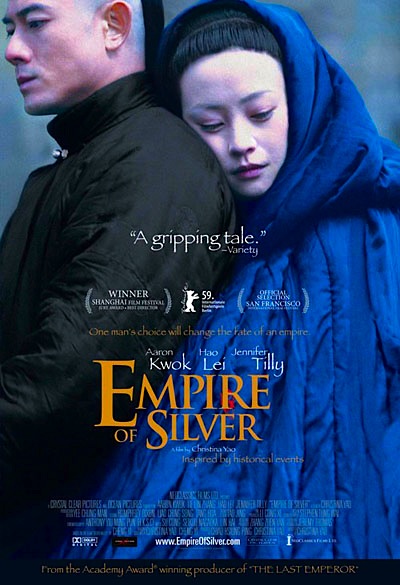
By Joe Bendel. Initially, the late Qing Dynasty’s new paper money is an economic boon, especially helpful facilitating transactions for the lower classes. Unfortunately, when the people come to suspect it is not fully backed by silver, it leads to bank runs. This is an ominous development for Lord Kang’s financial dynasty. Yet he will face even greater tribulations within his own family in Christina Yao’s Empire of Silver, which opens tomorrow in New York.
In 1899, the “piaohao” bankers of Shanxi were like Tom Wolfe’s “Masters of the Universe.” Lord Kang, or “Old Master” as he is often called, assumed four sons would be sufficient to ensure a safe line of succession for his venerable banking company. Of course, as a pious Buddhist deaf-mute, “First Master” never really counted. Unfortunately, when the Second and Fourth Masters are undone by calamity partly of his own making, old Kang is left with the dissolute playboy Third Master. Still, he is probably the most talented of the lot, but he has heretofore squandered his life out of resentment for his father’s Machiavellian management of family affairs. This is Third’s time to chart his ascendance, but it remains unclear whether he wishes to assume the mantle of leadership.
Needless to say, Old and Third Masters have very different management philosophies. However, his relationship to his young stepmother is even more strained. Quickly we come to understand Third and his former teacher had quite a bit of history before she became Madame Kang, which obviously explains much.
Silver is a big historical melodrama, but there is only a spot of actual fighting here and there. Still, the costumes, sets, and sweeping vistas are worthy of epics like Hero and Red Cliff. Jeremy Thomas, the producer of ambitious films like The Last Emperor, Little Buddha, and Merry Christmas Mr. Lawrence, served as executive producer, lending Silver further prestige.
While Silver is indeed a finely crafted period production, Aaron Kwok is surprisingly flat as Third Master. Yes, his character is emotionally damaged, but at some point we should see some signs of life percolating. Still, Hao Lei largely compensates as Madame Kang with her exquisite expressiveness. Frankly it is just nice to see her working, considering she appeared in Lou Ye’s bold Tiananmen Square drama Summer Palace, which was duly banned by the Communist authorities. Silver also boasts a number of rich supporting performances, particularly Ding Zhi Cheng and Lei Zhen Yu as two rival branch managers – one talented but dangerously independent, while the other is deemed controllable by virtue of his mediocrity.
Yao revels in the classical tragedy of her story, but she periodically offers up shrewd nuggets of insight as well. It is intriguing to look at a proud family and their celebrated house of finance – increasingly destabilized by China’s mounting anarchy – but it might well be too restrained and respectable for fanboys. An engaging feature directorial debut for Yao (if not a perfect star vehicle for Kwok), Silver opens today (6/3) in New York at the AMC Empire and AMC Village 7.
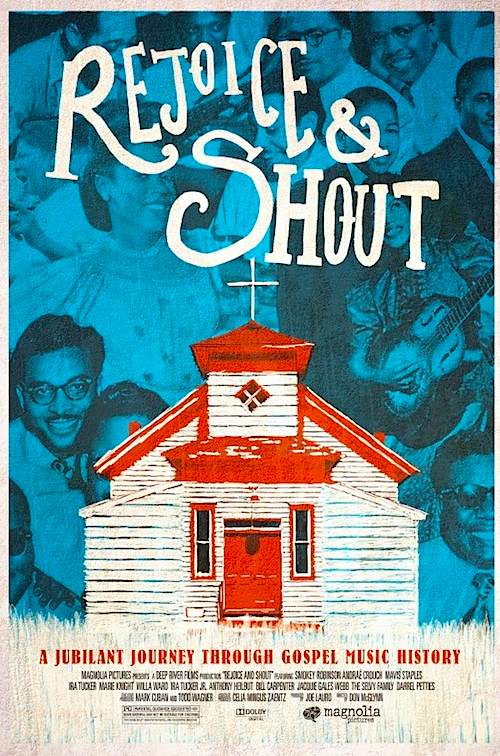
By Joe Bendel. How hip a blues guitarist was Sister Rosetta Tharpe? Well, she was one of the primary influences on a kid from Tupelo, Mississippi named Elvis. Yet she was not really a blues or R&B artist, but a Gospel singer. By profiling trailblazers like Tharpe, director Don McGlynn and producer Joe Lauro celebrate the rich legacy and diversity of American Gospel music in Rejoice and Shout, which opens this Friday in New York at Film Forum.
Rejoice opens on a true high note, as a young member of the Selvy Family of Gospel singers belts out a powerful old-time religion rendition of “Amazing Grace.” The film then proceeds to backpedal, explaining where the music came from. Yes, it is rooted in the plantation experience of African Americans, but the story of Gospel’s development is more complicated, involving entrepreneurial figures like Thomas A. Dorsey. A reformed bluesman, Dorsey penned and promoted scores of Gospel standards, often popularized through performances by the great Mahalia Jackson.
Frankly, it is pleasantly surprising how intelligently Rejoice addresses the actual music. The film is particularly effective illustrating the complexity of the arrangements and the syncopated jazz influences of the vocal ensembles like the Golden Gate Quartet. More to the point, many people will probably be surprised how much fun this legitimately sacred music truly is.
Of course, the music is the thing in Rejoice. To their credit, McGlynn and Lauro unearthed some remarkable rare footage, ranging from sound film that predates Al Jolson in The Jazz Singer to some totally cool video of the Edwin Hawkins Singers performing “Oh Happy Day” during a stadium concert. Still, Rejoice never forgets the music’s raison d’être, allowing former 1970’s Gospel superstar turned everyday preacher Andraé Crouch the time and space to speak eloquently of the glory and power of God. Continue reading Say Amen! LFM Reviews Rejoice and Shout
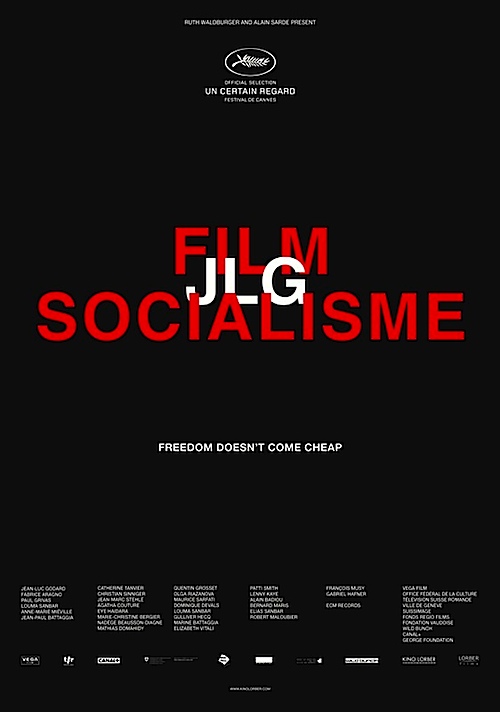
By Joe Bendel. A Mediterranean cruise sounds like a pleasant indulgence, but of course, none of the standard rules apply to Jean-Luc Godard. Certainly narrative and aesthetic conventions will be flaunted, as will polite decorum. Indeed, some might argue Godard’s latest and possibly final film (he has been somewhat coy on the subject) represents the height of self-indulgence. Yet, for hardy cineastes, the arrival of Film Socialisme, Godard’s latest cinematic-essay-provocation is as serious as a heart attack. Needless to say though, there will be plenty of shaking heads in the audience, even amongst the initiated, when Socialisme opens this Friday in New York at the IFC Center.
Dubbed “a symphony in three movements,” Socialisme is not Breathless, which proceeds along a more or less traditional narrative course, despite Godard’s periodic winking subversions. It is closer to his 1987 anti-adaptation of Shakespeare’s KingLear, but even there Godard left enough structural building blocks laying around for viewers to impose their own order. Rather, like his other post-2000 works, Socialisme is largely a cinematic collage providing viewers hints of narrative only for the sake of immediately snatching them back.
As Socialisme’s initial non-setting, the luxury ocean liner offers Godard a vehicle for some striking images and a frequent water motif. Just how the non-characters came to be on this cruise scarcely matters. Though a colorful assemblage – including a French philosopher, a war criminal of undisclosed nationality, a spy of some sort, and a chanteuse (played by Patti Smith) – they are only here to give voice to Godard’s polemical slogans. As he segues into his second and third movements, the film becomes something of a movie mixtape, juxtaposing text and visuals for ideological purposes.
It is not snarky to question just whom Socialisme is meant for, because of Godard’s signature gamesmanship. While the French dialogue is relatively conventional (if stilted), Godard’s subtitles are translated into crude Tarzan-like English, formatted in a style befitting e.e. cummings. Are English audiences seeing Socialisme as it is truly intended, or were the French, for whom it was presumably exhibited sans subs? Perhaps the film is best appreciated by those fluent in both languages, watching outside the francophone world. Is this a film primarily produced for French expats?
Naturally, Godard’s mischief is not limited to subtitles, but extends to soundtrack drop-outs and film-stock adulterations as well. As one would also expect, his extremist politics are also front-and-center, including a preoccupation with the Arab-Israeli conflict and the rather unsettling observation: “strange thing Hollywood Jews invented it.” Continue reading LFM Review: Jean-Luc Godard’s Film Socialisme
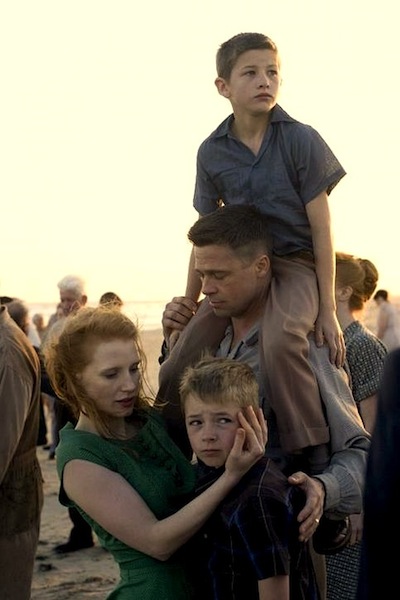
Brad Pitt and Jessica Chastain lead "The Tree of Life."
By Patricia Ducey. Terrence Malick’s latest, The Tree of Life, is a movie of big ideas: the cycle of birth and death, the mystery of suffering, and especially the necessity—and tragic elusiveness—of love. All Malick’s trademark film conventions are present here: the whispered voiceover narration, the elliptical narrative, the preoccupation with what is not said, what cannot be said but only imagined or felt. Malick’s genius has always been how he reveals the ineffable through the most mundane rudiments of everyday life in his characters. As Holly in Badlands seamlessly leaves her murdering boyfriend behind and begins a new life as wife and mother, we realize she is the innocent Malick imagines, never torn from any Eden. Or when Pocahontas at the finale of The New World rises, with a joyous smile of triumph, from her curtsy to the English King, we feel a kindred joy at her discovery of that new world – not as an “other” defined by conventional anti-colonial apologia, but as her own woman.
But in this film, Malick renders explicit, with unmatched visual and aural splendor, his vision of the essential spiritual quest; his characters literally ask God, where are you, why do you make me suffer?Tree of Life is almost an experimental movie, in that it eschews traditional narrative; no alarm bell plot points or expository dialogue here. So the passages of the family’s present life or memories seem more like montage than story; no one is explaining anything or planting clues. Any “real” story thus almost disappears. It is not surprising to read that Malick is an admirer of Kubrick—TreeofLife looks and feels a lot like Kubrick’s 2001: A Space Odyssey. Perhaps Malick at 67 feels ready to travel these same territories.
A saga of an American family.
We first meet the main character, Jack, as a young boy in Texas in the late ‘50s. Jack’s mother (Jessica Chastain), loving and devout, narrates the opening of the film. She tells us that there are two paths in life, one of nature and one of grace, and that we must choose which one we follow. Nature cares only for itself, while grace relies on a sense of oneness with all of existence. News suddenly arrives that Jack’s younger brother has died at age 19. We are not told how or why, but we see how grief and spiritual panic devour the family—and these questions dog Jack for the rest of his days. He grows up resenting his harsh father (Brad Pitt), longing for the love his father cannot or will not give him. Years later, as a successful architect, Jack lives and works in skyscrapers amid a sterile concrete modernity. He is as cold to his own wife and his own father was to him; this coldness is mirrored in the towering glass cities and rippling freeways that stand in stark opposition to nature. The way of the mother or the way of the father? This is Jack’s lifelong insoluble dilemma.
Malick soon interrupts the story of the family and the death of the brother, and embarks on a depiction of his own genesis story, from a cosmic Big Bang to Earth’s volcanic beginnings, to the kill-or-be-killed era of the dinosaur—all with special effects engineered by renowned veteran Douglas Trumbull. When Jack’s story resumes, we see through Malick’s expert direction, and the amazing camera work of cinematographer Emmanuel Lubezki, a childhood of back yards and sprinklers, running boys and budding sexuality—and, finally, all the furious civilizing that parents, knowing the alternative, try to impose. No American director could have evinced the intensity and naturalness of these childhood scenes any better. Jessica Chastain as Jack’s mother and Brad Pitt as his father illuminate their roles – especially Pitt, who artfully subsumes his soft attractiveness into a more severe toughness befitting his man-of-action character. And ever one of our most skilled actors, Sean Penn excels as the spiritually bereft adult Jack.
As always, Malick captures his audience with a whisper, from the mother’s opening narration—prayer, really—to the otherworldly climax. But TreeofLife is not an easy film. It must be seen on the big screen; no other movie this cartoon summer will look or feel anything like it. The soundtrack of largely religious music reminds us that this is a spiritual cri de coeur from someone who feels the autumn chill. When the lights came up in our theater today, the silence lingered—no chit-chat or phones chirping open. And when I turned onto the freeway, I had to click my radio off. The wind rushing by, the hum of the engine pulling me along—it seemed more fitting to turn down the noise and listen, closely for once, as the world in its magnificence flew by.
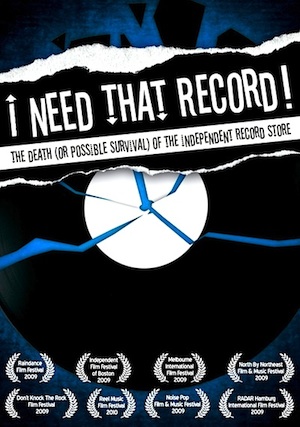
By David Ross. Brendan Toller’s documentary I Need That Record! The Death (or Possible Survival) of the Independent Record Store (2010) brings a good deal of personality and attitude (in the best sense) to the story of the demise of the independent record store, though it might just as well tell the story of the demise of the independent video or book store, all of which are victims of the same forces: box store encroachment followed by on-line revolution, all feeding the bottom lines of large corporations that don’t particularly give a damn about records, or movies, or books. The restaurant business has been similarly decimated. Applebee’s anyone?
"I Need That Record!" on DVD.
I am a fierce advocate of free-market capitalism, and yet I have to agree with Toller that something has gone wrong when Wal-Mart sells 20% of all albums and those albums are largely the work of corporate mannequins like Lady Gaga and Justin Bieber. My mid-sized Southern college town has one remaining used record store and one remaining used book store. Our last independent video store closed in December, and our Borders – which drove out our independent book and record stores – recently got a dose of its own medicine and closed amid a blaze of luridly florescent signage of the kind you associate with particularly tacky used car lots.
I’ll have to explain to my young daughter how likeminded people used to gather – in the flesh – to mingle, swap notions and preferences, and listen to whatever was on the turntable. I will have to recreate the lost world of my youth, and tell how I roamed the second-hand record stores of Boston and Cambridge, spending hours in grungy mouse-holes like Mystery Train (named in honor of the Elvis tune), and how I timidly put my fourteen-year-old inquiries to the superior wisdom of pierced twenty-four-year-olds, who had, in fact, heard everything and evolved a real critical acumen. Between 1988 and 1992, I spent many procrastinative late afternoons at Cutler’s in New Haven (still there!). I once asked the sagacious manager about Moby Grape’s first album, about which I’d read in The Rolling Stone Record Guide (before it annoyingly became the “album guide”). He said that the record was out of print but that he had a copy (of course) and that he’d make me a tape. My tape was waiting for me the next day, as promised. You don’t get that kind of service – that degree or any degree of giving a damn – at Wal-Mart. Continue reading The Lost World of the Indie Record, Book & Video Store