Communists in Japan!: LFM Reviews: United Red Army

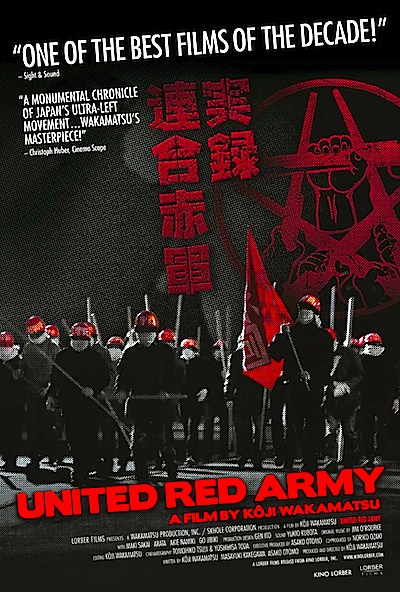
By Joe Bendel. It was certainly red, but not always united. Former underground filmmaker Kôji Wakamatsu witnessed the Japanese New Left degenerate into a loose network of terrorist groups plagued by factionalism and internal power struggles. A sometime ally and contemporary of the militant paramilitaries, Wakamatsu has produced a chilling look at the inner workings of the militant left in United Red Army, which opens this Friday in New York at the IFC Film Center.

Wakamatsu leaves absolutely no doubt where the Marxist United Red Army (URA), as well as its Red Army Faction (RAF) and Revolutionary Left Wing (RLF) predecessors, were coming from. During one of many “self-critique” re-education sessions, their leader, Tsuneo Mori, pretty clearly spells out the need to sacrifice any sense of individuality and embrace death to advance the so-called class struggle. To do anything less is construed as counter-revolutionary, unless you happen to be one of the commanders.
In his largely narrated opening sequences, Wakamatsu tries to suggest that the URA terrorists began as misguided anti-war protestors. However, they quickly evolve into violent hardcore Maoists (in fact, when Nixon makes his historic visit to China late in the film, it’s a real buzz-kill for the surviving URA faithful). In fact, as Wakamatsu tells the group’s history, one wonders if he realizes how much he actually reveals.

In the second, centerpiece segment of the film, the RAF consolidates with the RLF into the URA – taking to the mountains, ostensibly for military training. Yet, well before the revolution can possibly begin, the Red Army launches a reign of terror within its ranks. Here URA begins to resemble a horror movie, as one-by-one, loyal members are forced to undergo “self criticism,” clearly inspired by the Cultural Revolution, culminating with torture and fatal beatings.

URA concludes with the ill-fated Asama-Sansō hostage crisis, in which a remnant of the terrorist group held an innocent woman captive in her husband’s mountain lodge. Despite his personal disillusionment, Hiroshi Sakaguchi commands his men in this act of horrific folly. As disturbing as the final stand-off might ordinarily be, it is something of a let-down compared to the sheer gut-wrenching cruelty of the self-criticism sessions. What we see in URA is the sublimation of the individual to the collective—a textbook example of how cults work. Continue reading Communists in Japan!: LFM Reviews: United Red Army

Experiment in Fascism at a German High School: LFM Reviews The Wave; Film Opens Friday (5/27) in New York

By Joe Bendel. Any experiment in social control that deliberately exploits obedience and conformity is cause for concern. In Germany, it is all kinds of disturbing, for obvious reasons. As Libertas readers are well familiar through Patricia Ducey’s recent review of the documentary The Lesson Plan, the so-called “Third Wave” classroom exercise was actually the brainchild of American leftist Ron Jones, who converted his Palo Alto high school into a fascist mini-state in 1967. The incident subsequently inspired Morton Rhue’s young adult novel The Wave and Dennis Gansel’s film adaptation – the Sundance standout The Wave – which opens this Friday at New York’s ReRun Gastropub on a double bill with Gansel’s hipster vampire noir We Are the Night.

Mr. Wenger is a popular teacher. He lets kids call him Rainer and reminisces about his time on the barricades. He’s all geared up to teach a special topics class on anarchism, but a senior faculty member nips that in the bud. Instead, Wenger is stuck with the ‘autocracy’ course. Yet, low and behold, the topic inspires him. Suddenly it’s “Mr. Wenger” again, but only during autocracy class. Surprisingly, the students also take to the new discipline he dishes out, embracing the rather stylish white button-down shirt and blue jeans as their uniform. As befits a collective, they also adopt an ominous sounding name: The Wave. Yes, they even have their own special salute.

Naturally, students who are not part of The Wave, feel keenly excluded. Those not enrolled in Wenger’s class are still able to join, provided they blindly submit to the rules of the budding cult. A few, like Karo, the formerly popular ex-girlfriend of Marco (the star water-polo player) recognize the insidious nature of the Wave. Yet as long as they are not too outrageous in their tactics, the administration condones Wenger’s ill-conceived project.

Continue reading Experiment in Fascism at a German High School: LFM Reviews The Wave; Film Opens Friday (5/27) in New York

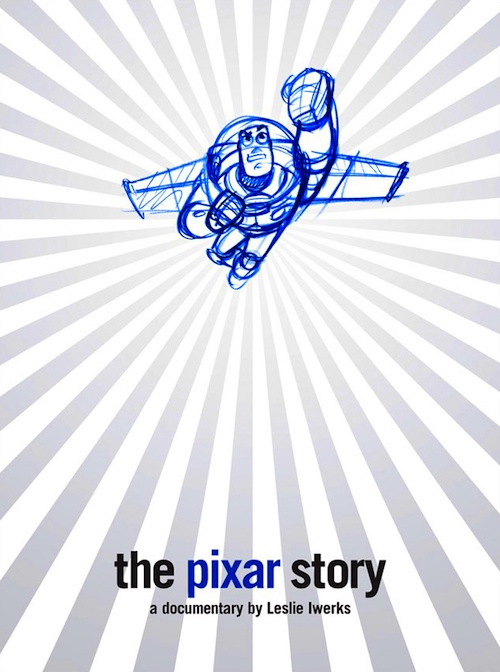
The Pixar Story & The Lessons of Pixar’s Success

By David Ross. We all have a vague idea of the ‘Pixar story’: John Lasseter, Steve Jobs, technological innovations of some kind, fractious dealings with a decadent Disney, eventual world-wide success measured in billions of dollars and universal critical adulation. The 2008 documentary of the same name fills in the historical detail and provides human color.

If the documentary itself is merely workmanlike, the story it narrates belongs amid the July 4th bunting of the American pageant. It’s a chapter in the tale of Graham Bell, Edison, the Wright Brothers, Disney, and Apollo 11, an episode in the cheerful reinvention of the world on the basis of something deep and generous in the American spirit. There’s very little for which contemporary Americans will not have to apologize to whatever god or superior alien race is watching, but Pixar speaks well of us. It mitigates just a little the malls and video games and rap music, everything we might, following Allen Ginsberg, call “Moloch.”

The Pixar Story is informative cultural history, but its implicit lessons have wider and more important application. For better and for worse, corporations now infiltrate every crevice of our culture, and it has become crucially important to weigh how corporatism and cultural meaning can be reconciled. Pixar represents a rare digital-age example of a corporation that’s deepened rather than debased the culture. The lessons are not particularly abstruse, but difficult to drive home and implement, viz.:

1) Corporations must construe themselves as communities rather than machines. Communities consist of autonomous and interactive people; machines consist of inanimate parts that exist in a paradoxical state of mutual dependency and complete isolation. Pixar resists the temptation to rationalize, regulate, and formalize presumably because those at the top – Lasseter et al. – are so free of the usual egomaniacal impulse to control and subsume. The result is an organization that’s supple, organic, and decentralized, as loose and yet unified as an eighteenth-century village. I imagine that Chuck Jones’ Warner Brothers team was much the same. Continue reading The Pixar Story & The Lessons of Pixar’s Success

Avast! LFM Mini-Review of Pirates of the Caribbean: On Stranger Tides

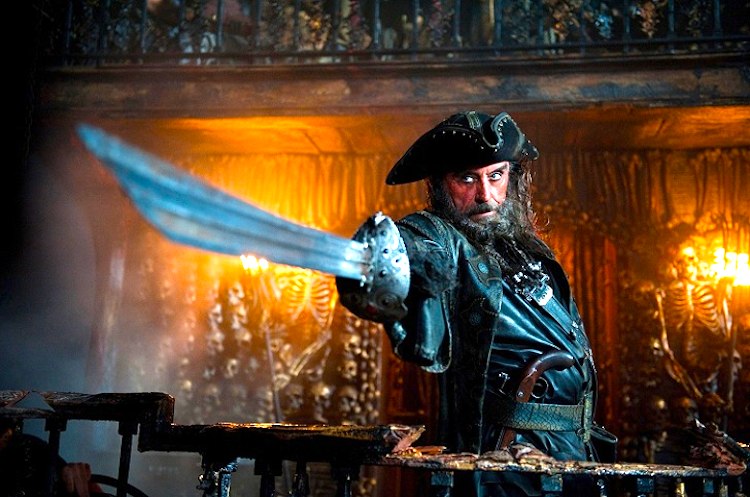
Ian McShane as Blackbeard in "Pirates of the Caribbean: On Stranger Tides."

By Jason Apuzzo. THE PITCH: With seductive mermaids, the Spanish fleet, and a cranky Geoffrey Rush standing in their way, Johnny Depp’s Captain Jack Sparrow leads saucy pirate wench Penélope Cruz and Ian McShane as Blackbeard on a quest for the mythical Fountain of Youth.

THE SKINNY: After the previous film’s reportedly $300 million budget, Disney’s formidable Pirates franchise goes on a diet – as this slightly undernourished sequel jettisons the heavy VFX sequences of the past, but makes up for them with humor and a colorful turn by Ian McShane as the legendary, real-life pirate Edward Teach/Blackbeard, along with a long-overdue love interest for Captain Jack in the form of a fiery and duplicitous Penélope Cruz.

Johnny Depp as Captain Jack Sparrow.

WHAT WORKS:

• Johnny Depp’s Jack Sparrow schtick has been refined down to a pleasant bouillabaisse of squints, smirks, pirouettes and self-effacing one-liners. It all works here again, like clockwork, and it’s the key to what makes these films tick. While most of the Pirates cast typically get lost in their costumes or heavy make-up, Depp is the only one who really seems to feel at home – always bringing a lightness of touch to the proceedings. Whatever Disney’s paying him, it’s worth it, as the franchise would be lost without his good humor.

• Even though they’re a bit too covered-up for my tastes, the film’s exciting mermaids add to the growing catalogue of vivid mythological creatures already encountered in this series.

• Typical of the Pirates series, the film’s production design is rich and sumptuous. Also helping matters out in giving the film a lavish touch is Hans Zimmer’s score, aided here by guitar flourishes from the Mexican musical pair Rodrigo y Gabriela.

• An absolutely priceless cameo from Keith Richards, who utters what’s probably the film’s most memorable line.

WHAT DOESN’T WORK:

• Geoffrey Rush is an actor I’ve never warmed to, and this film doesn’t help matters. For someone so vexatious, with a permanently constipated look on his face, he certainly gets a lot of screen time.

• In comparison to the vast VFX spectacles of the past, this new Pirates feels a little on the smallish side – and some sequences feel like filler. Also: I’m not certain that the film’s payoff at the end – at the Fountain of Youth – really packs enough of a punch, given what we’ve become accustomed to from this series.

THE BOTTOM LINE: Continue reading Avast! LFM Mini-Review of Pirates of the Caribbean: On Stranger Tides

LFM Review: Piran-Pirano @ The 2011 Bosnian-Herzegovinian Film Festival

By Joe Bendel. How better to start the 2011 Bosnian-Herzegovinian Film Festival than with a film about the arbitrary nature of geography? Antonio is Italian. Veljko is Bosnian. Yet both have only felt truly at home in a particular apartment in the picturesque Slovenian city of Piran. That is where their paths fatefully crossed during WWII in Slovenian filmmaker Goran Vojnović’s Piran-Pirano (trailer here), the opening film of the 2011 BHFF in New York.

Antonio was not a Fascist, but his father certainly was. A school teacher whose lesson plans were little more than hateful propaganda, he decides discretion is the better part of valor when Tito’s forces arrive. Only concerned with his own neck, he leaves his college-aged son behind in their flat. Through sheer fortune, Antonio eludes the Partisans’ initial sweep of the apartment, but he is caught flat-footed by Anica, a young Slovenian woman traveling with the partisans.

Mourning her entire family, the vengeful Anica is in no mood to show mercy to an Italian, yet they reach an uneasy truce of sorts for the night. It is there in the apartment that Veljko discovers them. Like Anica, he has also lost his family, but he is not inclined towards retribution. In fact, he is not much of a soldier at all.

Told in flashbacks when the two men meet again decades later, Piran’s themes of cruelty and compassion in times of war have obvious resonance for Bosnian audiences. It hardly glorifies Tito’s army either, clearly depicting the summary executions ruthlessly carried out by the Communist forces. The commander matter-of-factly accepts the brutal tactics, as well as the potential death of innocents, as the cost of waging war. However, some of his subordinates are more enthusiastic about the dirty business of war. Continue reading LFM Review: Piran-Pirano @ The 2011 Bosnian-Herzegovinian Film Festival

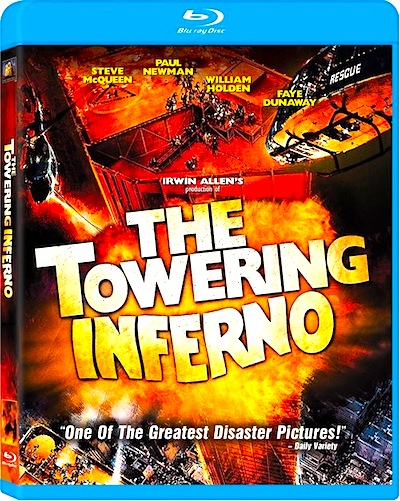
Classic Blu-ray Review: The Towering Inferno, American Ambition & The Post 9/11 World

By Jason Apuzzo. The imagination sometimes wanders in unexpected directions. Govindini’s recent post on The Demise of bin Laden and The Cinematic Legacy of 9/11 put me in the frame of mind to revisit a favorite film of mine from years ago, a classic Hollywood action spectacle with eerie and unsettling echoes in the September 11th attacks: Irwin Allen’s The Towering Inferno, from 1974.

The Towering Inferno is, in my opinion, a genuinely great Hollywood adventure film – likely one of the best the industry has ever produced. It was certainly recognized as such in its day; the film was nominated for 8 Academy Awards, including Best Picture (it won 3 Oscars – for Cinematography, Editing and Best Song). What’s more, the film was a gigantic hit at the domestic box office – taking in around $116 million. What this means is that adjusted for inflation, the film would’ve grossed around $482 million today. (By comparison, the top film at the domestic box office in 2010, Toy Story 3, made $415 million.) Today the film is largely remembered for being the greatest of the 1970s era ‘disaster’ epics, but that probably puts the film in too narrow a box. There really are very few action films of its scale, energy or dramatic impact. The film also has the distinction of being the last great action film made by either Steve McQueen or Paul Newman, who co-starred in the film – and so for that reason alone, The Towering Inferno has a special place in cinema history.

Around 1973, just after the smash success of producer Irwin Allen’s The Poseidon Adventure, a bidding war erupted between Fox and Warner Brothers for a forthcoming novel called The Tower, which told the harrowing tale of a fire that breaks out in the world’s tallest building just as celebrities and dignitaries gather for its opening. The Tower, which I’ve read, is basically a morality tale set in a spectacular setting – in which we get to see how different types of people behave in the midst of a terrifying crisis.

Allen wanted to adapt the novel for Fox, but Warner Brothers outbid him for the novel. As luck would have it, a similar novel called The Glass Inferno – telling almost the same story – would also soon be coming out on the market, so Allen acquired the rights to that one. Allen then pulled one of the great producing maneuvers in Hollywood history: he called a summit between Fox and Warner Brothers, and got both sides to co-operate on an expensive joint project marrying the two novels into one film: The Towering Inferno, with a screenplay – a superb one, by the way – to be written by Stirling Silliphant. Thus was born the first major joint studio project in history. (As an interesting aside, years later James Cameron’s similarly expensive disaster epic Titanic would be another such joint venture, this time between Fox and Paramount.)

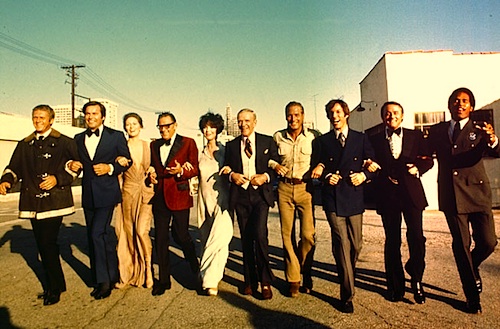
Old-school cast photo for "The Towering Inferno."

The film that resulted from this collaboration between these two major studios lived up to expectations – and to some extent surpassed them. A project that could easily have flopped, or spun out of control in a maelstrom of budget overruns, dangerous stunts and FX work – or out-of-control star egos – was put together by Irwin Allen in an atmosphere of crisp, military precision and professionalism.

The first big thing Allen did was assemble the film’s extraordinary cast, beginning with the improbable, blockbuster pairing of Steve McQueen and Paul Newman. More on that pairing below. Take a look at the rest of the cast, though, for Towering Inferno: Faye Dunaway, William Holden, Fred Astaire, Jennifer Jones, Richard Chamberlain, Robert Vaughn, Robert Wagner … and, of course, O.J. Simpson (he’s actually pretty good in his few scenes). Can you imagine a cast of this caliber appearing in a special effects picture today? It’s unimaginable. Continue reading Classic Blu-ray Review: The Towering Inferno, American Ambition & The Post 9/11 World