Interrupted Lives: Portraits of Student Repression in Iran Now Available

By Jason Apuzzo. With the protests currently taking place in Iran, we wanted to alert Libertas readers to a short film called Interrupted Lives: Portraits of Student Repression in Iran (see the trailer above). Interrupted Lives is a 20 minute documentary that deals with the repression of free-thinking students by the Iranian government, and specifically examines documented human rights cases of student imprisonment, torture or execution since the 1979 revolution.

The film is available to be seen in full here. Interrupted Lives will be traveling to major university campuses this Spring – including Harvard, Berkeley, and Oxford. We wish the filmmakers the very best in this important effort.

Posted on February 16th, 2011 at 10:18am.

Mad Men & Boomer Revisionism

[Editor’s Note: Mad Men Season 4 , reviewed in full here at LFM by Jennifer Baldwin, will be released on DVD/Blu-ray March 29th.]

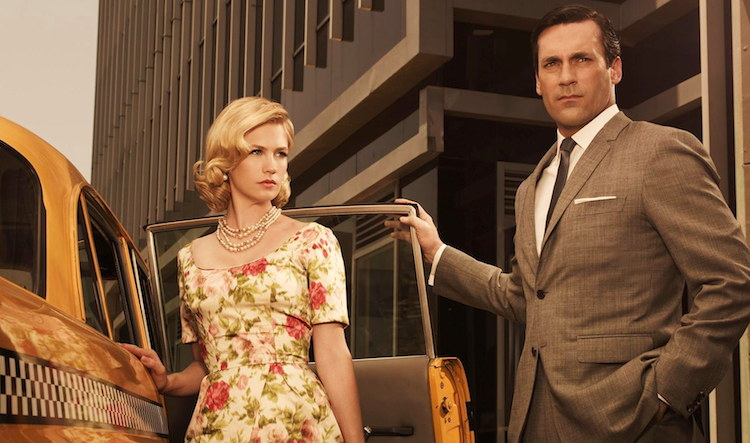
By David Ross. Our own Jennifer Baldwin has written stylishly – very stylishly in my opinion – on Mad Men. I share her admiration for the glamour of the era, and I particularly share her instinct that the Eisenhower generation in some sense enabled the mayhem of the 60s:

The reason AMC’s original series Mad Men was such a sensation when it debuted four seasons ago, and what continues to make it one of the best shows on TV, is that it approaches the 1960s from a somewhat different angle. It’s the angle of men in suits, women in tasteful and elegant clothing, cocktails and business meetings – in other words, the world of grown ups. This is the 1960s from the point of view of the adults. What makes the show so brilliant is that by focusing on the adults of the era it shows where the real breakdown of society occurred in the 60s:  not with the kids, but with their parents.

Kids will always rebel, in any era, in any time period. It’s part of our adolescent development to test boundaries and question our world. But it’s up to the adults in a society to maintain civilization in the face of this adolescent upheaval. Where the 60s went wrong – where the rot set in – wasn’t that the youth started tuning out and turning on, it’s that the adults did as well.

This is well put: it is indeed “up to the adults in a society to maintain civilization in the face of [……] adolescent upheaval.” As I see it, however, the essence of the sixties dysfunction was not that the adults tuned out and turned on, but that they did not entirely trust in their own culture and world view. Their liberalism was too relativistic, pluralistic, urbane – too unsure of itself at root – and they had become unconsciously estranged from the tradition that should have functioned as the great countervailing force: the ‘culture’ that should have thundered in refutation of the ‘counter-culture.’ Too tentative to muster the necessary ferocity or tenacity, they failed to acculturate their own children, and they suffered the patricidal consequences.

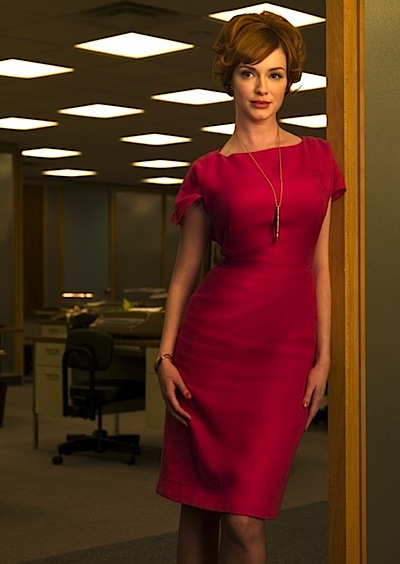
Christina Hendricks as Joan Holloway.

The ultimate origin of the problem is hard to identify. Could it be that having won World War II and vanquished the most monstrous manifestation of evil in the history of the world, the Eisenhower generation let its guard down? Assumed that the culture needed no further defense? Or was this generation simply – and forgivably – a bit weary at the core?

There is a subtle point to be made, but Mad Men – of which I have seen only the first season – does not seem to make it. Instead, the show depicts the culture of the 50s and early 60s with a heavy-handed Baby Boomer bias, turning a complicated and often brilliant era of American art and culture – the era of Nabokov and Coltrane – into a flimsy straw man of political convenience, as if to say, “You see! This is why we had to wreck the world in order to save it!” I have previously aired something of this complaint in my “Defense of the 1950s” (see here).

I simply don’t accept the clichés in which Mad Men tirelessly traffics. My grandparents belonged to the exact generation of Mad Men and occupied a Jewish version of the same milieu. My grandfather was a corporate lawyer in Manhattan, a drinker of good Scotch, an amateur photographer (I have his lovely old Leica), a dapper wearer of Burberry coats and felt homburgs, a weekend golfer with a second house in Westport, Connecticut. Mad Men‘s revelry in boorishness and chauvinism – its excited finger-pointing at sexual naughtiness and latent dysfunction – seems utterly detached from my grandparents’ unselfconscious sophistication and from the real elegance of their world. This world was sober, thoughtful, and ordered. It was perhaps a bit passive and naively broadminded, but it was not stupid and never crude. It was a middle-brow world, but middle-brow, in 1960, encompassed the Museum of Modern Art, The New Yorker, and the New York City Ballet.

Daniel Mendelsohn, writing in The New York Review of Books, weighs in with a lengthy and devastating critique along my own lines. He derides the show as cheap soap opera, an obligatory point in the pages of NYRB and one that the show’s defenders are likely to concede with a shrug. He may touch a nerve, however, when he denies “the special perspective [the show’s] historical setting creates, the graphic picture that it is able to paint of the attitudes of an earlier time, attitudes likely to make us uncomfortable or outraged today.” Mendelsohn continues:

To my mind, the picture is too crude and the artist too pleased with himself. In Mad Men, everyone chain-smokes, every executive starts drinking before lunch, every man is a chauvinist pig, every male employee viciously competitive and jealous of his colleagues, every white person a reflexive racist (when not irritatingly patronizing). It’s not that you don’t know that, say, sexism was rampant in the workplace before the feminist movement; it’s just that, on the screen, the endless succession of leering junior execs and crude jokes and abusive behavior all meant to signal ‘sexism’ doesn’t work – it’s wearying rather than illuminating.

Here, as with Don’s false identity and (literally) meretricious mother, Mad Men keeps telling you what to think instead of letting you think for yourself. As I watched the first season, the characters and their milieu were so unrelentingly repellent that I kept wondering whether the writers had been trying, unsuccessfully, for a kind of camp, for a tartly tongue-in-cheek send-up of Sixties attitudes. (I found myself wishing that the creators of Glee had gotten a stab at this material.) But the creators of Mad Men are in deadly earnest. It’s as if these forty- and thirty-somethings can’t quite believe how bad people were back then, and can’t resist the impulse to keep showing you.

This impulse might be worth indulging (briefly), but the problem with Mad Men is that it suffers from a hypocrisy of its own. As the camera glides over Joan’s gigantic bust and hourglass hips, as it languorously follows the swirls of cigarette smoke toward the ceiling, as the clinking of ice in the glass of someone’s midday Canadian Club is lovingly enhanced, you can’t help thinking that the creators of this show are indulging in a kind of dramatic having your cake and eating it, too: even as it invites us to be shocked by what it’s showing us (a scene people love to talk about is one in which a hugely pregnant Betty lights up a cigarette in a car), it keeps eroticizing what it’s showing us, too. For a drama (or book, or whatever) to invite an audience to feel superior to a less enlightened era even as it teases the regressive urges behind the behaviors associated with that era strikes me as the worst possible offense that can be committed in a creative work set in the past: it’s simultaneously contemptuous and pandering. Here, it cripples the show’s ability to tell us anything of real substance about the world it depicts.

This critique is reasonable as far as it goes, but it misses the show’s water-carrying tendency in the larger campaign of the kulturkampf. The show does not represent the failure of the anthropological eye, but the triumph of the revisionist strategy by which the Baby Boomers have always justified their berserk torching of the culture. The show fails because it’s not fundamentally interested in its own subject matter except as the premise in a political syllogism. It has no real curiosity. No real affinity. Too often its portrait is an effigy brandished at a show trial.

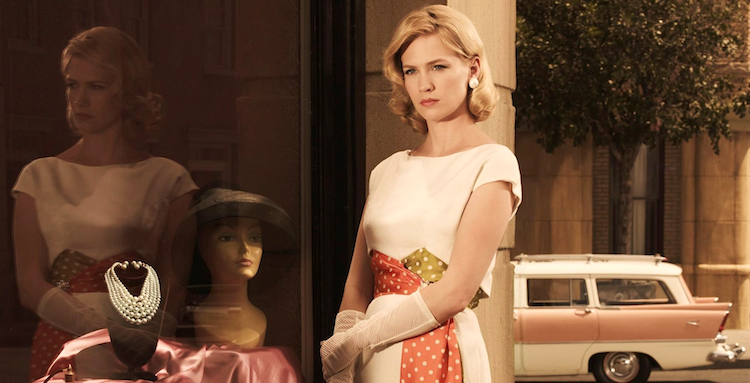
January Jones in "Mad Men."

It’s true that Mad Man depicts the nascent counterculture somewhat caustically, but I wonder whether this merely reflects the show’s implicit alignment with the perspective of the older generation. It seems to me we are supposed to understand that we witness the birth of the counterculture through Don’s eyes, and that the putative inadequacy of his comprehension is one more point against him and his generation.

I wish there were a corrective to adduce, but films like George Lucas’ American Graffiti and Barry Levinson’s Diner are a bit patronizing in their own way, envisioning an aimlessness and harmlessness that has nothing to do with the complexities that were roiling through the culture in a late efflorescence of modernism. For me, the defining tableau is an auditorium at Cornell, Nabokov at the lectern, Pynchon seated amid the crowd.

Posted on February 15th, 2011 at 9:20am.

The Way Back Available on DVD/Blu-ray April 22nd

Colin Farrell in "The Way Back."

By Jason Apuzzo. Special thanks to reader Vince for alerting me to the fact that Peter Weir’s The Way Back, an epic saga starring Ed Harris and Colin Farrell about a breakout from one of Stalin’s gulags, will be released on DVD and Blu-ray on April 22nd. You can pre-order the film below through the LFM store.

We greatly admired The Way Back here at Libertas (see our review here), along with the courage it took to make it, and are glad to see the film making the transition to DVD/Blu-ray so quickly. It’s often frustrating for us to recommend indie films of this kind here on this site, and then have to wait 6 months from their appearance in a film festival or in limited theatrical release for people to be able to see them. Bravo to the team behind The Way Back for making it available so swiftly. This, one hopes, is the way of the future for indie releasing.

Posted on February 15th, 2011 at 9:17am.

Classic Top 6: Film Noir Posters (Foreign Edition)

By Jennifer Baldwin. Before photography (and then Photoshop) took over the movie poster business, illustrators and artists ruled. Billboards, lobby cards, one sheets — these were the domain of the movie art masters, the geniuses who plastered our imaginations with color and drama and a parade of disembodied heads all in various states of emotion. Nowhere, it seems, were the old movie poster artists more unbridled than in their posters for film noir. Violence and sex are everywhere, and the artwork is always fun.  Sometimes the posters are lush and romantic, other times chaotic and carnal. But always interesting, always worth looking at. Whether the movies turn out to be good or bad, the posters always manage to sell them.

In fact, sometimes in the case of the old film noirs, the foreign artwork is better than the American. These foreign posters seem to get to the thematic heart of the stories because the artists weren’t as hampered by the studios to make sure a certain actor was featured or a movie star actress looked glamorous. And because foreign artists often had different sensibilities than their American counterparts, some of the best posters have a distinct strangeness to them that make the artwork even more compelling.  These are my Top 6 picks for best film noir movie posters from foreign countries:

#6:  Belgian poster for Criss Cross (Dir. Robert Siodmak, 1949)
Bold, violent, unrelenting — the red crisscross that dominates the center of the poster might be a bit crude and obvious for a movie titled “Criss Cross,” but it fits this nihilistic, underrated classic perfectly. With Yvonne De Carlo’s gorgeous face looming enigmatically above it, the “X” threatens to cross out both Duryea and Lancaster, two men who are both on a road to annihilation thanks to their lust for Yvonne’s intoxicating femme. What’s even more disturbing than those crisscrossed streaks of blood, though, is the look of cool, indifferent “who cares” on De Carlo’s face. That “who cares” look, as blood rains down, is the essence of the film noir “dangerous woman.”

#5: Italian poster for T-Men (Dir. Anthony Mann, 1948)
The artwork for this poster is flawless. One of the great things about old movie poster art is the way it tells a story. It’s not just one thing — one face, one situation, one image. These old posters take us into the story of the film, almost like the sequential art of a comic book, where we move from character to character, situation to situation, image to image. This T-Men poster gives us pieces of the story, while leaving us hungry for more. The death of a beautiful woman; a bag full of money; a brutal interrogation; a shootout at the pier; and at the center of it all, a heroic Dennis O’Keefe, trying to stand up for what’s right, but surrounded by crime on all sides. Film noir is a black and white genre, yet an eye-popping poster like this one reveals all of the intense, explosive emotions roiling beneath the silver-dark black and white sheen.

#4:  French poster for F.B.I. Girl (Dir. William Berke, 1951)
I’ve never seen F.B.I. Girl. From what I’ve read on the internet, it doesn’t appear to be a very good movie, despite the presence of one of the all-time noir pros, Audrey Totter. But damn, if this poster isn’t the coolest thing ever! Coolness, of course, is one of the attractions of the genre. In fact, some might even argue that film noir isn’t a real genre at all, just a style. And style is about aesthetics, about the “look” of something. In the case of F.B.I. Girl, the movie itself is irrelevant. This poster — the look, the attitude, the style of it — is all we need. There’s a sexiness, a romantic sensibility, to the artwork that seems appropriate for the French. The pinkish red coloring; the playful elegance of the woman in the foreground; the hint of sexual violence between the man and woman in the background — all of it adds up to a retro modern design that is still absolutely fresh. I would kill to have this poster framed and hanging on my wall.

#3:  French poster for Notorious (Dir. Alfred Hitchcock, 1946)
Symbolic, highly stylized, and unlike anything that would have been done in America, this is Hitchcock’s Notorious as only the French can render it. There’s the romantic passion of Cary Grant and Ingrid Bergman’s love affair, which dominates the poster and hangs over every frame of the film; the wine cellar key that is at the center of  Bergman’s espionage and the symbol for her duplicity; and a very stylized version of Claude Rains within the key itself, uniting Bergman’s two acts of deception and betrayal, the betrayal of her husband’s work and his heart. The blue coloring gives the poster a sad romanticism, like the farewell of lovers on a rainy train platform; while the gold works as both the golden hues of warm sunlight (Bergman’s character wants to live in the light) and as the menacing gold of the cellar key. Interestingly, Rains’ face is half gold, half black, perhaps as a symbol for how his character is an evil yet weak man, not so much a villain to be hated but one to be pitied. More than just an advertisement for a movie, this poster works as a compelling piece of art.

#2:  Italian poster for Force of Evil (Dir. Abraham Polonsky, 1948)
This poster just IS noir. One of the few from the era to be almost entirely in black and white, it captures the essential paradox of the genre. The menace of the gun; the threat of violence from a heavy bathed in shadow; the trapped look on the face of illustrated John Garfield — all of the doom and psychological terror of these films, and yet, amidst the crime and despair, there’s a stark beauty to the image. This is the tension at the heart of the noir style: beauty within the darkness. These are dark films, with dark themes. Murder, blackmail, exploitation, cruelty, selfishness, greed. But the artists who create these films, the painters of shadow and light, the directors and cinematographers — they create something beautiful to look at out of stories filled with evil. The illustration for this poster looks like it could be a still photograph from the movie itself. Filled with fear and violence and menace, and gorgeous.

#1:  German poster for Double Indemnity (Dir. Billy Wilder, 1944)
This is number one simply because it looks like the face of Barbara Stanwyck is emerging from Hellfire, her seductive wickedness consuming MacMurray and Robinson in an inferno of murder and lies. If that doesn’t sum up Double Indemnity, I don’t know what does. Stanwyck is all heat in this one, a ball of fire of the deadly variety. MacMurray and Robinson, in their monotone hues, look almost like ghosts, like men reduced to mere shadows by the power of Stanwyck’s evilness. The real relationship in the movie is between the two men, of course. When their friendship is destroyed because of Phyllis Dietrichson, it is that destruction that pains us in the end. She is the devil who comes between them, bringing everything to ruin. This illustration, more than any other, captures these themes. And even more than that, it’s just an electrifying visual design. Everything about this poster just makes me want to watch the movie again right now. It gives new life to a movie I’ve seen dozens of times. And that is the mark of great movie poster.

This article is a contribution to the For the Love of Film (Noir) Blogathon, hosted by Ferdy on Films and The Self-Styled Siren.  Check out the Facebook page HERE and consider supporting the cause of film preservation with a donation.

Posted on February 14th, 2011 at 11:05am.
LFM Reviews The 2011 Oscar Nominated Animation Shorts

By Joe Bendel. It is quite the literate field for this year’s Oscar nominated short films. Two are based on acclaimed children’s books and one was inspired by the creator’s travel journal. All three are accomplished films, worthy of the ultimate prize. All five 2011 nominees along with two other shortlisted films screen as part of the program of Academy Award nominated shorts, which opened this past Friday in New York at the IFC Center.

If King’s Speech sweeps this year’s Oscars, perhaps it will pull along Jakob Schuh and Max Lang’s The Gruffalo along with it. After all, it features the voice talents of Helena Bonham Carter as a mother squirrel, who tells her children the tale of a rather resourceful mouse. The rodent-protagonist scares off various forest predators with tales of his supposed friend, the dread Gruffalo. Much to the mouse’s surprise, the Gruffalo really exists, looking pretty much as he described, but with the voice of Robbie Coltrane. While older viewers will probably have a good idea where Gruffalo is heading right from the start, it is a charming film with some rather clever bits of business, wholly appropriate for all ages.

While Shaun Tan and Andrew Ruhemann’s The Lost Thing is also based on a children’s book (written and illustrated by Tan), it is told from the reflective perspective of a man of somewhat mature age wistfully looking back at a mysterious event from his childhood. Discovering some sort of alien or fantastical creature at the beach (apparently a mollusk in an armored tea kettle), the narrator tries to figure out what to do with this new friend the adult world tries its best to ignore. A strange but gentle fable, Thing is visually arresting and surprisingly meditative. It is easily the most substantive of the animated nominees.

Stylistically, Bastien Dubois’s Madagascar, carnet de voyage is by far the animated line-up’s most distinctive work. Employing watercolor and sketches of varying degrees of sketchiness, Dubois vividly brings his travel journal-scrap-book to life, animating episodes from his year-long sojourn through Madagascar. In terms of story, it is a wee bit thin. Indeed, it could easily serve as a promotional film for Madagascar’s tourism bureau, but its graceful élan and spirited vibe distinguishes Carnet apart from the competition.

The only real clunker amongst the nominated field is probably the leading contender, Geefwee Boedoe’s one-note didactic anti-capitalist polemic Let’s Pollute. This year’s Pixar slot was filled by Teddy Newton’s Day & Night, which is as safe and pleasant as one might expect. Rounding out the animation program are two shortlisted titles that did not make the final cut. Bill Plympton’s The Cow Who Wanted to be a Hamburger was probably selected simply on the basis of the filmmaker’s reputation. By contrast, Moritz Mayerhofer’s archetypal Urs is a striking work that might have benefited from a bit more narrative muscle.

This is a stronger year than usual for Oscar nominated short form animation, with at least three very strong films still in contention. Indeed, the combination of Gruffalo, Thing, and Carnet (and to a lesser extent Urs) makes the animated program well worth seeing in New York currently at the IFC Center.

Posted on February 14th, 2011 at 10:42am.

Cold War Update!: DiCaprio as Hoover, Streep as Thatcher & X-Men Solve the Cuban Missile Crisis?

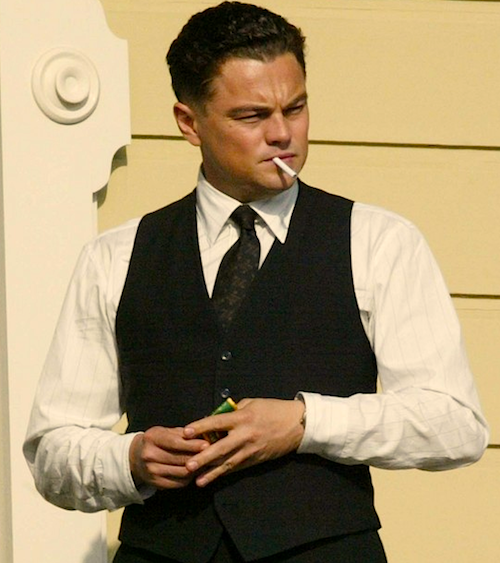
Leonardo DiCaprio as J. Edgar Hoover.

By Jason Apuzzo. • Photos leaked this week of Leonardo DiCaprio playing Hoover (see here and here). In all the chatter I’m seeing about this film, I still haven’t heard a peep about how this film intends to depict Hoover’s confrontation with actual – i.e., non-imaginary – Soviet infiltration of the American government from the 1930s-1950s. This is an enormous issue that has rarely been covered adequately in film, beyond the usual treatment as being a phenomenon of ‘paranoia.’ I’m hoping that Clint breaks from that clichéd and misleading template – although, for a multitude of reasons, I’m doubting he will.

You know who would’ve made a great film out of this subject matter? Kazan. (I’m actually reading his autobiography right now.) There are no Kazans today, however, because they’ve been weeded out of the system by the same people so enamored with Eastwood right now.

Die Hard 5 suddenly has a director, and the latest rumors on that film involve Bruce Willis/John McClane fighting a relative of his old nemesis, German ‘Red Army Faction’-style terrorist Hans Gruber, wonderfully played by Alan Rickman in the original film. (Jeremy Irons played a relative of Rickman’s in Die Hard 3; I actually thought Irons was even better than Rickman.) What do people still think of this franchise? Personally, I’m long past caring about Willis or what he does; I didn’t even bother to watch Die Hard 4 – a film which, I might add, dropped its American title of Live Free or Die Hard in certain foreign territories in order not to ‘offend’ certain sensibilities. Opinions on the film and on Willis are welcome.

• Sony will apparently be releasing James Bond 23. Also: no word yet on whether or how this may also affect MGM’s Red Dawn.

• According to The Hollywood Reporter, the Russians are building a huge new studio complex, ‘Lenfilm XXI,’ which apparently could become Europe’s largest film studio. Question: isn’t it ironic that the Russians are actually building studios, while we’re shipping our film production overseas?

• The big news this week was the release of the new X-Men: First Class trailer, in which the young X-Men and X-Babes appear to play a role in … resolving the Cuban Missile Crisis. Not exactly what I was expecting, but I’m rolling with it. Check out the trailer above, and see how the Cold War continues to be fought and re-fought on our screens these days. (Also: Bryan Singer talks about the new film here.) By the way, where are all the juicy production stills we’re expecting of January Jones and Jennifer Lawrence? (January Jones talks more about her sexed-up costumes here.) The latest production photo they released was of the back of Magneto’s head. Weird marketing, guys.

• Speaking of publicity stills, the first such still of Meryl Streep as Margaret Thatcher has just been released. I’m not sure what the point of that was – to prove that Streep can transform herself? I think we all know that by now. The photo doesn’t make me feel any better about the ugly rumors over this film being a hit job – or about the Thatcher family’s ardent opposition to the film. Here’s what Streep herself is saying about playing the role:

“The prospect of exploring the swathe cut through history by this remarkable woman is a daunting and exciting challenge.  I am trying to approach the role with as much zeal, fervour and attention to detail as the real Lady Thatcher possesses—I can only hope my stamina will begin to approach her own!”

Sounds wonderful. Why am I not believing a word of it?

• The Atlas Shrugged trailer arrived this week, and to some extent it raised more questions than it answered. Certainly the main question it raised was: who is John Galt? OK, bad joke, I haven’t my coffee yet. But seriously, reader Vince noticed that Dagny Taggart is driving a Toyota in the trailer – quite the irony given Toyota’s recent acquittal in court over their supposedly bad brakes. My question is: wouldn’t Dagny be driving something like a Jaguar? Or a Mercedes? She strikes me as being an expensive kind of gal.

• A word of note: Mao’s Last Dancer will be arriving on DVD/Blu-ray on March 29th (we loved the film, see our review here), and Farewell – a great Cold War thriller, featuring Fred Ward as Ronald Reagan (see our review here) – will be arriving on DVD/Blu-ray April 12th.

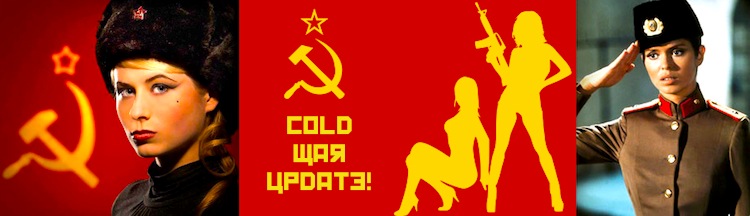
• AND IN TODAY’S MOST IMPORTANT COLD WAR NEWS … Russian former Bond babe Olga Kurylenko’s The Assassin Next Door hits DVD this week, and her new film There Will Dragons just got picked up for distribution for Samuel Goldwyn Films. Olga’s proving that old homespun adage about what Russian immigrants should do to make it in America: play Bond girls and assassins.

And that’s what’s happening today in The Cold War!

Olga Kurylenko, with gun.

Posted on February 12th, 2011 at 12:37pm.