By Jason Apuzzo. Here it is above, folks, so take a look. The film hits theaters on April 15th. Atlas Shrugged Part I covers the first third of the novel (Part I: “Non-Contradiction”) up through the “Wyatt’s Torch” chapter.
As regular Libertas readers know, LFM was invited on-set and did the very first interview with director Paul Johansson about the film (see here and here). Audiences will now soon get to render their own verdict.
By Joe Bendel. Between war, terrorism, and environmental degradation, this year’s Oscar nominated short documentaries have a nightmare scenario for just about everyone. However, the better nominees also find hope where they can. For the first year ever, the Academy Award nominated short film road show will also include documentaries, split into two program blocks, both of which open today in New York and Los Angeles.
Jed Rothstein’s Killing in the Name was born in tragedy. Co-produced by Carie Lemack, whose mother was murdered at the World Trade Center, Name profiles Ashraf Al-Khaled, her fellow terrorism survivor and co-founder of Global Survivors Network. Al-Khaled will tell you that Islam is the religion of peace, and he has earned the right to say it. On his wedding day, a suicide bomber targeted the Jordanian hotel hosting his reception, killing his father and in-laws. Since then, Al-Khaled has become an outspoken critic of Islamist terrorism, challenging other Muslims to speak out more forcefully. As he reminds them, it is their co-religionists who are most likely to be the victims of their attacks.
While outwardly unassuming, Al-Khaled will boldly confront anyone in his quest to de-radicalize Islam, even “Zaid,” an Al Qaeda recruiter. Not surprisingly, Zaid proves to be a craven coward, refusing to meet Al-Khaled, instead consenting only to answer his questions through Rothstein. Yet, it is not just Al-Qaeda that glorifies wanton killing. The attitudes of children at an Indonesian madrassa are downright chilling. Frankly, Al-Khaled sounds like he is kidding himself when he speaks of planting seeds of doubt in them, but again, he has earned the right to a little self-deception at that point. Though only thirty-nine minutes, Name is easily one of the most illuminating documentary examinations of terrorism to play the festival circuit.
Like Al-Khaled, Zhang Gongli also fights to make the world a safer place. A farmer in Central China, Zhang became a self-taught legal activist, who challenged the chemical plant poisoning his region as well as the local Communist Party authorities which protected it. Aided by an Chinese environmental NGO, Zhang’s struggles are documented in Ruby Yang’s The Warriors of Qiugang. Eventually privatized, the serial polluting began while the plant was a state enterprise. Indeed, it was the local Party that first turned a gang of thugs loose on the village in an attempt to intimidate the activists. It would be a strategy the plant would repeat, with the local authorities’ acquiescence.
Though largely compatible with the no-frills observational approach of the so-called Digital Generation of independent Chinese filmmakers, Warriors also features occasional grimly stylized animated sequences. It is a searing indictment of the Chinese government’s hypocrisy, not simply in terms of environmental protection, but even more fundamental human rights. While hardly concluding with everything happily resolved, it is definitely an encouraging David-and-Goliath story.
For inspiration, none of the nominees can compete with Karen Goodman and Kirk Simon’s Strangers No More. There is a country where immigrants fleeing war and civil strife finally feel safe enough to allow their children to enroll in school (in many cases for the first time ever): that country is Israel. Yes, the irony is not lost on the teachers of Tel Aviv’s Bialik-Rogozin school, where students from forty-eight countries find a safe harbor every day. Focusing on students from Ethiopia and Sudan, we see Bialik-Rogozin’s Hebrew immersion strategy pay dramatic dividends. Clearly, what they do at that school works. Though Goodman and Simon avoid making the obvious point, it is worth noting you will not find a comparable institution anywhere else in the region.
Inspiring and disturbing in equal measure, Name and Warriors are excellent films, highly recommended in any context. They play together as part of Program A, along with Jennifer Redfearn’s Sun Come Up. Following a group of South Pacific Islanders who must relocate due to rising sea levels, reportedly the result of global warming, Redfearn wisely does not overplay the environmental card. While it raises a few interesting anthropological-sociological issues, ultimately Sun’s POV figures simply are not as compelling as those of the other nominees.
Strangers is a totally grounded, legitimately feel-good movie, also enthusiastically recommended. Unfortunately, it plays with Sara Nesson’s Poster Girl, a film top-heavy with the director’s agenda. It profiles Sergeant Robynn Murray, who was once on the cover of ARMY magazine, thus making her the “poster girl” for the war, at least if you were a serviceman or retiree who saw the magazine and somehow still remembers it. While Nesson’s approach borders on the exploitative, it is certainly heartrending to watch as Murray learns first-hand how problematic government-run healthcare truly is. (In contrast, the Renaud Brothers’ Warrior Champions stands as example of how to sensitively address PTSD, without turning it into a political football.)
Three out of five is pretty good by Oscar standards. Indeed, Name, Warriors, and Strangers each provide real insight into the state of the world and a small measure of hope that average people can have a constructive impact on big macro-level problems. Both Oscar nominated documentary short programs open today (2/11) in New York and Los Angeles.
By Jason Apuzzo. I wanted people to be aware that Chris Morris’ brilliant satire on Islamic terrorism, Four Lions, is coming to Blu-ray and DVD on March 8th. We loved the film here at Libertas (see the LFM review here).
I’ve embedded a clip of one of my favorite scenes from Four Lions above. (Note: the language gets a little rough.) You can pre-order the film now below in the LFM Store.
By Jason Apuzzo. The great Tura Satana passed away this past Friday. Our condolences to her family, many friends and fans. She will be greatly missed. (Read the NY Times obit here, and classic film blogger Kimberly Lindbergs’ fine 2007 piece “Tura Satana: An American Icon”).
Govindini and I met Tura about two years ago at an event. I’m a great fan of Russ Meyer’s films, and of Faster, Pussycat! Kill! Kill! in particular, so I approached Tura to express my enthusiasm for her work. What I expected to be a brief exchange turned into an hour-long conversation, and I soon found myself snapping pictures of Tura with Govindini (they got on like a house on fire) and with the other Pussycat girls Haji and Lori Williams, and having a fantastic time. I talked with Tura about her incredible life – her hard upbringing, her Japanese family’s stint in the Manzanar internment camp, her romance with Elvis. In particular I remember her telling me how some of Elvis’ signature dance moves were actually lifted from her burlesque act.
She also talked a lot about her love of America, and the opportunities it had given her. Tura was intensely patriotic, and was not shy about expressing it. It was amazing to see that coming from someone who’d had such a difficult upbringing – a young life filled with violence, betrayal and a lot of pain. (More horror stories, more abuse and hard luck than I care to recount here.) Nonetheless, the impression I had of Tura that day was of a survivor with a very tough exterior – who had nonetheless preserved a tender heart, and a robust love of life.
For those of you who may not be familiar with her, Tura delivered what is in my opinion – and in the opinion of many others – the iconic performance of cult cinema, playing Varla in Russ Meyer’s Faster, Pussycat! Kill! Kill!. And for some bizarre reason, it’s the only really large role that Tura was ever given. This is a bit like not wanting the young Wilt Chamberlain on your basketball team. I’ve heard many explanations for her disappearance from the film scene after Faster, Pussycat – but none of them has ever made any sense to me. She seems so impossible to ignore.
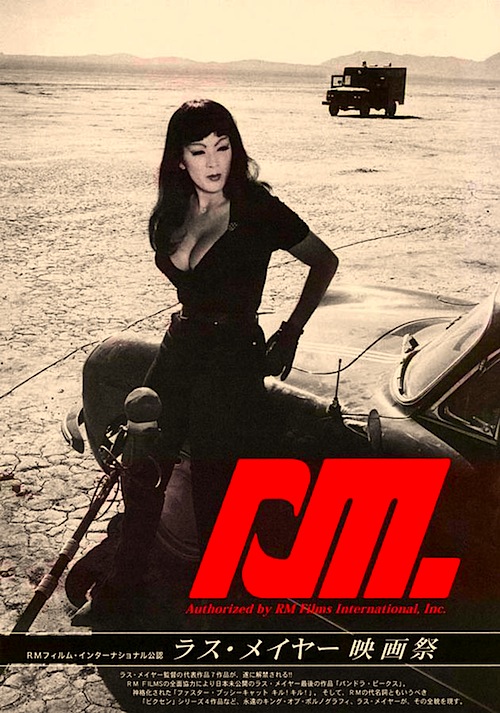
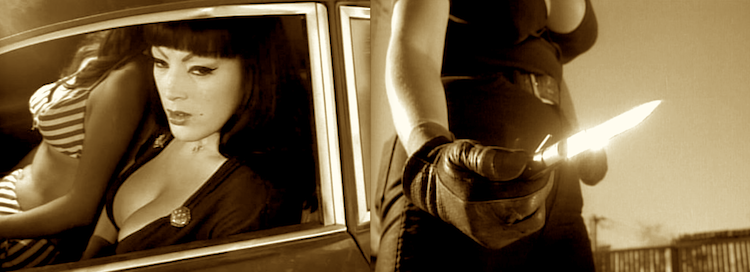
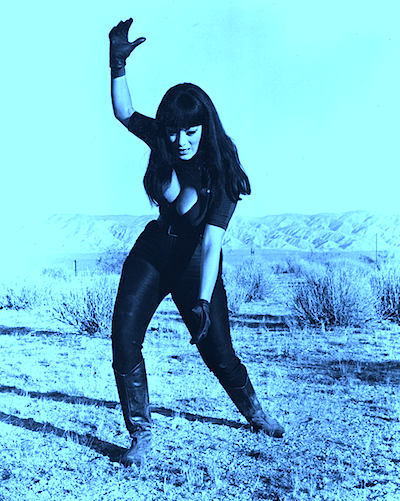
Images of Tura Satana from "Faster, Pussycat! Kill! Kill!"
The biggest tragedy of Tura’s career, one which Russ Meyer himself acknowledged, was that he and Tura didn’t continue to make films together. The mind reels to think of what those two could have accomplished, had they kept that partnership going.
In the very least, however, we have Faster, Pussycat! Kill! Kill!.
And on that subject, 1965’s Faster, Pussycat is easily the greatest cult film ever made – and the competition is not even close. Certainly one of the major reasons for the film’s success is Tura’s performance as Varla – and how does one describe her in that film? She’s like a force of nature – a category 5 hurricane – something primal, unstoppable, a torrent of violence, lust, desire, and mocking humor rolled into one. Imagine a Japanese Venus of Willendorf with bangs, dressed like Marlon Brando in The Wild One, puffing on a cheroot, bellowing quips into the desert air that seem like something out of a long-forgotten Bogart film. And then come the karate chops, the kicks and knives! Not exactly Bruce Lee stuff, but deadly nonetheless.
Publicity still for "Faster, Pussycat! Kill! Kill!"
The image of Tura Satana (has there ever been a name like that?) – dressed in black, leaning against her car in the high Mojave desert – has become one of those iconic images that end up on the dorm room walls of young guys in college … and increasingly young girls, as well. It’s a great American image, one of cool independence, not unlike the image that Steve McQueen or Clint Eastwood projected during that same period. It’s an image of what we all want to be, or should want to be – tough, self-reliant, skeptical, at home in the wild.
We don’t do ‘cool’ here in America very well, any more. I’m told by experts that we have a President who’s ‘cool,’ for example, but I don’t quite believe it. Cool people don’t get everything in life handed to them, and nobody handed anything to Tura Satana – except maybe Russ Meyer, who gave her that one role of a lifetime.
Since we still have that film, Tura will still be with us, reminding us of how cool all of us can be.
Somewhere in the afterlife, God and the Devil are probably fighting over credit for creating Tura Satana. God will win that one.
Footnote: Tura was a fan of Libertas Contributor Steve Greaves‘ music. Plus: I’ve embedded below the first 6 minutes of Russ Meyer’s Faster, Pussycat! Kill! Kill! There’s never been anything quite like it.
By Joe Bendel. Film distribution is a tricky proposition in China. Strict regulations govern what constitutes a “film festival,” while some of the country’s most celebrated filmmakers are only screened through bootlegs. One dodgy hawker of pirate DVDs gains a fresh appreciation of the power of cinema in Lu Yang’s My Spectacular Theater, which screens during the 2011 ReelAbilities in New York.
On the run from the coppers (mysteriously interested in protecting intellectual property), Chen Yu stumbles into old man Gao’s theater. He even takes out a video of the movie playing, but the patrons do not seem to notice. They are either blind or severely vision-impaired movie lovers, who partake of Gao’s live description assistance. Recruited as Gao’s apprentice, Chen Yu does not see the specialized theater as a long term prospect. He needs something more corporate to satisfy his uptown girlfriend. Yet slowly but surely, he becomes involved with the lives of their patrons, especially, the cute Xiao Ow – a young student feigning blindness to attract his attention.
From "My Spectacular Theater."
Given its sociologically relevant subject matter, Spectacular certainly represents independent Chinese cinema. Particularly daring is the historical context of Gao’s backstory. Though Lu understandably refrains from graphic details, it is clear that the old man honed his descriptive skills in helping his wife, following an incident during what was obviously the Cultural Revolution (though those exact words are never uttered).
While the third act partakes of a misguided narrative indulgence, the film itself has plenty of heart. Liu Yuan Yuan is a genuine standout as Liu May, a luminously beautiful cinema patron. Her tentative relationship with a recently blinded photographer is quite honest and moving. In the romantic lead, Zhou Yiwei is more-or-less adequate as Chen Yu, but Yizha brings real spirit and verve to the film as his admirer, Xiao Ow. Perfectly understated and dignified, Jin Shijie holds it all together as old Gao, handling his ease into senility with grace and conviction.
Clearly, Spectacular fits the bill for ReelAbilities in several respects. While one wonders how accommodating Chinese society really is for its vision-impaired citizens, Lu and co-writer Chen Shu clearly do not exempt the go-go new China from criticism. Indeed, Gao’s theater is presented as an oasis of empathy and acceptance. A very strong feature directorial debut, Spectacular is highly recommended when it screens again today (2/8) at the Chatham Square Library, as the 2011 ReelAbilities concludes at points throughout the City.
By Joe Bendel. In an ironic way, President Ronald Reagan might have approved of the approach taken by his documentary profiler, Eugene Jarecki – at least in principle. While readily conceding Reagan’s personal virtues, Jarecki gives no quarter in the political arena. Such a strategy earned Jarecki Pavlovian praise for his ‘evenhandedness’ at the 2011 Sundance Film Festival, but it contributes little to the public discourse. Instead, Jarecki essentially offers viewers the same old canned talking points in Reagan, which debuts on HBO tonight.
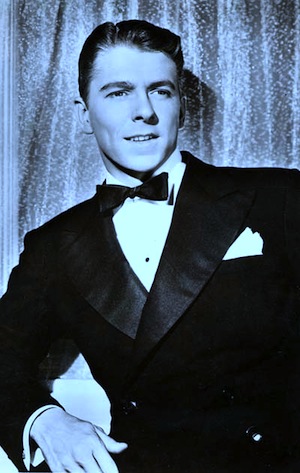
Reagan in Hollywood in the 40s.
Frankly, Jarecki’s polemical Reagan is best when covering the early Reagan years. A better actor than generally acknowledged, Reagan was eager to serve his country during WWII. Unfortunately, he was nearly as blind as a film critic, which to his genuine regret kept him out of combat duty. So the metaphor Jarecki ultimately latches onto is Reagan the lifeguard, the vision-impaired teenager who pulled seventy-seven floundering swimmers to safety.
By contrast, when addressing political issues, Jarecki is far from an honest broker. He only cursorily discusses Reagan’s time as the Screen Actor’s Guild President, largely to speculate on whether the future president named names. Had he delved deeper, he would have examined Reagan’s alarm at the extent to which Communist and fellow-traveling factions had co-opted Hollywood’s unions and progressive organizations. Of course, this would have challenged long held articles of faith regarding Hollywood and the HUAC committee, which Jarecki obviously was not about to do. Better to play it safe.
As a result, this omission leaves Reagan’s evolution from Roosevelt Democrat to Reagan Republican (if you will) largely unexplained. Context is not a priority here, though. All viewers are really told about his predecessor Jimmy Carter, for example, is that Carter had the ‘courage’ to make his ‘malaise’ speech. The word “stagflation,” however, is scrupulously ignored. The Iranian hostages are discussed, but apparently only to illustrate Reagan’s providential good fortune with their fortuitous release.
Jarecki interviews some Reagan insiders, but his editorial hand is always obvious. Peter Robinson has a chance to discuss Reagan’s frequently-lauded talents as a communicator, but policy analysis is reserved solely for the President’s partisan critics. So what do you suppose they say happened to ‘the rich,’ for example, during Reagan’s tenure?
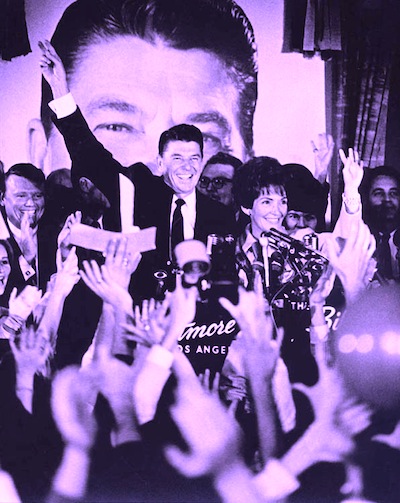
Reagan on the campaign trail in the 60s.
One can also see this formal balance but practical bias in the appearances of Reagan’s family. Michael Reagan is only seen playing a cheerleader role while conducting a Reagan-themed tour (just long enough for the audience to suspect he might be trading on his father’s name). Conversely, Ron Reagan is allowed long, thoughtful camera time to whittle away at his father’s political legacy. It is worth noting, though, that Jarecki’s film directly contradicts the junior Reagan’s claim that his father exhibited symptoms of Alzheimer’s while in office.
Despite the near constant criticism of Reagan, Jarecki never comes close to suggesting that the iconic president ever acted out of self interest or cynical calculation. Even during the Iran-Contra affair, the ‘lifeguard’ metaphor is too hard for him to shake. Indeed, this is Reagan’s ultimate saving grace – or failure, depending on one’s perspective. Further diminishing the film’s seriousness, the constant use of vintage 1980’s pop tunes, like “99 Luftballoons” to underscore Reagan’s nuclear policy, is rather shallow and clichéd. (Sadly, it seems Jarecki was not able to clear the Buggles’ “Video Killed the Radio Star” for a “Great Communicator” segment.)
Disappointing but not surprising, Jarecki’s Reagan does a disservice to its subject and to its audience. It airs tonight (2/7) on HBO, following its recent Sundance premiere.