LFM Reviews Defiant Requiem @ DocuWeeks 2012 in NY & LA

By Joe Bendel. A Catholic requiem in a concentration camp might sound like a problematic endeavor. So it was, but not necessarily for the reasons one might assume. It was actually the programming choice of a group of prisoners, led by a remarkable maestro. The story of the Terezin performances of Verdi’s Requiem and the subsequent on-site re-staging for survivors decades later are documented in Doug Shultz’s Defiant Requiem, which screens as part of the 2012 DocuWeeks in New York and Los Angeles.

Verdi’s Requiem is a draining chorale work, in many ways. It would not seem like a natural piece of music to unwind with after a hard day of labor—slave labor to be more accurate. However, these were far from normal times for the Terezin (a.k.a. Theresienstadt) concentration camp captives. These Czech citizens had been swept up by the conquering National Socialists and held at Terezin until they were deported to a death camp. Nonetheless, many died at Terezin due to the inhuman conditions, but a determined young conductor harnessed the power of music to keep their spirits up.
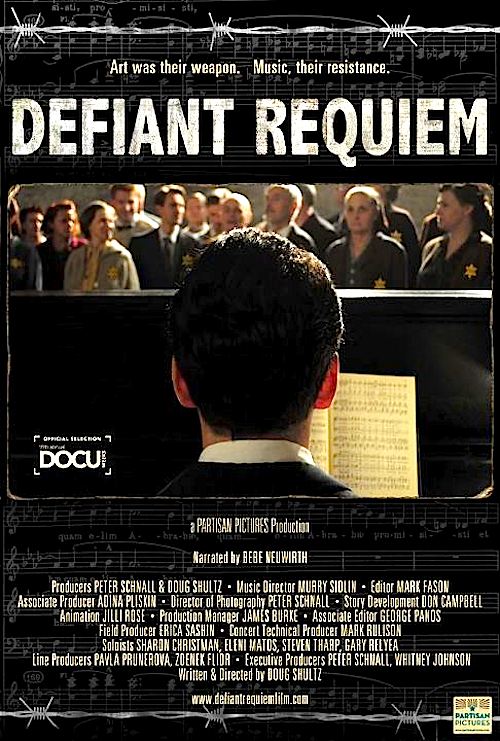
Gathering those interested around an old upright providentially discovered in the basement of his barracks, Rafael Schächter started his make-shift chorus off with Czech popular songs and Smetana operas, but he eventually coaxed them into the Requiem. The key might have been his translation of Verdi’s Latin into Czech. As Murry Sidlin, the conductor of the commemorative Requiem concerts observes, the Requiem’s lyrics hold tremendous meaning for anyone unjustly denied their liberty and dignity. Rife with prophesies of judgment from above, Verdi’s opus is not just a requiem. It became a J’Accuse—an indictment of the National Socialist crimes so bold, only the International Red Cross inspectors could miss its significance.

Yes, the Requiem was performed at that Terezin, the concentration camp temporarily remodeled into a Potemkin village to fool the Red Cross. It was there that Sidlin brought members of Catholic University of America chorale ensemble and a full orchestra, for an emotional performance.

In fact, mounting Verdi’s Requiem and telling the story of Schächter has become a mission for Sidlin, who serves as the film’s musical director and one of its primary commentators. It is an important story, but the film also fosters a greater appreciation for Verdi’s work. Wisely, Shultz takes a rather traditional documentarian approach, largely approximating the shape of Sidlin’s music-with-historical-context concert presentations of the Requiem, filling in here and there with tastefully recreated scenes in the rehearsal cellar and some animated sequences adapted from surviving Terezin drawings. This is hardly the place to get experimental, after all.

Granted, anyone who knows anything about the Holocaust and the fate of the Terezin prisoners in particular will sadly know exactly what to expect from the film. Nonetheless, it deepens our understanding of life at Terezin and offers up an example of music as an instrument of survival. Frankly, hearing some of the stormier passages promising divine justice will likely make viewers’ hair stand on end. Highly recommended precisely for such memorable moments, Defiant Requiem screens through Thursday (8/9) in New York at the IFC Center as part of DocuWeeks New York as well the week of August 17-23 during DocuWeeks LA.

Posted on August 6th, 2012 at 12:58pm.

Playing Liars’ Poker in Hong Kong: LFM Reviews Supercapitalist @ The Asian American International Film Festival

By Joe Bendel. Like a financial Luke Skywalker, Connor Lee is about to assume his destiny as the son of a legendary trader. He will find his destiny in Hong Kong. His Chinese is limited, but he speaks money. That will be all he needs in Simon Yin’s $upercapitalist, the centerpiece selection of this year’s Asian American International Film Festival, which opens this Friday in New York.

Lee regularly predicts the unthinkable, yet is never able to adequately capitalize on his foresight. That may soon change. He has caught the eye of hedge fund master of the universe Mark Patterson, who dispatches him to Hong Kong. His assignment is to mount a takeover of Fei & Chang, a hidebound family run conglomerate in which they already own a minority stake. This does not sit well with the ruling Chang family, especially the heir apparent son, Richard, who is spearheading a top secret project afoot to radically re-engineer the company’s ailing import-export division.

Will Lee facilitate the revitalization or the liquidation of the company? This depends on who gets the final word: the devil or the angel sitting on his shoulders. The devil is Quentin Wong, Lee’s colleague and mentor in the HK fast life. The angel is Natalie Wang, a corporate publicist working with Richard Chang and his IT guru.

From "Supercapitalist."

Once again, $upercapitalist portrays an American hotshot who must go abroad to get a lesson in business ethics. At least it is HK rather than the CP dominated Mainland doing the teaching this time around. However, the supposed killer app for employee motivation Richard Chang’s team is developing sounds highly dubious. Essentially, their plan to increase productivity involves an intra-company facebook, in which workers try to amass attaboys from their peers. I think I’d rather start the day with a dozen lashings.

Conceived as a star vehicle for himself, screenwriter Derek Ting has a few nice moments in $upercapitalist as Lee. Mostly though, his character follows the old school Tom Cruise template of a humbled young Maverick finding redemption through the help of a more emotionally mature love interest. Kathy Uyen holds up her end well enough as the virtuous publicist, but it is not a particularly well fleshed out role.

However, as Wong, Darren E. Scott clearly enjoys playing the villain, bringing a nice infusion of energy to his scenes. Still, for those who follow Asian cinema, the real highlight of $upercapitalist is seeing veteran HK actors Richard Ng (a Jackie Chan alumnus also seen in Detective Dee) and Kenneth Tsang (recently in Starry Starry Night, as well as John Woo classics like Once a Thief) do their thing as Chairman Donald Chang and his board member brother Victor, respectively.

$upercapitalist is not a bad boardroom soap opera, but it falls in too easily with the lazy Bain Capital attacks currently circulating in the media. Frankly, if Fei & Chang’s import/export division is dragging down the entire company, they have a responsibility to all their employees to fix the problem. Of course, why worry about the complexity of reality in a film when simplistic stereotypes are so much safer? A decent showcase for some fine supporting work, the flawed but still quite watchable $upercapitalist opens this Friday (8/10) in New York at the Village East.

LFM GRADE: C

Posted on August 6th, 2012 at 12:57pm.

Claude Sautet at The Film Society of Lincoln Center: LFM Reviews Max et les Ferrailleurs

Romy Schneider in "Max et les Ferrailleurs."

By Joe Bendel. Most Americans would consider it entrapment. One unyielding Parisian detective would say it is just “pas de chance.” He is determined to catch his man red-handed, so if he has to help matters along, then so be it. However, things do not go strictly according to plan in Claude Sautet’s Max et les Ferrailleurs, which starts its premiere American theatrical run this Friday in conjunction with the Film Society of Lincoln Center’s The Things of Life: Claude Sautet retrospective.

Max has issues, but money is not one of them. Like a French Milton Hardcastle, the well-heeled crusader was once a judge, but became a cop after he was forced to free too many criminals on technicalities. His obsession with iron-clad proof stems from this experience. It has not been working out well lately, though. This will indeed be bad luck for Abel Maresco, a petty lowlife and onetime comrade-in-arms with Max, who has the misfortune of crossing the copper’s path.

Maresco is on the lowest rung of the criminal ladder. He is a junkman, who literally lives of the metal and junked cars castoff by serious crooks. Basically deciding he looks guilty, the anti-hero plants the suggestion that it is time for Maresco and his crew to pull a real job. To nurture this seed, he starts visiting Maresco’s streetwalking girlfriend Lily, in the guise of Felix, a neighborhood branch banker who regularly receives large deposits from the wholesale meat market.

Ferrailleurs is a fascinating film in Sautet’s canon, because it incorporates elements of both his early noirs (like the briskly entertaining Dictator’s Guns) and his late period intimate character studies. Beginning in media res, and proceeding to tour through the dodgy corners of Nantes, it observes most of the noir conventions. Indeed, Max is certainly one cold fish of an anti-hero. Yet, the scenes of the emotional distant older man developing an ambiguous relationship with a younger, more passionate woman prefigures several of his career defining masterworks, such as Un Coeur en Hiver and Nelly and Monsieur Arnaud.

From "Max et les Ferrailleurs."

Frankly, it is downright bizarre it took so long for Ferrailleurs to get a proper American release, given the combination of Sautet and its stars, Michel Piccoli and Romy Schneider. The title is an obvious suspect, usually translated as Max and the Junkmen, unfortunately suggesting a Francophone Sanford & Son. Nonetheless, it is anything but. In fact, it represents one of Schneider’s sultriest turns, giving her the opportunity to rock some Klute-like threads—again, all very noir worthy. She also plays off Piccoli’s ultra-reserved protagonist quite effectively. His Max is a bit of a cipher, but he clearly suggests a tightly wound man about to snap.

Though it ends in a rather shocking (but oddly logical) place, Ferrailleurs is ultimately quite satisfying. While its characters are thoroughly compromised, it serves as a sharply delineated morality play, featuring a funky soundtrack from the great Philippe Sarde. Must viewing for Schneider fans and Sautet appreciators, Max et les Ferrailleurs opens this Friday (8/10) at the Elinor Bunin Munroe Film Center, in tandem with the FSLC’s continuing The Thing of Life: Claude Sautet retrospective.

LFM GRADE: B+

Posted on August 6th, 2012 at 12:55pm.

Love & Protest in Taiwan: LFM Reviews Girlfriend Boyfriend—GF BF

From "Girlfriend Boyfriend: GF-BF."

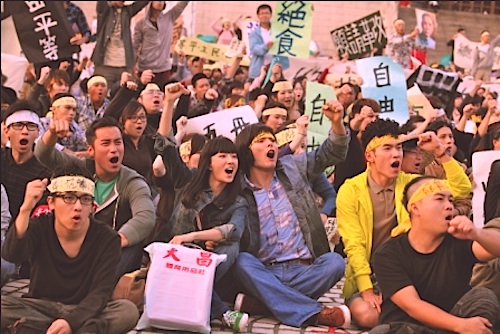
By Joe Bendel. In the 1980’s, student protesters across Taiwan started demanding a more democratic form of government. By 1997, the country functioned much like our own duly elected but media-driven dysfunctional system. While historic events unfold on a macro level, three classmates struggle with their own messily intertwined lives and loves in Yang Ya-che’s Girlfriend Boyfriend—GF BF (trailer here), which opens today in New York.

High school magazine editor Aaron is passionate about Mabel and the democracy movement. She likes him well enough and supports the cause, to an extent, but she really has eyes for Liam. Though he has affection for her too, it is definitely of the “just friends” variety. He pines for Aaron instead, but realizes that simply is not to be. Eventually, Aaron wins Mabel over, at least temporarily, but the three keep in close contact for the next decade or so, which leads to considerable pain and complications for them all. Meanwhile, they watch from the student barricades as political reform sweeps across Taiwan.

Granted, GF BF’s premise certainly lends itself to melodrama, but Yang’s approach to the material is unexpectedly restrained. Frankly, he passes up several golden opportunities for tearjerking. Similarly, he consistently eschews didacticism when depicting the student movement. In fact, the orderly, matter-of-fact manner the film portrays Taiwan’s revolutionary liberalization is rather surprising (and telling).

Nonetheless, GF BF has a wistful air of innocence lost that leaves quite an impression. Cinematographer Jake Pollock’s early candle-lit night scenes are particularly evocative. There is a real sense of time passing in the film, even though its ridiculously attractive cast never seems to age a crow’s foot over a dozen or so trying years.

From "Girlfriend Boyfriend: GF-BF."

Who would want to see Gwei Lun Mei age anyway? As Mabel, she vividly projects earnest sensitivity, without degenerating into an emotional basket case. It is a perfect starring vehicle for her. Likewise, Joseph Chang is also a pretty effective tortured slow burner as Liam. However, Rhydian Vaughan never really gets inside Aaron, leaving viewers with the impression of a rather shallow opportunist.

It is hard not to favorably compare the response to the Wild Lily Student Movement with the Tiananmen Square protests just one year earlier, but that is hardly GF BF’s central point. It is sort of like a Taiwanese Jules & Jim, intensified by tumultuous social change and the closeted homosexual dynamic added to their mismatched love story.

Like the lives it presents, GF BF can be a bit unwieldy, but it is consistently engaging viewing and also fascinating as a reflection of current Taiwanese socio-political attitudes. Recommended for those who enjoy a love triangle with a very definite sense of time and place, Girlfriend Boyfriend opens today (8/3) in New York at the AMC Empire and Village 7, as well as in San Francisco at the AMC Metreon and Cupertino Square, courtesy of China Lion Entertainment.

LFM GRADE: B

Posted on August 3rd, 2012 at 11:35am.

Women’s Rights & Islam: LFM Reviews Invoking Justice @ The Asian American International Film Festival

By Joe Bendel. They are called Jamaats. In Muslim areas of Southern India, these neighborhood old boys’ networks supposedly apply sharia law. However, in practice, they regularly provide cover for abusive and even homicidal husbands. At least, such appears to be the case based on the evidence presented to the upstart women’s Jamaats. Deepa Dhanraj documents the efforts of the women’s Jamaat leaders to redress gender based injustices in Invoking Justice, which screens during this year’s Asian American International Film Festival in New York.

As per Indian custom, Islamic law officially supersedes secular law in the provincial south. It is a nice set-up if you are a man, particularly if you and your cronies are on the community Jamaat. If you are a woman, though, the system is literally rigged against you. However, a small but growing number of Muslim women have challenged the institutionalized misogyny by forming alternative women’s Jamaats. While their legal standing is rather iffy, especially by the local standards, the civilian police force has to deal with them. This often means the men’s Jamaats must as well, albeit rather grudgingly.

From "Invoking Justice."The kinds of cases women’s Jamaat activists investigate are frankly shocking, including several cases of spousal murder and one abused wife and mother desperately trying to divorce her pedophile husband. The women’s Jamaat founder Sharifa Khanam clearly knows the Koran and uses it to shame their male counterparts. Yet, on a fundamental level, they still acknowledge the primacy of Islamic law over civilian authority. Indeed, this begs an obvious question Dhanraj does her level best to ignore: is religious-based law compatible with any meaningful notion of justice? Indeed, viewers might well wonder if non-Muslims living in Tamil Nadu have any recourse for legal redress, whatsoever.

To be fair, Dhanraj largely adopts the observational approach, only sparingly mixing in traditional on-camera interview sequences. We see the Jamaat case-workers do the leg work and build the trust of families seeking their assistance. Tellingly, it is not just women who petition the women’s Jamaats for help, but often the male relatives of women who have been battered and even killed.

Invoking is certainly eye-opening stuff. However, if ever there was a film that could have benefited from a little confrontational showboating, it would have been this one. Ultimately, viewers will feel justice is not being served in Tamil Nadu and may well suspect the situation is even worse than it appears in Dhanraj’s documentary. Still, capturing courage on-screen is always a worthy endeavor. Earning a moderate recommendation for those concerned about the state of women’s affairs in the Islamic world, Invoking Justice screens this coming Saturday (8/4) at the Chelsea Clearview, as part of the 2012 AAIFF.

LFM GRADE: B-/C+

Posted on August 3rd, 2012 at 11:35am.